Skip to content

ORIGO/MD‑V: A Dimensionless Topological Structure Class for Universal Coupling of Dynamical Systems (Patent)

Sep 2026 · Zenodo (CERN European Organization for Nuclear Research)
Control and Stability of Dynamical Systems

Abstract

ORIGO/MD-V: A Dimensionless Topological Structure Class for Universal Coupling of Dynamical Systems (Patent, Hardware Validation, Simulation). ORIGO/MD-V is a dimensionless, topological, decentralized structure class for describing dynamical systems without the artefacts c (speed of light), t (time), and G (gravitational constant). All defining objects are dimensionless, topologically invariant, and hardware-independent. This Zenodo record contains the complete scientific documentation: full monograph, official DPMA patent filing, executive summary, Nature-style research article, C++ reference implementation, hardware validation with three STM32 NUCLEO-G431RB microcontrollers, simulation results for N=36, full artefact analysis of c, t, G, Lyapunov stability proofs, graph-Laplacian invariants, cross-sector applications, and climate-impact model. The central dynamical relation is dθ_i/dτ = α_i + (K/N)*sum_j sin(θ_j - θ_i). Stability is defined by the negative graph-Laplacian operator Σ̃ = A - D with eigenvalues λ̃_k < 0. Hardware validation shows stable 120-degree phase distribution with less than 0.5-degree deviation and full self-recovery after node failure within seconds. Simulation with N=36 confirms invariants such as Tr(L⁺) = (N² - 1)/12 to machine precision. ORIGO/MD-V applies to energy systems, robotics, automotive networks, digital circuits (ASIC, FPGA, SoC), sensor networks, biological systems, neural architectures, and AI systems. The climate-impact model shows potential reduction of 9.15 gigatons CO2 per year immediately, 140 gigatons CO2 over ten years, and a projected global emissions level of 22.5 gigatons per year by 2036. This record includes the full patent “ORIGO · MD-V — Decentralized method and digital circuit arrangement for master-free, trajectory-stable phase and state coordination in multi-node networks.” The patent covers the MD-V coupling operator, Lyapunov stability, latency bounds, deterministic pre-injection, fixed-point digital implementation, multi-sector applications, and ASIC/FPGA/SoC architectures. Keywords: ORIGO/MD-V, dimensionless structure class, topological coupling, graph Laplacian, artefact-free dynamics, phase coordination, universal coupling logic, negative Laplacian eigenvalues, Lyapunov stability, STM32 NUCLEO-G431RB, biological networks, energy systems, climate impact, CO2 reduction, universal dynamics, patent, DPMA, A-D operator, Tr(L⁺) = (N² - 1)/12. Suggested citation: Drößler, Markus (2026). ORIGO/MD-V: A Dimensionless Topological Structure Class for Universal Coupling of Dynamical Systems. Zenodo. DOI generated automatically.
View source

Similar papers

#computer vision Conference Aug 2008

Scrum in a Multiproject Environment: An Ethnographically-Inspired Case Study on the Adoption Challenges

Agile methods continue to gain popularity. In particular, the Scrum method appears to be on the verge of becoming a de-facto standard in the industry, leading the so called Agile movement. While there are success stories and recommendations, there is little scientifically valid evidence of the challenges in the adoptio...

A. Marchenko, P. Abrahamsson · 59 citations · ⚡11
#computer vision Open access Sep 2012

Making the leap to a software platform strategy: Issues and challenges

A comprehensive taxonomy of the challenges faced when a medium-scale organization decided to adopt software platforms is provided, namely: business challenges, organizational challenges, technical challenges, and people challenges.

Yaser Ghanam, F. Maurer, P. Abrahamsson · 41 citations · ⚡3
#machine learning Open access Mar 2024

Integration of molecular coarse-grained model into geometric representation learning framework for protein-protein complex property prediction

MCGLPPI, a novel geometric representation learning framework that combines graph neural networks (GNNs) with the MARTINI molecular coarse-grained (CG) model to predict overall PPI properties accurately and efficiently, offers an effective and efficient solution for PPI overall property predictions.

Yang Yue, Shu Li, Yihua Cheng et al. · 15 citations

PepPCBench is a Comprehensive Benchmarking Framework for Protein-Peptide Complex Structure Prediction

PepPCBench enables a robust evaluation of PFNN-based methods and supports their continued development for peptide-protein structure prediction, and highlights the influence of peptide length, conformational flexibility, and training set similarity on prediction accuracy.

Si-Long Zhai, Huifeng Zhao, Ji-Ke Wang et al. · 13 citations · ⚡1
#machine learning Open access Sep 2025

Unified and explainable molecular representation learning for imperfectly annotated data from the hypergraph view

OmniMol is presented, a framework using hypergraphs to improve predictions of molecular properties, addressing challenges of imperfect data annotation and enhancing model explainability, and achieves state-of-the-art performance in properties prediction.

Bowen Wang, Junyou Li, Donghao Zhou et al. · 11 citations

Related blog posts

Microsoft Research Blog Jul 13, 2026

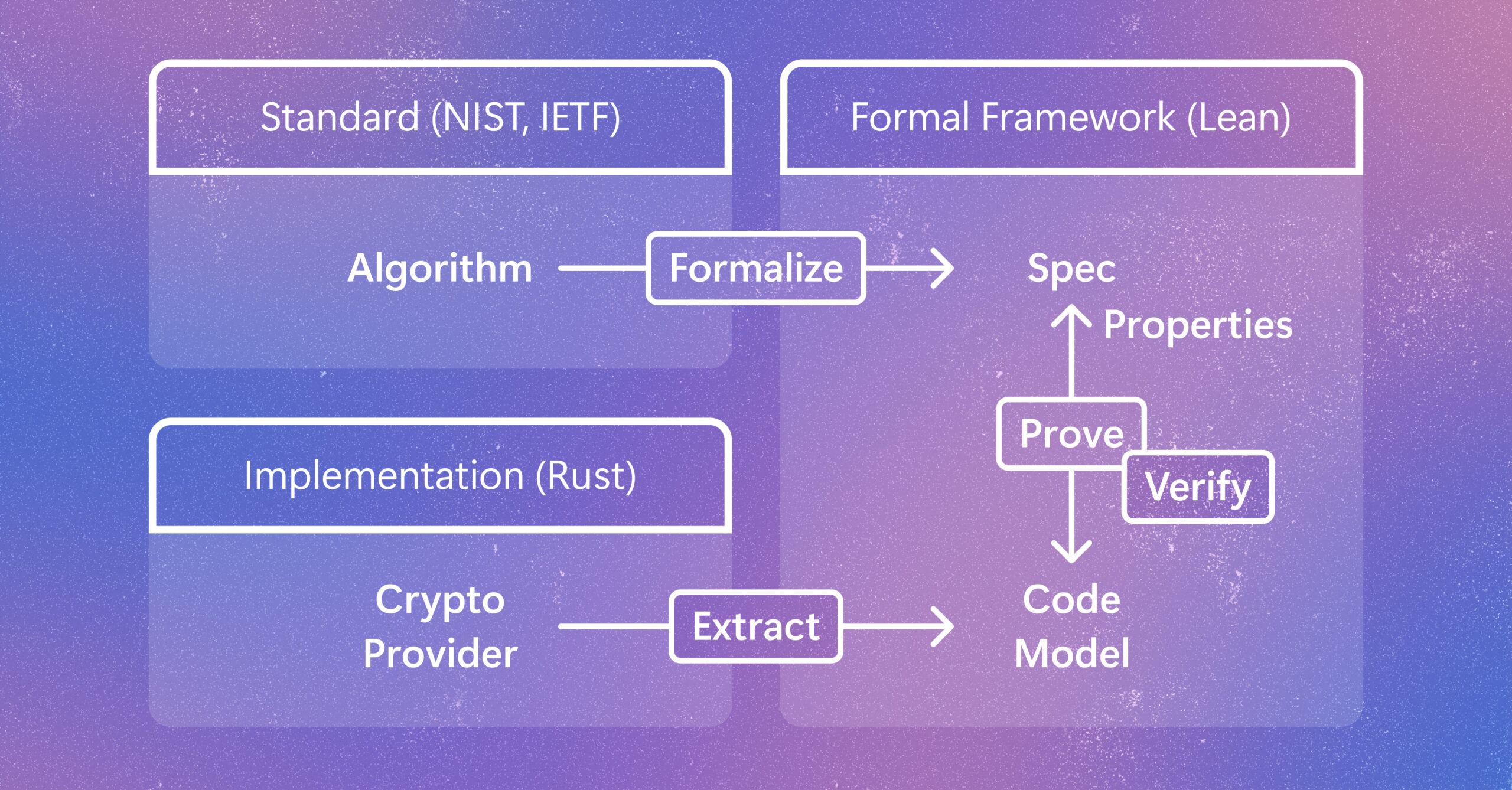
Verifying Rust cryptography in SymCrypt, from standards to code

Cryptographic code supports vital protections in modern computing systems. Learn how a new method helps verify code as developers write it while preserving speed and adaptability as it gets implemented and evolves. The post Verifying Rust cryptography in SymCrypt, from standards to code appeared first on Microsoft Research.

We use cookies to run the site and, with your consent, for analytics and to show ads. See our Cookie Policy.