Skip to content

RumorGAL: Graph-anchored LLM for domain-generalized rumor detection

Sep 2026 · Information Processing & Management · Vol 64, pp. 105188 · 32 references
Misinformation and Its Impacts

Abstract

Rumor detection models must remain robust to breaking events that are unseen during training. Although large language models (LLMs) offer strong generalization potential, their text-centric nature makes them vulnerable to spurious textual patterns in noisy social media discussions and leaves them without explicit awareness of how rumors propagate through conversation threads. To address these limitations, we propose RumorGAL, a graph-anchored LLM framework for domain-generalized rumor detection. The framework first employs a graph neural network (GNN) to derive graph-anchored structural prefixes from the propagation graph, providing structural guidance for the LLM. It then identifies high-quality textual evidence from noisy discussions through an evidence density-guided mining strategy. Finally, a hierarchical reasoning mechanism organizes both the structural prefixes and textual evidence into a unified reasoning process, enabling the LLM to ground its predictions in both propagation patterns and informative content. Across the three transfer settings, RumorGAL achieves robust performance, improving average accuracy over the strongest baseline, zero-shot GPT-4.1, by 5.27 percentage points under the domain generalization setting. When compared with domain adaptation methods, it surpasses the best domain adaptation method in two out of three tasks, with improvements of 3.1 and 0.5 percentage points in F 1 score for the rumor class, respectively. These findings suggest that an LLM-as-primary, GNN-as-auxiliary design, which couples structure-aware guidance with evidence-grounded reasoning, is a promising approach to robust and interpretable rumor detection.
View source

Similar papers

#computer vision Conference Aug 2008

Scrum in a Multiproject Environment: An Ethnographically-Inspired Case Study on the Adoption Challenges

Agile methods continue to gain popularity. In particular, the Scrum method appears to be on the verge of becoming a de-facto standard in the industry, leading the so called Agile movement. While there are success stories and recommendations, there is little scientifically valid evidence of the challenges in the adoptio...

A. Marchenko, P. Abrahamsson · 59 citations · ⚡11
#computer vision Open access Sep 2012

Making the leap to a software platform strategy: Issues and challenges

A comprehensive taxonomy of the challenges faced when a medium-scale organization decided to adopt software platforms is provided, namely: business challenges, organizational challenges, technical challenges, and people challenges.

Yaser Ghanam, F. Maurer, P. Abrahamsson · 41 citations · ⚡3
#machine learning Open access Mar 2024

Integration of molecular coarse-grained model into geometric representation learning framework for protein-protein complex property prediction

MCGLPPI, a novel geometric representation learning framework that combines graph neural networks (GNNs) with the MARTINI molecular coarse-grained (CG) model to predict overall PPI properties accurately and efficiently, offers an effective and efficient solution for PPI overall property predictions.

Yang Yue, Shu Li, Yihua Cheng et al. · 15 citations

PepPCBench is a Comprehensive Benchmarking Framework for Protein-Peptide Complex Structure Prediction

PepPCBench enables a robust evaluation of PFNN-based methods and supports their continued development for peptide-protein structure prediction, and highlights the influence of peptide length, conformational flexibility, and training set similarity on prediction accuracy.

Si-Long Zhai, Huifeng Zhao, Ji-Ke Wang et al. · 13 citations · ⚡1
#machine learning Open access Sep 2025

Unified and explainable molecular representation learning for imperfectly annotated data from the hypergraph view

OmniMol is presented, a framework using hypergraphs to improve predictions of molecular properties, addressing challenges of imperfect data annotation and enhancing model explainability, and achieves state-of-the-art performance in properties prediction.

Bowen Wang, Junyou Li, Donghao Zhou et al. · 11 citations

Related blog posts

Microsoft Research Blog Jul 13, 2026

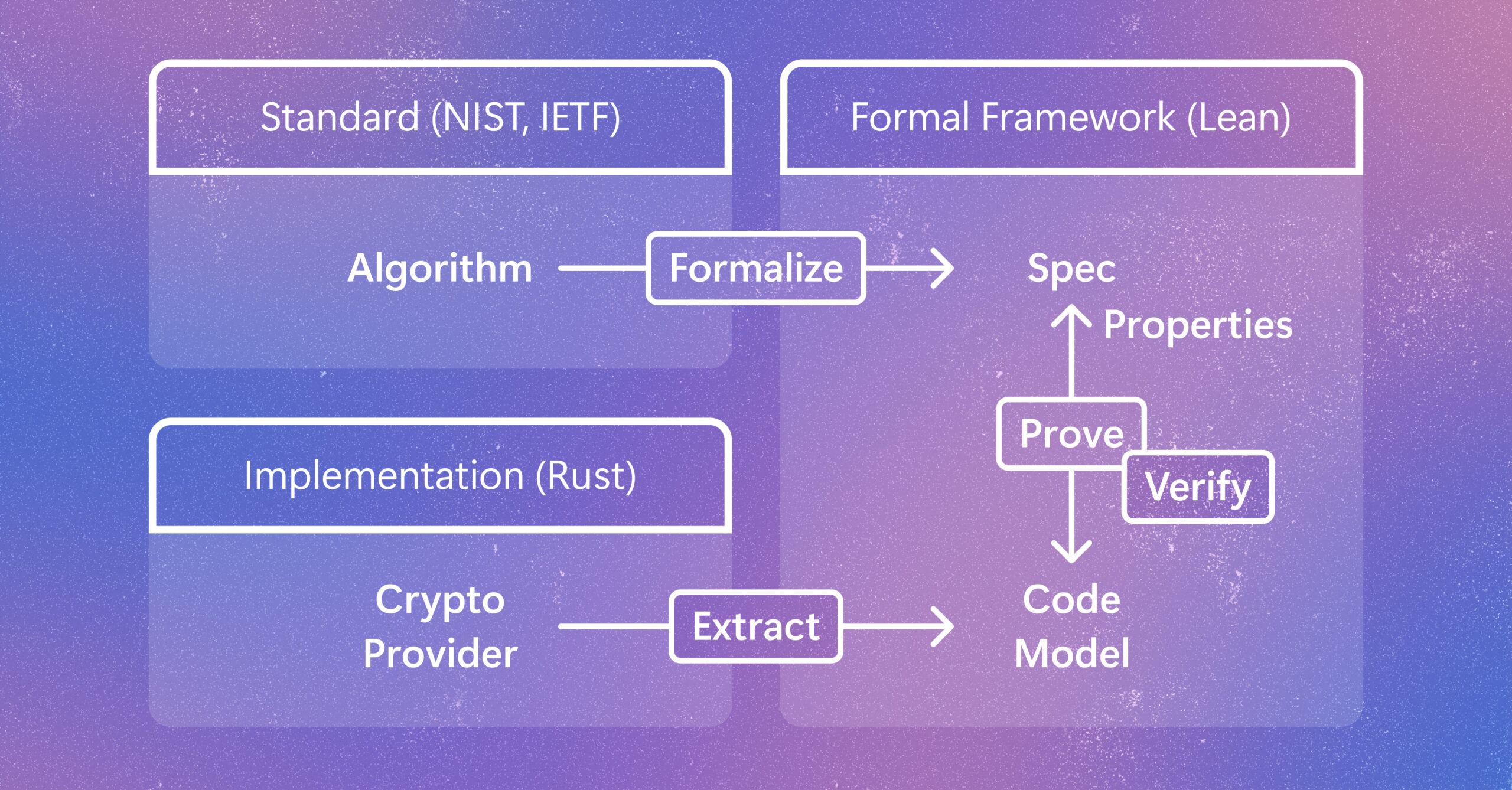
Verifying Rust cryptography in SymCrypt, from standards to code

Cryptographic code supports vital protections in modern computing systems. Learn how a new method helps verify code as developers write it while preserving speed and adaptability as it gets implemented and evolves. The post Verifying Rust cryptography in SymCrypt, from standards to code appeared first on Microsoft Research.

We use cookies to run the site and, with your consent, for analytics and to show ads. See our Cookie Policy.