Skip to content

Computational Primes: A Systematic Framework for Partitioning Neural Network Computation Across Analog and Digital Domains

Sep 2026 · Zenodo (CERN European Organization for Nuclear Research)

Abstract

Twelve irreducible operations (P1-P12) with known physical implementations, and four without, as a basis for deciding which parts of a neural network belong in the analog domain. 114 algorithms are factored into these primes; the paper builds a compiler that decomposes a compute graph, assigns each prime to a domain, fuses multi-computation patterns and minimises domain transitions. Version 3. (i) Feedback as a design principle extends to training: a gradient measured on the mismatched forward path lets the normalization affine absorb per-channel mismatch (0.7-0.95 sigma down to 0.06-0.16 sigma, the analytic least-squares floor); the backward path needs sign concordance with the forward crossbar but not reciprocity, and the tolerable number of wrong-sign channels is zero. (ii) The four 'missing primes' are not operations but the four components a finite circuit lacks relative to a Turing machine, so the line they mark is the circuit/software line rather than the analog/digital line; 0 of 114 algorithms are fundamentally unmappable once a compile-time bound is supplied, and 28 entries change status. (iii) A signal-domain axis and a 21-rule mismatch calculus make the design space tractable: the calculus retrodicts 36 measured numbers with none outside a factor 2 and predicts two unseen composites to 1.00x and 1.05x. (iv) The four open validation gaps of version 2 are closed at circuit level. Corrections to the published record. The headline count of version 2 (107 algorithms, 79 M / 22 G / 6 U) did not agree with the supplementary table it summarised, which has 114 rows and 86 M; the M column and the total were understated by seven. The equilibrium gain error 'below 1e-4' is an ideal-integrator figure and becomes 7.2e-4 at a realistic 60 dB integrator gain. The '0.006 %' common-mode entries were a solver quantisation floor and are 0.0024 % / 0.0007 % with a converged solver. The priority claim that no prior work had implemented normalization fully in analog is withdrawn and the prior work cited. Fourteen references inherited from version 2.1 carried a wrong field and are corrected; each correction and its verification source is listed in docs/errata_v2.1.md inside the code archive. Prior versions. The version 2 / 2.1 preprint is publicly indexed under two version DOIs of this same concept record: 10.5281/zenodo.21138358 and 10.5281/zenodo.21179525. This version supersedes 10.5281/zenodo.21179525. Files. prime_compiler_v3.pdf (paper), supplementary_factorizations_v3.pdf (complete factorization table, 114 entries), prime_compiler_v3_code.zip (compiler source, tests, all circuit testbenches and the experiment records each reported number comes from). Source repository: https://github.com/Biech95/prime-compiler
View source

Similar papers

#computer vision Conference Aug 2008

Scrum in a Multiproject Environment: An Ethnographically-Inspired Case Study on the Adoption Challenges

Agile methods continue to gain popularity. In particular, the Scrum method appears to be on the verge of becoming a de-facto standard in the industry, leading the so called Agile movement. While there are success stories and recommendations, there is little scientifically valid evidence of the challenges in the adoptio...

A. Marchenko, P. Abrahamsson · 59 citations · ⚡11
#computer vision Open access Sep 2012

Making the leap to a software platform strategy: Issues and challenges

A comprehensive taxonomy of the challenges faced when a medium-scale organization decided to adopt software platforms is provided, namely: business challenges, organizational challenges, technical challenges, and people challenges.

Yaser Ghanam, F. Maurer, P. Abrahamsson · 41 citations · ⚡3
#machine learning Open access Mar 2024

Integration of molecular coarse-grained model into geometric representation learning framework for protein-protein complex property prediction

MCGLPPI, a novel geometric representation learning framework that combines graph neural networks (GNNs) with the MARTINI molecular coarse-grained (CG) model to predict overall PPI properties accurately and efficiently, offers an effective and efficient solution for PPI overall property predictions.

Yang Yue, Shu Li, Yihua Cheng et al. · 15 citations

PepPCBench is a Comprehensive Benchmarking Framework for Protein-Peptide Complex Structure Prediction

PepPCBench enables a robust evaluation of PFNN-based methods and supports their continued development for peptide-protein structure prediction, and highlights the influence of peptide length, conformational flexibility, and training set similarity on prediction accuracy.

Si-Long Zhai, Huifeng Zhao, Ji-Ke Wang et al. · 13 citations · ⚡1
#machine learning Open access Sep 2025

Unified and explainable molecular representation learning for imperfectly annotated data from the hypergraph view

OmniMol is presented, a framework using hypergraphs to improve predictions of molecular properties, addressing challenges of imperfect data annotation and enhancing model explainability, and achieves state-of-the-art performance in properties prediction.

Bowen Wang, Junyou Li, Donghao Zhou et al. · 11 citations

Related blog posts

Microsoft Research Blog Jul 13, 2026

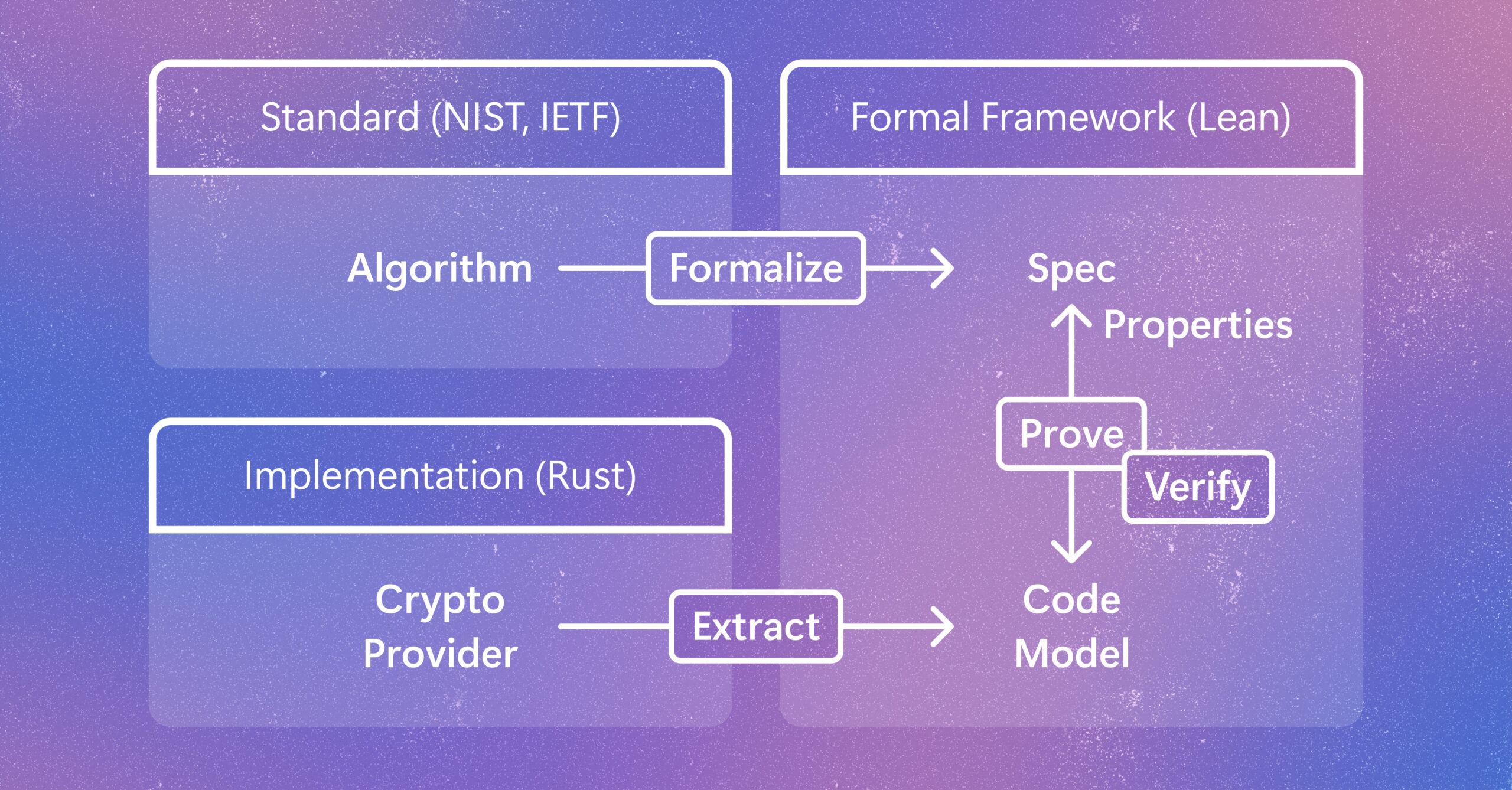
Verifying Rust cryptography in SymCrypt, from standards to code

Cryptographic code supports vital protections in modern computing systems. Learn how a new method helps verify code as developers write it while preserving speed and adaptability as it gets implemented and evolves. The post Verifying Rust cryptography in SymCrypt, from standards to code appeared first on Microsoft Research.

We use cookies to run the site and, with your consent, for analytics and to show ads. See our Cookie Policy.