Egocentric human data offer a path to scaling robot learning beyond costly robot demonstrations, yet the embodiment gap makes raw human trajectories a poor supervisory target for control. Our key insight is that, although low-level actions are embodiment-specific, their underlying motion intent can capture task-relevan...
Li-Han Zha, Shresth Grover, Tenny Yin et al.· 0 citations
Contact with contaminated objects can spread hazards through a household robot's grippers, tools, and shared surfaces, while new contacts can make an existing plan unsafe. Existing benchmarks do not jointly assess how planners identify hygiene risks from contact history and plan safe continuations after new contact eve...
Yurun Chen, Josh Qixuan Sun, Jason Qin et al.· 0 citations
Early stress detection in crops is a necessity today to improve efficiency and reduce waste of time, money, and effort. However, most modern techniques, such as hyperspectral imaging and AI-based systems, are too costly and complex for medium and small-scale farmers to implement. This paper showcases CropSentry, a low-...
Deep generative models often produce structured outputs composed of interacting components. Modelling these outputs with a single model requires learning both the component distributions and their interactions. We pursue a modular alternative: reuse independently trained component generators and learn only how to coord...
Riccardo Barbano, Vincent Pauline, Runchang Li et al.· 0 citations
Reach audiences
Advertise in front of researchers, engineers, and readers.
In this paper, we investigate the synthesis of Micro Neural Policies (MNP) to enable safe and robust real-time robotic control on computationally constrained embedded devices. We demonstrate that integrating Evolution Strategy (ES) and Statistical Model Checking (SMC)-based verification for policy search can drasticall...
Hong-Peng Cao, Riccardo Curcio, Daniele Ottaviano et al.· 0 citations
Visual world models enable goal-directed control through decision-time action search, but their deployment efficiency is often limited by conservatively large planning budgets. We show that competitive task performance can be achieved without agreement with the Full-budget action, that sufficient budgets vary across mo...
Chang-Bai Li, Si-Rui Li, Yi-Chen Yang et al.· 0 citations
Teleoperation serves as the fallback solution to autonomous driving but reliable functions of the teleoperation require a certain amount of mobile network resources, which cannot be guaranteed at all times. Therefore, predictive quality of service (pQoS) is introduced as a concept to increase the resilience of the tele...
Xiyan Su, Jianning Gao, Mahmoud Ashri et al.· 0 citations
Portable mobile-manipulation demonstrations can help alleviate data scarcity for embodied intelligence, but obtaining reliable, low-cost, and robot-free motion supervision from RGB observations remains challenging. Existing approaches often rely on teleoperation or specialized devices equipped with additional sensing h...
Yutian Zhang, Xingrui Xiong, Siyuan Ma et al.· 0 citations
Visual disruptions can arise while a robot is executing a task, leaving a vision-language-action (VLA) policy to respond without knowing the disruption type or timing. We introduce Self-supervised Adaptation from Leftover Trajectories (SALT), which uses the leftover trajectory, the unexecuted part of the previous actio...
Ahin Lee, Jinwoo Seo, Youngsoo Jang et al.· 0 citations
Dexterous manipulation poses a challenging high-dimensional optimization problem, as useful behaviors require coordinated motion across many hand joints. In reinforcement learning (RL) and sampling-based trajectory optimization, exploration commonly relies on independent robot joint perturbations, making coordinated be...
Harsh Gupta, Tyler Ga Wei Lum, Changhao Wang et al.· 0 citations
The ability to interact with articulated objects is essential for embodied intelligent systems, but collecting large-scale real-world demonstrations for these interactions remains challenging due to the precise contact and constraint-following motions involved. Although simulation provides a promising alternative, exis...
Jicong Ao, Shuhan Jiang, Yuling Zhong et al.· 0 citations
Dense 3D mapping with semantic understanding is essential for robotic perception in complex environments. Recent 3D Gaussian Splatting-based mapping approaches enable high-fidelity geometry and efficient open-vocabulary perception, but typically represent semantics as unstructured feature fields that limit object-centr...
Binh Long Nguyen, Kien Nguyen, Clinton Fookes et al.· 0 citations
Robots are getting smarter, but how can their hardware match that growth? New Microsoft Research findings show that moving AI inference beyond the robot can improve task success, boost efficiency, and support more advanced physical AI workloads. The post Offloaded inference for real-world physical AI robotics appeared first on Microsoft Research.
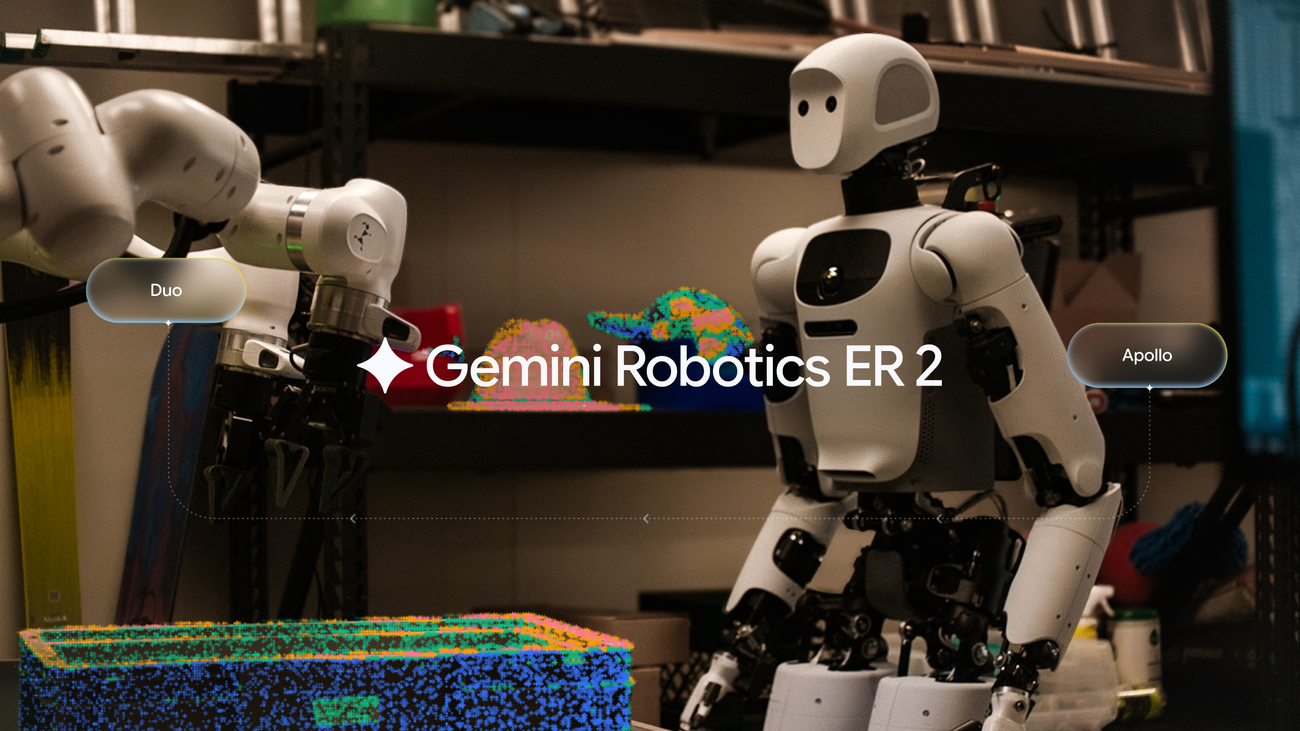
Gemini Robotics ER 2 helps robots reason, collaborate, and solve real-world tasks. It represents a step change in video understanding, tool orchestration, and multi-robot collaboration for robotic applications.
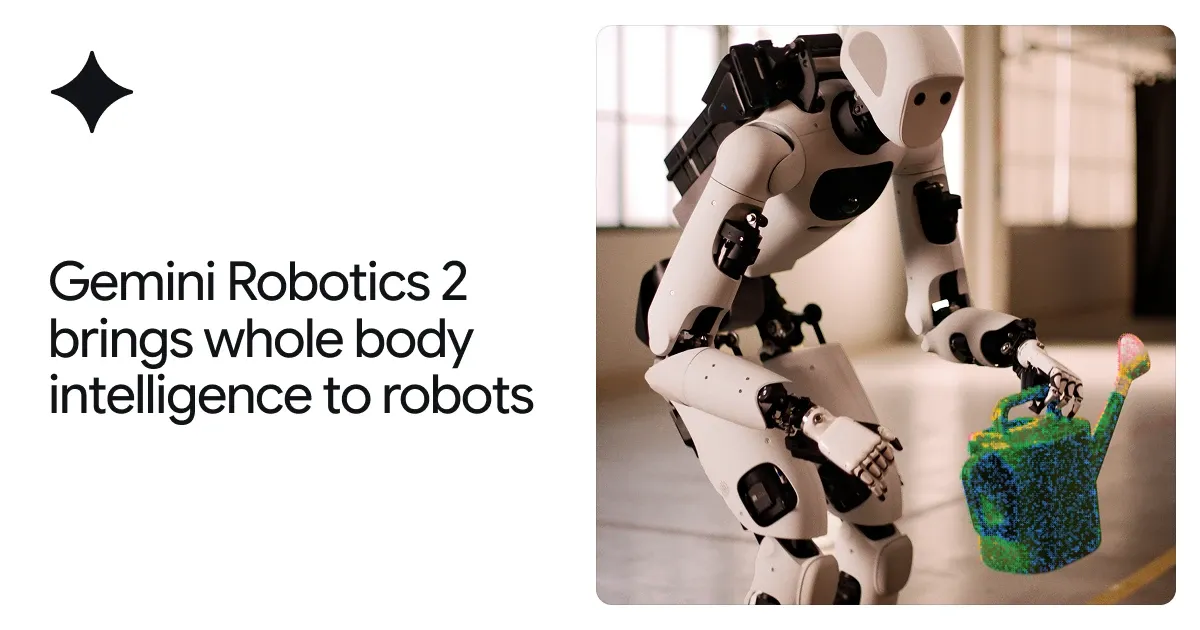
From feet to fingertips — we are teaching robots intelligent whole-body control, fine dexterity, and teamwork to complete a broad range of complex tasks.
We use cookies to run the site and, with your consent, for analytics and to show ads.
See our Cookie Policy.