Deep-space crews cannot rely on real-time ground support for urgent off-nominal events. Initial alerts may underdetermine cause, while discriminating evidence may reside in crew observations or at locations that are unsafe, costly, or unavailable for crew inspection. We present an evidence-driven architecture for human...
Ignacio G Lopez-Francos, Alexis Gallagher, Samira Shalal· 0 citations
We present Go2-DrivoR, a goal-conditioned adaptation of the end-to-end autonomous driving trajectory planning framework DrivoR for urban navigation with quadrupedal robots. By conditioning trajectory generation on a local-frame subgoal through a goal token and adapting the vehicle-centric scoring formulation, the metho...
Joochan Kim, Chanuk Yang, Tackgeun You et al.· 0 citations
Latent world models have shown a remarkable ability to predict future states and to plan in the real world. In practice, however, we lack a principled way to estimate how their capabilities scale with model size, data, and compute, an open problem that slows progress in the field. In this work we present RoboJEPA, a wo...
Artem Zholus, Nicolas Beltran-Velez, Jianhao Yuan et al.· 0 citations
Autonomous navigation in dynamic environments requires computing spatiotemporal trajectories that satisfy non-holonomic motion constraints. When the trajectories of the moving obstacles are predictable or known, a promising approach is to rely on the combination of state lattices constructed from precomputed feasible m...
Marat Agranovskiy, Konstantin Yakovlev· 0 citations
Reach audiences
Advertise in front of researchers, engineers, and readers.
Long-running autonomous agents must reuse accumulated reasoning experience without allowing explicit historical memory and LLM context to grow indefinitely. However, existing memory mechanisms mainly retrieve, summarize, or compress past content and do not directly learn when particular kinds of thinking should be acti...
Multi-agent path planning (MAPP) in continuous environments often relies on roadmaps to balance safety and search efficiency. However, traditional roadmap generation methods, such as lattice grids or standard sampling-based approaches, frequently face a trade-off between graph density and the likelihood of finding feas...
Brandon Ho, Nikola Rogers, Seung-Kyum Choi· 0 citations
Reinforcement learning can improve vision-language-action (VLA) policies beyond supervised fine-tuning, although this typically involves further updates to the policy parameters. For flow-matching policies, iterative action generation provides an additional opportunity to incorporate task information during inference....
Liuhaichen Yang, Zhuang Jiang, Chenchao Sheng et al.· 0 citations
Generative dynamics models enable planning in challenging systems, but safe deployment requires detecting policy-induced out-of-distribution (OOD) transitions. Existing methods typically treat learned dynamics as fixed and rely on post hoc support surrogates for OOD detection. This overlooks a critical failure mode: le...
Hongzhan Yu, Chenghao Li, Ruipeng Zhang et al.· 0 citations
Autonomous driving in complex traffic requires planners that generalize beyond hand-crafted rules, motivating data-driven approaches that learn behavior from expert demonstrations. Diffusion-based trajectory planners have recently shown strong closed-loop performance by iteratively denoising a full-horizon plan, but th...
The ability to manipulate tools significantly expands the set of tasks a robot can perform. Yet, tool manipulation represents a challenging class of dexterity, requiring grasping thin objects, in-hand object rotations, and forceful interactions. Since collecting teleoperation data for these behaviors is challenging, si...
Kushal Kedia, Tyler Ga Wei Lum, Jeannette Bohg et al.· 0 citations
Physics-based human motion control can make a simulated character walk, sit, and manipulate objects with high physical realism. Almost always, though, this happens in short, isolated clips that are re-initialized between interactions. We instead aim for continuous, reset-free long-horizon motion: a physically simulated...
Haozhuo Zhang, Jingkai Sun, Michele Caprio et al.· 0 citations
World models offer a data-driven alternative to traditional simulators for robotics, with applications spanning policy evaluation, improvement, and planning. All of these uses depend on faithful 3D geometry, yet current video-based world models are trained on RGB alone and produce rollouts that look correct frame-by-fr...
Jai Bardhan, Josef Sivic, Vladimir Petrik· 0 citations
Robots are getting smarter, but how can their hardware match that growth? New Microsoft Research findings show that moving AI inference beyond the robot can improve task success, boost efficiency, and support more advanced physical AI workloads. The post Offloaded inference for real-world physical AI robotics appeared first on Microsoft Research.
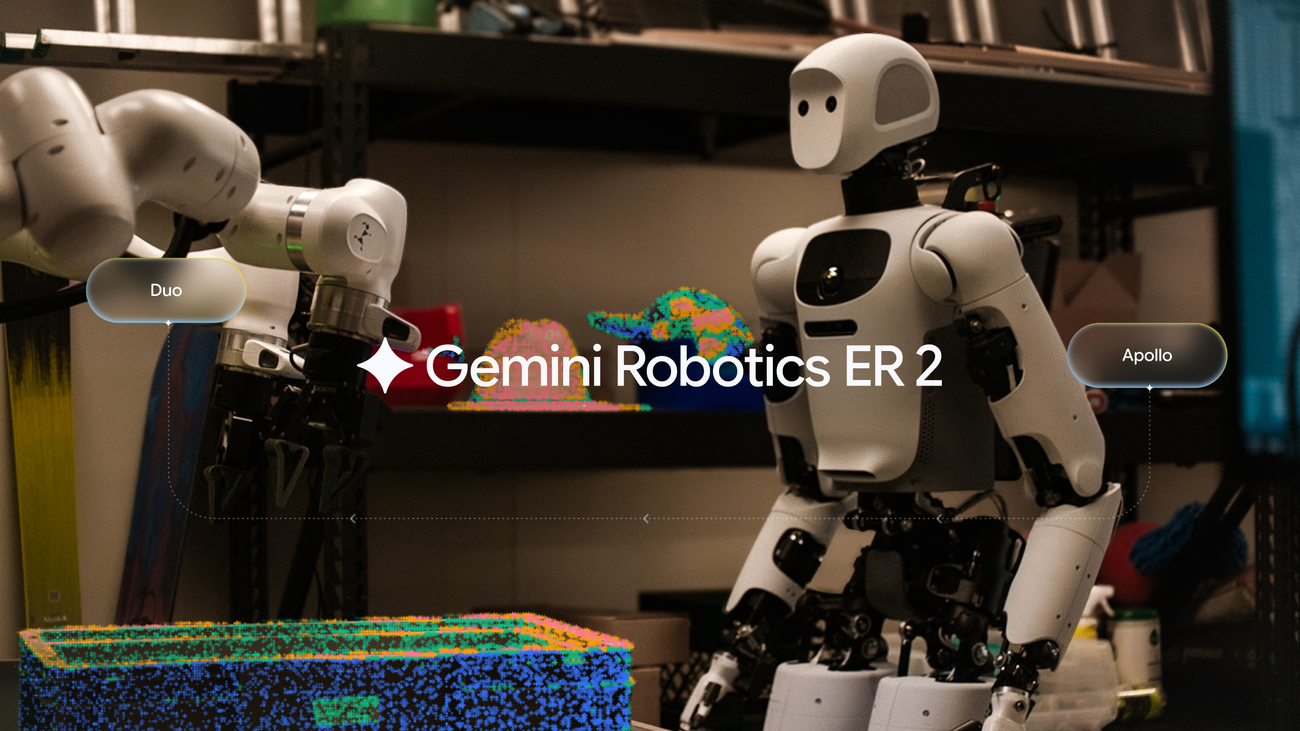
Gemini Robotics ER 2 helps robots reason, collaborate, and solve real-world tasks. It represents a step change in video understanding, tool orchestration, and multi-robot collaboration for robotic applications.
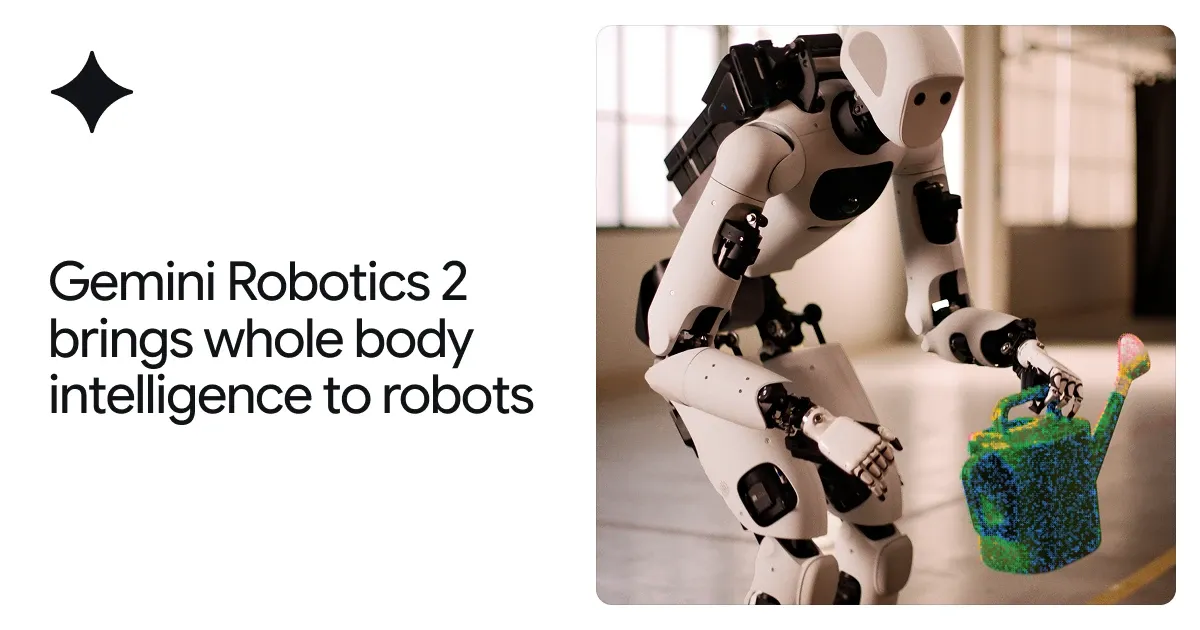
From feet to fingertips — we are teaching robots intelligent whole-body control, fine dexterity, and teamwork to complete a broad range of complex tasks.
We use cookies to run the site and, with your consent, for analytics and to show ads.
See our Cookie Policy.