Experimental results demonstrate that ForgetMimic effectively eliminates memory of designated motions while maintaining the normal operation of all other motions, and identifies and resolves two key training mechanisms in robot control that lead to unlearning failure.
Xu-Kun Luan, Zhong-Xiang Lei, Chen Gong et al.· 0 citations
Control barrier functions (CBF) are a popular safety filter to ensure safety for nonlinear dynamical systems. However, when the system is subject to uncertainties and disturbances, this requires the use of robust variants of CBFs, which can be difficult to construct and can be overly conservative, especially for high-d...
Robotic assembly in high-mixture settings requires adaptable systems that can handle diverse parts, yet current approaches typically rely on policies specialized to each insertion task. Although this can reach high success rates, it makes the process of deploying systems for new problems tedious and time consuming. We...
Nicklas Hansen, Iretiayo Akinola, Yi-Jie Guo et al.· 0 citations
Advances in generative modeling have recently been extensively employed in robotics for policy learning. In particular, Conditional Flow Matching (CFM) trained with expert demonstrations has been shown to outperform existing methods on robot manipulation benchmarks. While prior work has mainly focused on single-task se...
Shreya Deshmukh, Imen Mahdi, Nick Heppert et al.· 0 citations
Reach audiences
Advertise in front of researchers, engineers, and readers.
A three-stage pipeline that transforms abundant unlabelled observation-trajectory pairs into a substrate for language-conditioned control and achieves a Driving Score of 87.98 and a Success Rate of 70.46%, matching or surpassing fully supervised baselines on the closed-loop Bench2Drive benchmark.
Alexey Zakharov, Kemal Oksuz, P. Dokania· 0 citations
Robots deployed for competitive tasks must outmaneuver their opponents without sacrificing safety. Existing approaches, including safe reinforcement learning (RL), train a single policy to achieve task success and avoid failures simultaneously. This coupling can complicate training and leave the learned policy exploita...
Rui-Han Wu, Rui Yang, Donggeon David Oh et al.· 0 citations
Action-chunked visuomotor policies predict overlapping trajectories, so every executed action is covered by several predictions. Temporal ensembling smooths execution by combining these predictions with an exponentially weighted mean. One corrupted prediction can move the aggregate without bound: its breakdown point is...
Robotic embodiment encompasses the sensing, kinematics, dynamics, geometry, actuation, and control through which an agent physically interacts with the world. These properties vary across robots and change over time. We argue that general embodied intelligence requires learning that accumulates across these differences...
Personalizing exoskeleton assistance across operating conditions is constrained by the time and physical effort required to collect user feedback. We examined whether a user's preference landscape varies smoothly across operating conditions and when this continuity supports learning from limited feedback. We propose Co...
Sunin Baek, Sung-Woon Park, Daekyum Kim· 0 citations
A deep discrete-time dissipative recurrent neural network (DissipNet) that explicitly enforces dissipativity, a key property related to stability and energy dissipation, through structural weight constraints and a dedicated training algorithm is proposed.
Effective communication of robot touch intent is essential for safe and predictable physical human-robot interaction. While intent communication has been widely studied, existing approaches lack the spatial specificity and semantic depth necessary to efficiently convey robot touch intent. We present Mirror Skin, a ceph...
David Wagmann, Matti Kr\"uger, Chao Wang et al.· 0 citations
This study introduces an interdisciplinary framework for benchmarking robots deployed in public environments, addressing the gap between traditional laboratory metrics and real-world benchmarking requirements. We evaluate three distinct robots across diverse use cases - outdoor park cleaning, pedestrian underpass clean...
Raphael Memmesheimer, Martina Overbeck, Dominik Beyer et al.· 0 citations
Robots are getting smarter, but how can their hardware match that growth? New Microsoft Research findings show that moving AI inference beyond the robot can improve task success, boost efficiency, and support more advanced physical AI workloads. The post Offloaded inference for real-world physical AI robotics appeared first on Microsoft Research.
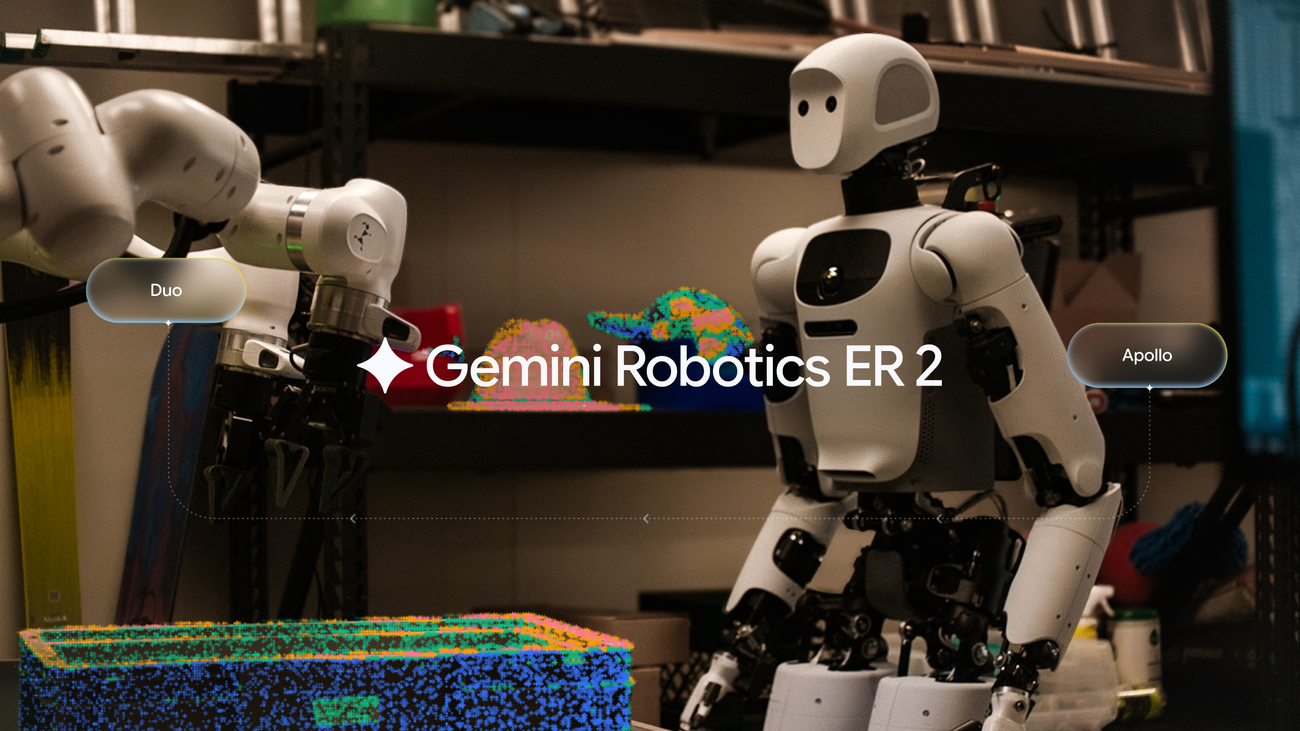
Gemini Robotics ER 2 helps robots reason, collaborate, and solve real-world tasks. It represents a step change in video understanding, tool orchestration, and multi-robot collaboration for robotic applications.
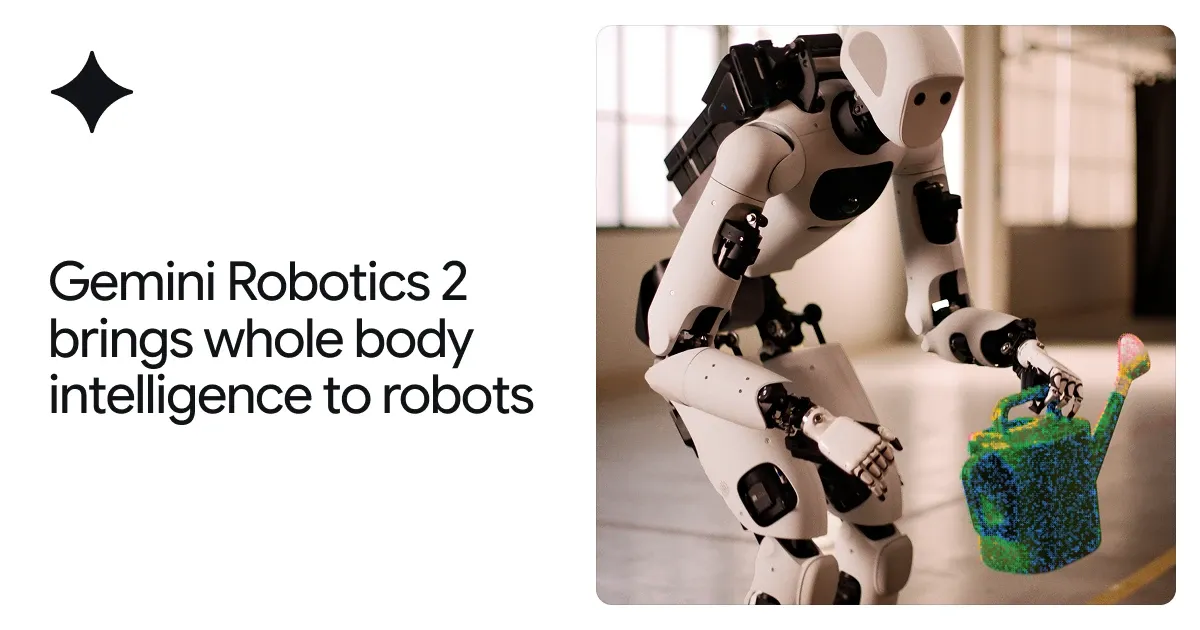
From feet to fingertips — we are teaching robots intelligent whole-body control, fine dexterity, and teamwork to complete a broad range of complex tasks.
We use cookies to run the site and, with your consent, for analytics and to show ads.
See our Cookie Policy.