Offline reinforcement learning enables reward-driven policy improvement from fixed datasets without requiring online exploration, making it particularly attractive in safety-critical domains. A central challenge, however, is distribution shift: policy optimization may favor actions that are weakly supported by the offl...
Mahmoud Selim, Cristina Cipriani, Karl Henrik Johansson· 0 citations
Deploying robots as Complex Adaptive Systems (CAS) in unknown and dynamic environments necessitates a transition from rigid command libraries toward intention-based autonomy, as natural language represents the only medium capable of articulating complex goals beyond the capacity of finite instruction sets. While Large...
Justus Flerlage, Thorsten Wittkopp, Alexander Acker et al.· 0 citations
Real-world applications require 6D pose estimation to be accurate, fast, and scalable to unseen objects. This paper introduces WAPR, a zero-shot wide-angle pose refinement model that refines candidate poses with rotational deviations up to 90 degrees. With as few as 12 candidate poses per detected object instance, WAPR...
Yulin Wang, Mengting Hu, Hongli Li et al.· 0 citations
Large vision-language models (VLMs) provide powerful open-world perception and reasoning for autonomous driving, but their high computational cost and inference latency make continuous cloud-side use impractical. This motivates fast--slow collaboration, where efficient onboard modules handle real-time perception and co...
Jiayi Chen, Shuai Wang, Guangxu Zhu et al.· 0 citations
Reach audiences
Advertise in front of researchers, engineers, and readers.
Vision-Language-Action (VLA) models have shown strong generalization in robotic manipulation by leveraging rich representations from pretrained vision-language models. However, their deployment in real-world environments remains limited by recurring unreliable behaviors. In this work, we study state hallucination, a re...
Jiho Lee, Jeongeun Park, Heayoun Choi et al.· 0 citations
Methods that recover individual latent variables of the world, from nonlinear ICA to dictionary learning and causal representation learning, anchor the latents to observations through reconstruction, auxiliary supervision, or distributional asymmetries such as non-Gaussianity. Methods without these anchors, including j...
Yujia Zheng, David Klindt, Randall Balestriero et al.· 0 citations
Benchmarks for measuring the quality of action-conditioned world models are still evolving and shifting away from visual similarity-based metrics to action-semantic and physically-grounded metrics. However, for domain and task-agnostic action-conditioned world model training, existing benchmarks provide a limited signa...
Nirmit Desai, Eric Song, Mayank Sengupta et al.· 0 citations
Many applications of physical AI run within finite or closed physical worlds with a limited set of physical laws governing object behavior. Examples include robots working in a warehouse and agents moving around in a video game. In order to better organize, filter, and curate data for physical AI applications, we propo...
Mayank Sengupta, Nirmit Desai, Eric Song et al.· 0 citations
The difficulty of learning goal-reaching policies is often attributed to a "curse of horizon" that manifests as bias accumulation in temporal-difference backups and noisy advantage estimates. In this work, we identify an additional informational curse of horizon in goal-conditioned policy learning, where increasing the...
John L. Zhou, Yuxuan Dong, Jonathan C. Kao· 0 citations
Human videos provide rich motion targets for humanoid learning, yet visually plausible references can still produce persistent failures under physics-based execution. These failures reveal where training supervision should change. We present MimicX, a policy-in-the-loop framework that uses execution feedback to refine...
Shuaijun Liu, Chenglong Zhang, Xuhao Liu et al.· 0 citations
Astra can act, yet reliable manipulation depends on the system through which it observes and controls the world. We introduce PhysEvo, a framework for physical recursive self-improvement (RSI) around a single frozen model. A task agent executes robot tasks; a meta-agent uses the resulting trajectories to diagnose failu...
Wenqing Tian, Zeyu Zhang, Zhaocheng Liu et al.· 0 citations
While offline reinforcement learning (RL) enables policy optimization from static datasets without costly online interaction, it remains bottlenecked by the risk of executing out-of-distribution (OOD) actions. Recent approaches mitigate this by learning a behavior-cloning policy through flow matching and then performin...
Songyuan Zhang, Oswin So, Eric Yang Yu et al.· 0 citations
Robots are getting smarter, but how can their hardware match that growth? New Microsoft Research findings show that moving AI inference beyond the robot can improve task success, boost efficiency, and support more advanced physical AI workloads. The post Offloaded inference for real-world physical AI robotics appeared first on Microsoft Research.
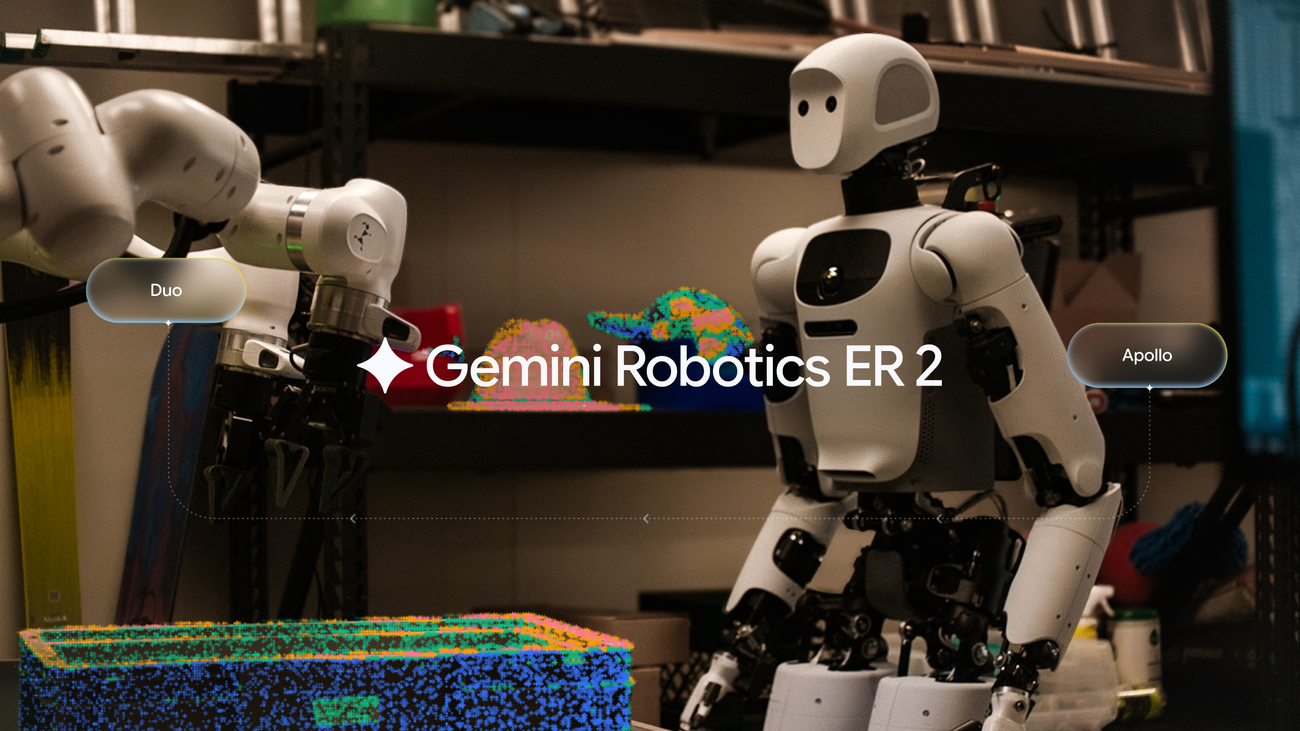
Gemini Robotics ER 2 helps robots reason, collaborate, and solve real-world tasks. It represents a step change in video understanding, tool orchestration, and multi-robot collaboration for robotic applications.
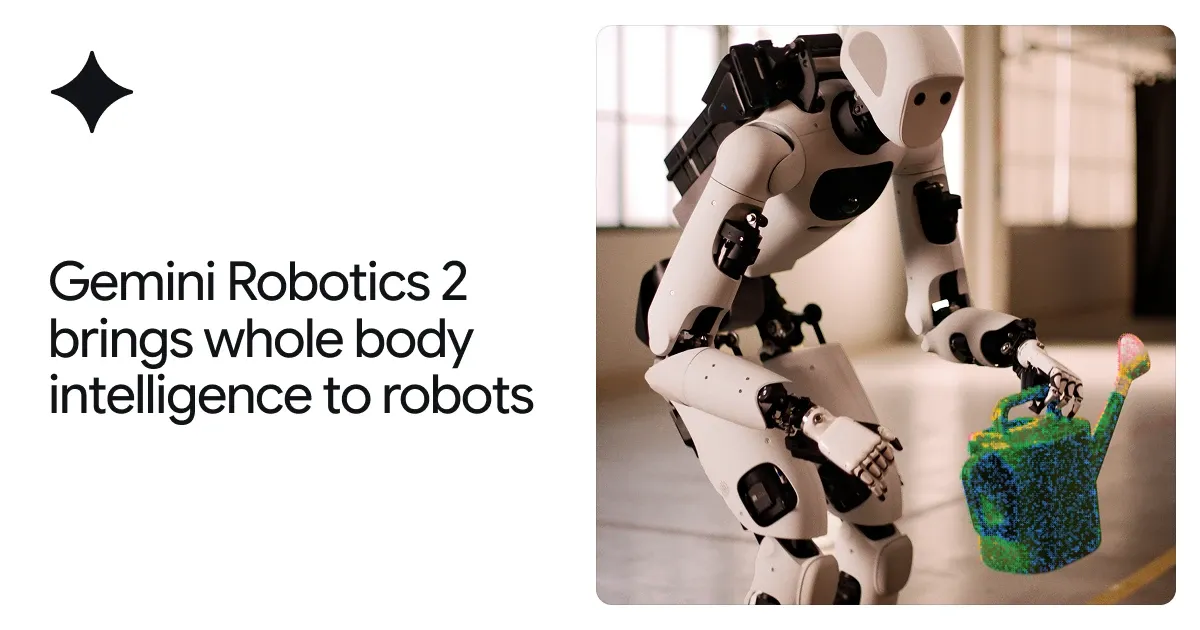
From feet to fingertips — we are teaching robots intelligent whole-body control, fine dexterity, and teamwork to complete a broad range of complex tasks.
We use cookies to run the site and, with your consent, for analytics and to show ads.
See our Cookie Policy.