Active vision -- where a policy controls its own gaze during manipulation -- has emerged as a key capability for imitation learning, with multiple independent systems demonstrating its benefits in the past year. Yet there is no shared benchmark to compare approaches or quantify what active vision contributes, on which...
Partial driving automation creates a tension: drivers remain legally responsible while being less active in control. Meaningful human control (MHC), a normative framework that can potentially address this tension, proposes that automated systems are designed to track relevant human reasons and that humans should at all...
Ashwin George, Lucas Elbert Suryana, Lorenzo Flipse et al.· 0 citations
Solving complex long-horizon robotic tasks requires joint reasoning over abstract task structure and low-level physical interaction. While combining Vision-Language Models (VLMs) and video generation models offers a promising path for zero-shot planning, their individual tendencies to hallucinate physics or violate geo...
Jiahui Fu, Junyu Nan, Lingfeng Sun et al.· 0 citations
Despite rapid progress in robotics, complex or long-horizon tasks remain a fundamental challenge. Most current approaches follow an open-loop paradigm with limited reasoning and no feedback, resulting in poor robustness to environmental changes and severe error accumulation. We present RoboPilot, a dual-thinking closed...
Xinyi Liu, Mohammadreza Fani Sani, Zewei Zhou et al.· 0 citations
Reach audiences
Advertise in front of researchers, engineers, and readers.
Vision-Language-Action (VLA) models have recently advanced robotic manipulation by translating natural-language instructions and visual observations into control actions. However, existing VLAs are primarily trained on successful expert demonstrations and lack structured supervision for failure diagnosis and recovery,...
Zewei Ye, Weifeng Lu, Minghao Ye et al.· 0 citations
Generative Artificial Intelligence (GenAI) constitutes a transformative technological wave that reconfigures industries through its unparalleled capabilities for content creation, reasoning, planning, and multimodal understanding. This revolutionary force offers the most promising path yet toward solving one of enginee...
Yuping Wang, Shuo Xing, Cui Can et al.· 0 citations
As we move through the world and carry out everyday tasks, we encounter objects that may become relevant only later. We are capable of recalling where we left something or what was inside a container, even without knowing we would need it later. Here, we study how an embodied assistant can build a similar memory from e...
Shravan Chaudhari, William Paul, Suchi Saria et al.· 0 citations
Real-time robot control demands enough visual history to infer motion and task progress, but processing that history can delay action. We present Long-WAM, a model-system framework for scaling the context of causal world-action models under real-time control constraints. Our central finding is that access to history is...
Wei Huang, Bohan Zhang, Chenzhi Liu et al.· 0 citations
We present FoldBack, a self-correcting masked generative policy for long-horizon garment folding. Existing long-trajectory policies may continue after a missed or slipped grasp even when the garment has not reached the intended configuration. We structure FoldBack's recovery mechanisms around three inference-time decis...
Lipeng Zhuang, Shiyu Fan, Yingdong Ru et al.· 0 citations
Flow policies capture rich and diverse action distributions, and fine-tuning them with off-policy RL to improve beyond the demonstrations has drawn growing interest. However, fine-tuning a flow policy against a learned value function is not trivial, because the policy generates its action over many flow steps. Adjoint...
Yonghoon Dong, Minsung Yoon, Jaehyuk Kim et al.· 0 citations
Recent advances in multimodal foundation models have made them capable generalist physical agents for a range of manipulation tasks. However, successful operation in an unfamiliar environment may require an agent to seek task-relevant information through interaction when it is absent from the observations: it may need...
Liu Renhang, Navonil Majumder, Tej Deep Pala et al.· 0 citations
Human-Robot Collaboration (HRC) can facilitate mass customisation in Industry 4.0, with Reinforcement Learning from Human Feedback (RLHF) representing a promising approach for developing safe AI-based robots. Practical challenges remain regarding safety during AI development, human feedback quality, and bidirectional h...
Alexandra Coroiu, Andrea Vogt, Viktor Werbilo et al.· 0 citations
Robots are getting smarter, but how can their hardware match that growth? New Microsoft Research findings show that moving AI inference beyond the robot can improve task success, boost efficiency, and support more advanced physical AI workloads. The post Offloaded inference for real-world physical AI robotics appeared first on Microsoft Research.
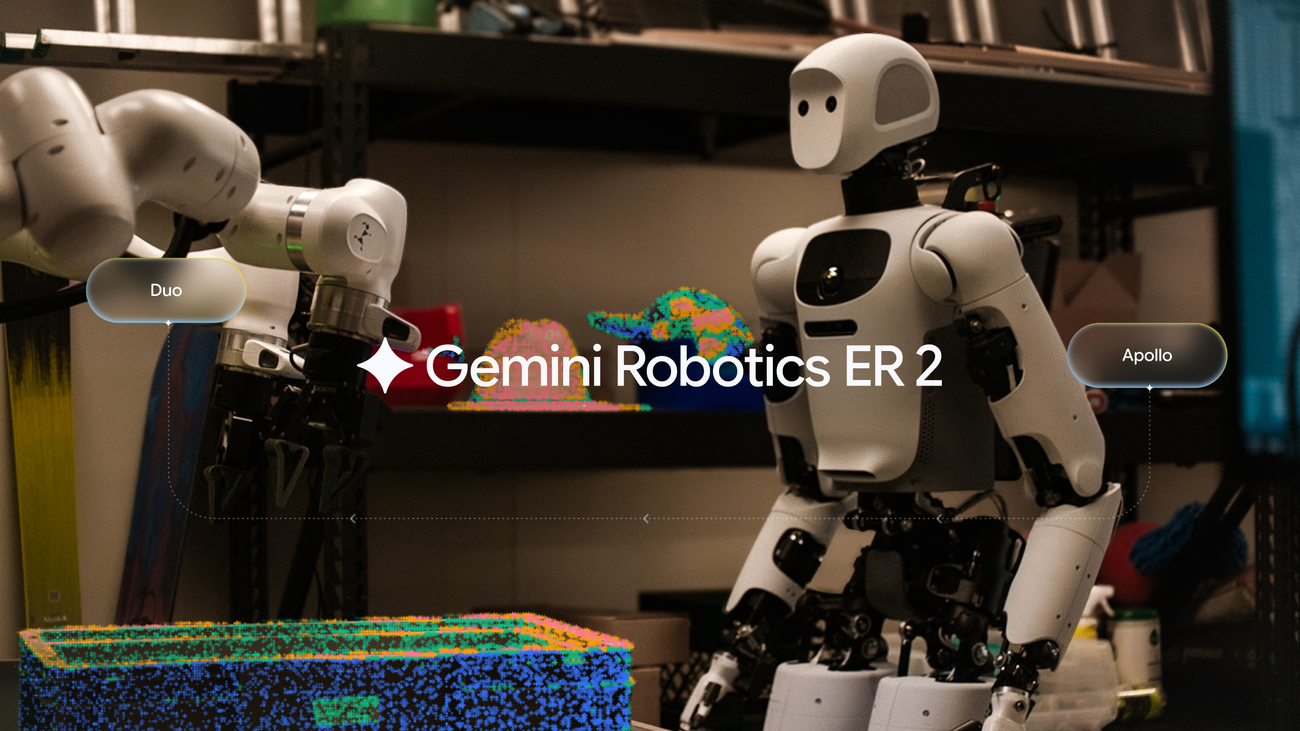
Gemini Robotics ER 2 helps robots reason, collaborate, and solve real-world tasks. It represents a step change in video understanding, tool orchestration, and multi-robot collaboration for robotic applications.
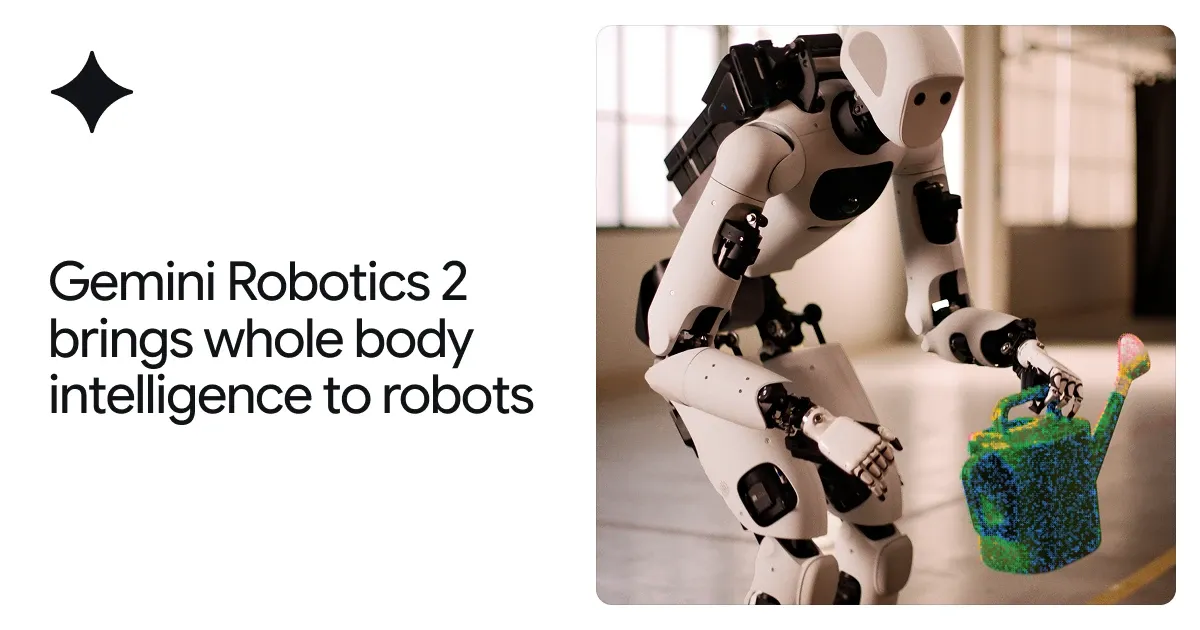
From feet to fingertips — we are teaching robots intelligent whole-body control, fine dexterity, and teamwork to complete a broad range of complex tasks.
We use cookies to run the site and, with your consent, for analytics and to show ads.
See our Cookie Policy.