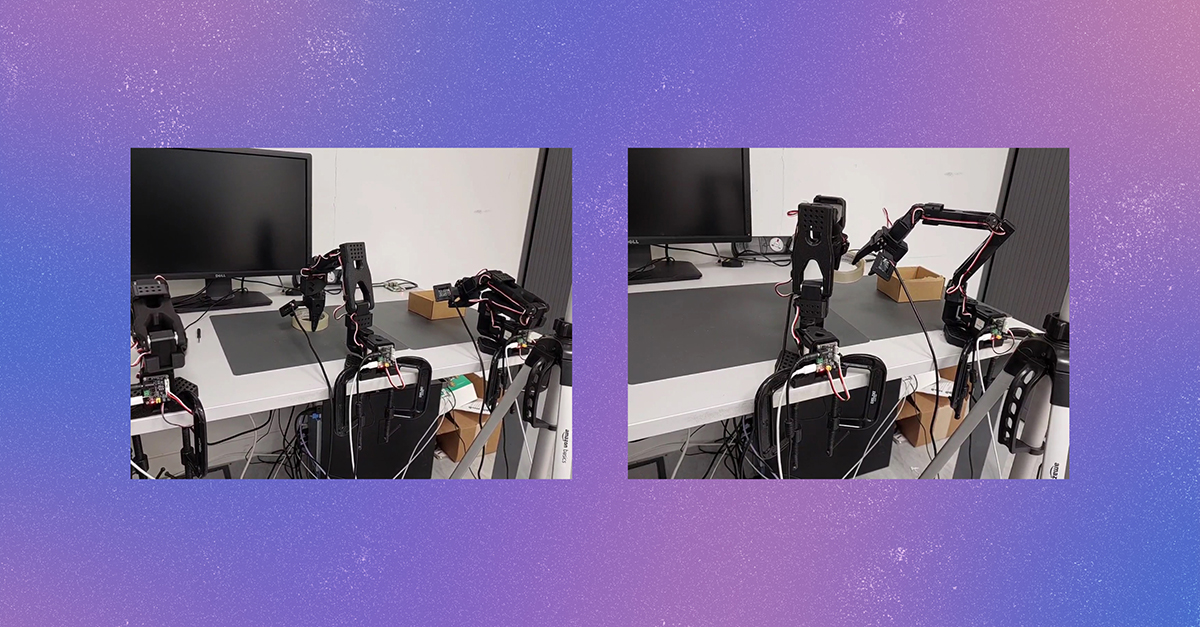
The sim-to-real gap remains a critical challenge in robotics, hindering the deployment of algorithms trained in simulation to real-world systems. We propose a flexible Real-to-Sim-to-Real (RSR) framework whose central contribution is an information-theoretic cost function that explicitly accounts for sim-to-real discre...
Yuxuan Xu, Shiyu Wang, Jinhao Huang et al.· 0 citations
Robot navigation in dynamic, human-centered environments requires socially-compliant decisions grounded in robust scene understanding. Recent Vision-Language Models (VLMs) exhibit promising capabilities such as object recognition, common-sense reasoning, and contextual understanding, capabilities that align with the nu...
Nathan Tsoi, M. Munje, Tejas Oberoi et al.· 0 citations
The analysis of the imitation objective shows how narrow conditional action support can leave grounded and instruction-keyed solutions indistinguishable on the demonstrations, and motivates Equivariant Counterfactual Training (ECT), which acts at two levels.
Hung-Jen Chen, Yue-Ling Hou, Yan-Hong Chen et al.· 0 citations
Accurate human torque estimation is crucial for enabling task-agnostic control in robotic exoskeleton systems. However, estimation errors may cause mismatches between the robot assistance and the human intention, degrading controllability and task performance. In this paper, we address this issue by formally defining m...
Duy Hoang, Bastien Berret, Olivier Bruneau et al.· 0 citations
Reach audiences
Advertise in front of researchers, engineers, and readers.
Vision-Language-Action (VLA) models have recently incorporated world models to provide richer dynamic supervision beyond sparse action labels. However, explicitly predicting future images or videos may include control-irrelevant appearance, while guidance derived from holistic future visual representations and shared g...
Does memory-dependent control need nonlinear recurrent dynamics? We study simulated air-hockey defence under temporary loss of puck tracking. A DreamerV3 teacher outperforms a memoryless policy under tracking loss, while resetting the teacher's recurrent state sharply reduces performance, which demonstrates that the ta...
While Vision-Language-Action (VLA) models enable flexible action generation, their generalization across diverse environmental elements, including manipulated objects, destinations, and backgrounds, is limited by the lack of diversity in robotic training data. Trained end-to-end on such data, VLAs tend to exploit visua...
Yan-Yan Zhang, Di-Sheng Liu, Xin-Peng Li et al.· 0 citations
Behavior cloning provides an offline route to autonomous-driving policy learning, but mean-squared-error regression is poorly matched to demonstrations in which one observation admits several valid actions. Diffusion policies can represent conditional multimodal action distributions, yet their closed-loop performance m...
Bruno Maciel Machado, Eric Aislan Antonelo· 0 citations
Stochastic differential equations (SDEs) can be studied via It\^{o} calculus and rough path theory. For stochastic optimal control, these two frameworks give distinct Pontryagin Maximum Principle (PMP) optimality conditions with forward-backward SDEs (FBSDEs) or rough differential equations. We show that the adjoint eq...
Neural trajectory predictors can reach low prediction error while violating dynamics, actuator limits, or state constraints, especially when controls are unobserved and dynamics are partially specified. We introduce the Markovian Dynamics Enforcer (MaDE), a time-invariant post-hoc operator mapping state-transition prop...
Kevin Yu, Tao Guo, C. Antoniou et al.· 0 citations
Random exploration reveals how an environment can be traversed before a goal is specified. Can this experience support long-range planning without policy-improvement training? Our random-walk analysis explains what temporal relations contain: short horizons reveal geodesic geometry in the diffusion limit, while longer...
De-Qian Kong, Guang-Yan Sun, Sheng Cheng et al.· 0 citations
Unmanned aerial vehicle (UAV) relay networks can restore connectivity after communication infrastructure is damaged. Urban relay placement is difficult because line-of-sight blockage, communication range, altitude, and three-dimensional obstacles must be considered jointly. Arm2Air transfers obstacle-avoidance skeleton...
Dohun Lee, Kyeonghyun Yoo, Seokmin Kim et al.· 0 citations
Robots are getting smarter, but how can their hardware match that growth? New Microsoft Research findings show that moving AI inference beyond the robot can improve task success, boost efficiency, and support more advanced physical AI workloads. The post Offloaded inference for real-world physical AI robotics appeared first on Microsoft Research.
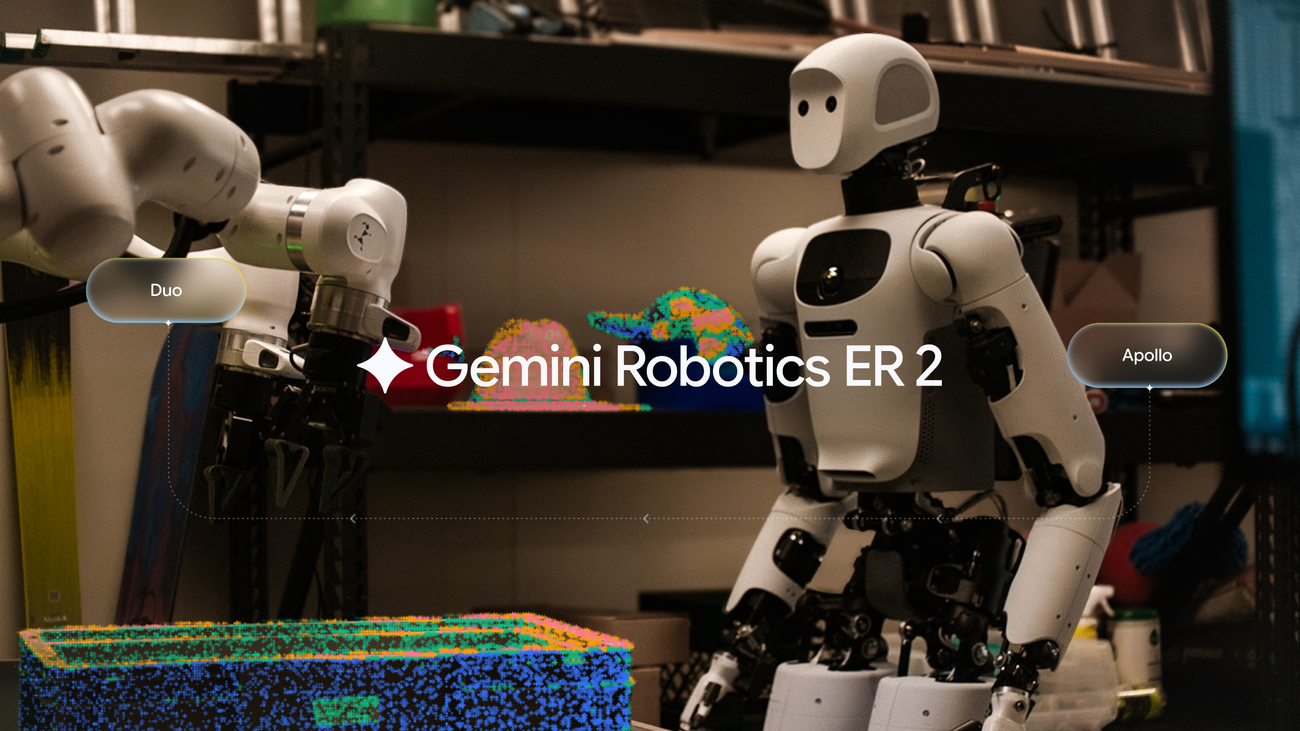
Gemini Robotics ER 2 helps robots reason, collaborate, and solve real-world tasks. It represents a step change in video understanding, tool orchestration, and multi-robot collaboration for robotic applications.
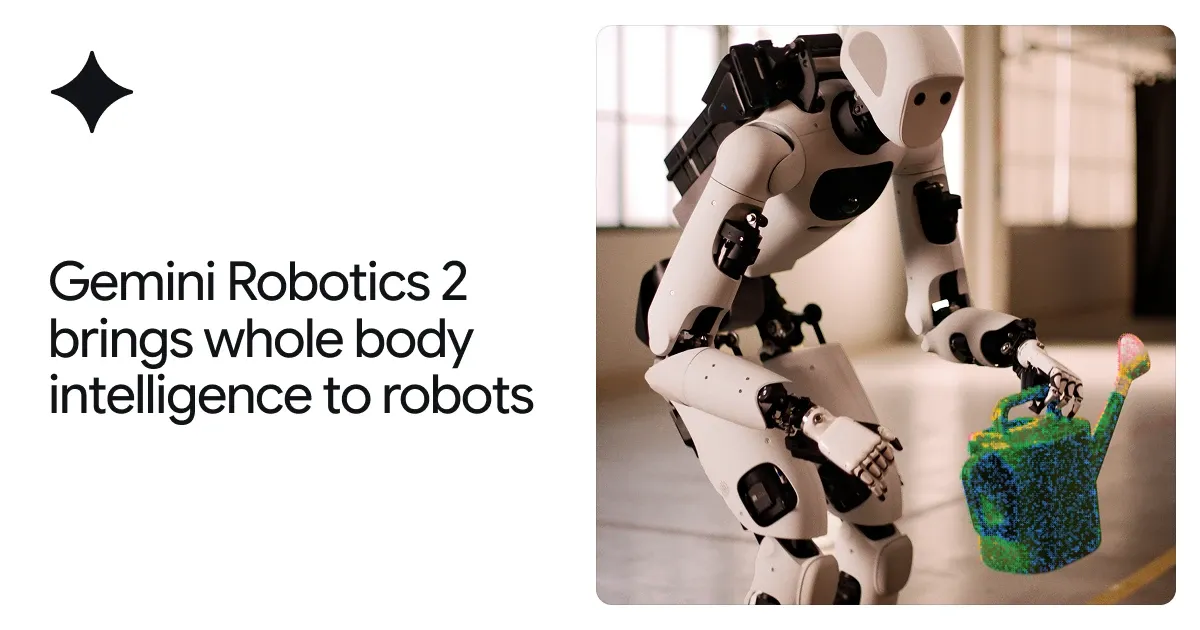
From feet to fingertips — we are teaching robots intelligent whole-body control, fine dexterity, and teamwork to complete a broad range of complex tasks.
We use cookies to run the site and, with your consent, for analytics and to show ads.
See our Cookie Policy.