Vision-Language-Action (VLA) models increasingly rely on action experts that generate short action chunks under receding-horizon control. While chunk-level training is convenient across robot embodiments, it optimizes local action likelihood without explicitly accounting for long-horizon task success. Sequence-level re...
Youngjun Jun, Kyumin Choi, Young Min Kim et al.· 0 citations
Legible planning is the creation of plans that best disambiguate their goals from a set of other candidates from an observer's perspective. In this paper we propose a method for legible planning for arbitrary PDDL domains, by extending previous research on legibility to classical planning without requiring to construct...
Sim-to-real research pursues physics fidelity as a primary objective: simulators are judged by how closely they reproduce real-world contact dynamics. For governance benchmarking of LLM-driven robots, where the simulator demonstrates that an admission/policy/contract/audit pipeline behaves correctly, contact fidelity a...
Xue Qin, Simin Luan, Cong Yang et al.· 0 citations
Vision models pretrained for frame-level appearance often struggle to infer hidden physical properties from motion. We study center-of-mass (CoM) localization for opaque, asymmetric rigid bodies from short monocular videos, where surface cues and point tracking are unreliable under self-occlusion. We propose STATERA, w...
Animesh Varma· 0 citations
Reach audiences
Advertise in front of researchers, engineers, and readers.
Large language model (LLM) based agents are often criticized for lacking spatial understanding and mainly exploiting statistical text patterns. We investigate their spatial comprehension through an architecture combining geometrical tools with a LLM serving as a high-level orchestrator in grid-world environments. The a...
Existing LLM-driven robot task planners rely on a taken-for-granted assumption of an ideal user whose instructions are clear, complete, and task-focused. However, when interacting with real-world users, especially those experiencing cognitive impairments, such as people living with dementia (PLWD), the planners often m...
Guangxin Zhao, Yiran Hu, Yuan Cao et al.· 0 citations
Diffusion- and flow-based robot policies have recently become widespread in robotic Imitation Learning (IL) due to their high performance and ability to model continuous and multimodal distributions. However, the iterative denoising procedure used by these models introduces significant prediction latency, hindering hig...
Aksel Vaaler, Marco Job, C. Holden et al.· IEEE Robotics and Automation...· 0 citations
It is suggested that effective legible motion in social robot navigation benefits from interaction-level intent representations that support coordination, with some effects persisting even when human attention is divided.
Pranav Goyal, Andrew Stratton, Christoforos Mavrogiannis· 0 citations
Perceiving human motion via privacy-preserving 4D millimeter-wave (mmWave) radar is critical for next-generation human-robot interaction (HRI), where point cloud scene flow serves as a foundational motion representation. Yet the extreme sparsity and noise of 4D radar point clouds make non-rigid motion flow estimation s...
Desk-based learning and creative activities benefit from handwritten engagement. However, current generative AI tools deliver guidance through a separate screen, creating a gap between where users think and where assistance appears. To address this, in this work we design AIfred, a desk-based robotic arm with a project...
Gregorio Orlando, Milan Groshev, Eduardo Castell\'o Ferrer· 0 citations
An embodiment-aware controller is formulated, the Universal Embodiment Engine (UEE), that infers the operator's embodiment and visuo-proprioceptive cue weighting from implicit gaze and pupil signals and task outcome, and chooses bounded device settings under explicit preferences, cast as a discrete Active Inference age...
This paper presents a novel autonomous robotic assembly framework for constructing stable structures without relying on predefined architectural blueprints. Instead of following fixed plans, construction tasks are defined through targets and obstacles, allowing the system to adapt more flexibly to environmental uncerta...
Jingwen Wang, Johannes Kirschner, Paul Rolland et al.· 0 citations
Robots are getting smarter, but how can their hardware match that growth? New Microsoft Research findings show that moving AI inference beyond the robot can improve task success, boost efficiency, and support more advanced physical AI workloads. The post Offloaded inference for real-world physical AI robotics appeared first on Microsoft Research.
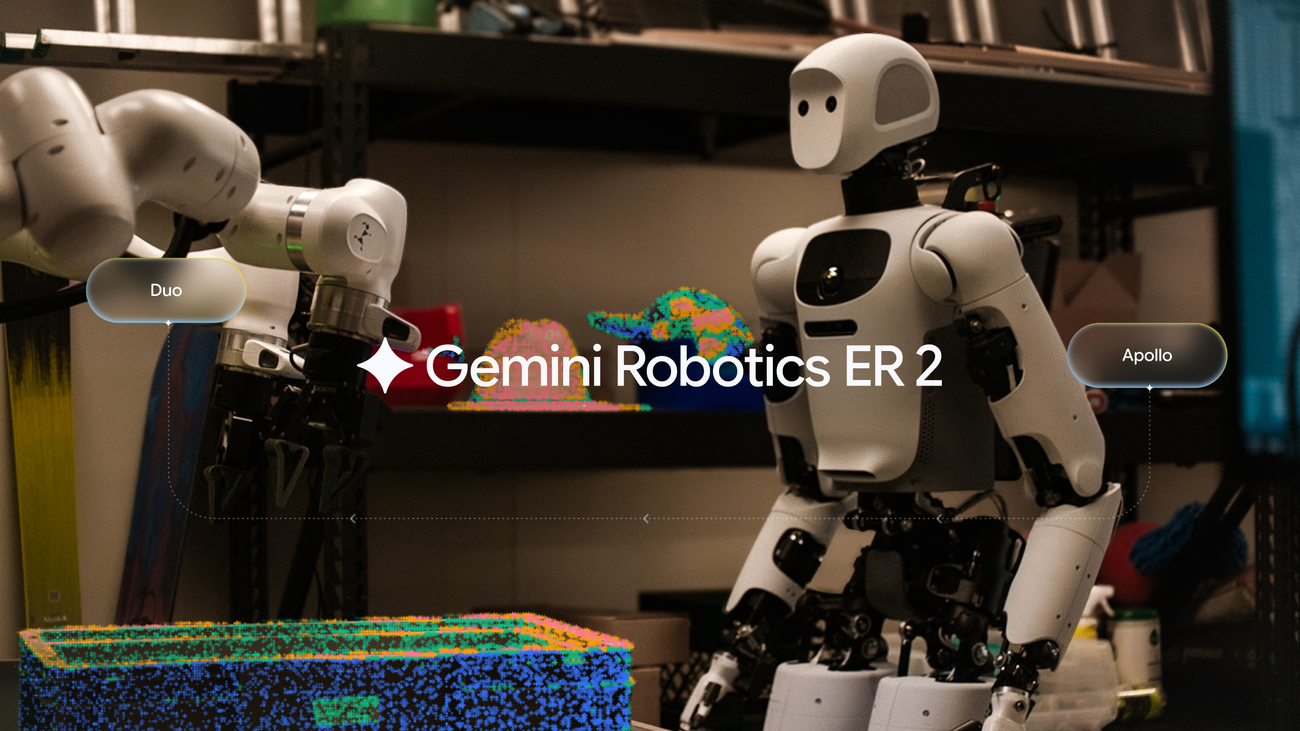
Gemini Robotics ER 2 helps robots reason, collaborate, and solve real-world tasks. It represents a step change in video understanding, tool orchestration, and multi-robot collaboration for robotic applications.
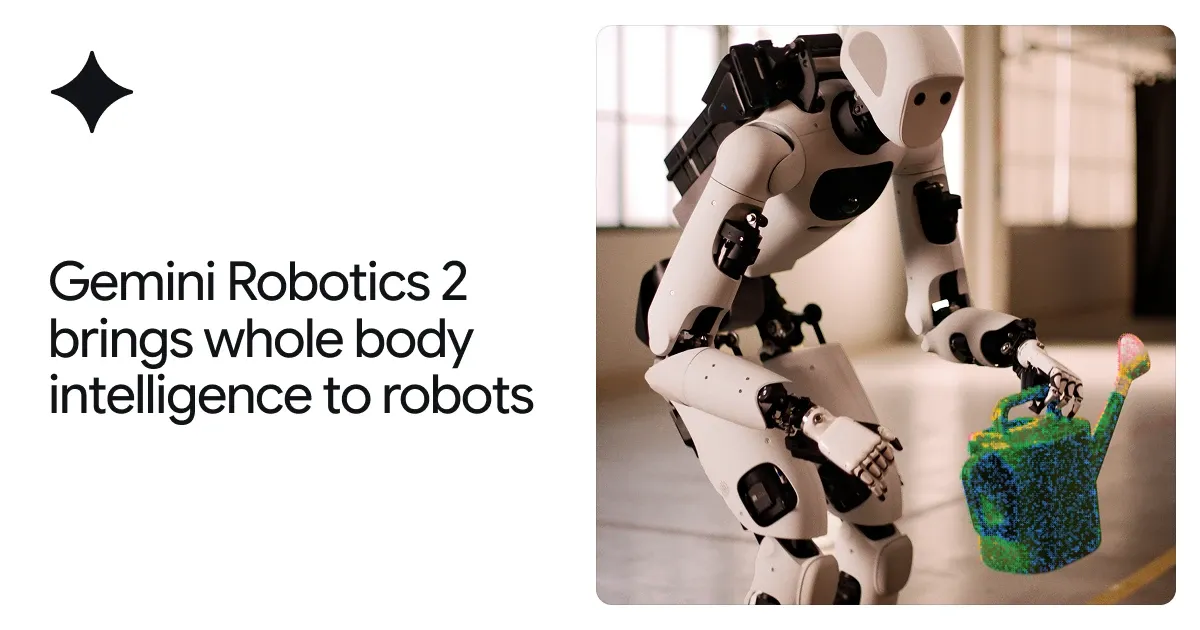
From feet to fingertips — we are teaching robots intelligent whole-body control, fine dexterity, and teamwork to complete a broad range of complex tasks.
We use cookies to run the site and, with your consent, for analytics and to show ads.
See our Cookie Policy.