Latent actions supervise robot policies with action-like codes inferred from visual transitions, and their usefulness hinges on two questions: what a code keeps from a transition, and whether it still means the same thing when reused in a different initial state. The first is a tension in time: an endpoint difference d...
We develop a bias-aware digital-twin calibration and control framework for multiscale bioprocess models within a biological systems-of-systems (Bio-SoS) paradigm. The digital twin is represented by a stochastic differential equation (SDE) model and calibrated from sparse, discrete observations using quasi-likelihood es...
This paper addresses the prediction of adjacency between pairs of 2D fragments based on their contours. We improved the two-stage architecture proposed in Beaulac's thesis, in which a rotation-equivariant Siamese convolutional neural network scores pairs of local image windows along the two contours of two fragments. T...
Guillaume Brouillette (Universit\'e du Qu\'ebec \`a Trois-Rivi\`eres, Trois-Rivi\`eres, Canada) et al.· 0 citations
Language models are routinely fine-tuned under a fixed context, such as a generic system prompt, persona or domain-specific instruction, yet the learned behavior sometimes stays confined to that context and sometimes broadly generalizes to unseen contexts. We propose the Persona Hierarchy Model to explain this: a share...
Jia-Chen Zhao, Zheng-Xuan Wu, David Bau et al.· 0 citations
When diffusion policies were first introduced, they were expected to recover multi-modal action distributions. However, we find this expectation does not always hold, as diffusion policies often collapse to a single modality even when we guarantee the balance of dataset modalities and exact within-batch symmetry. Our a...
Xiao Zhang, Yuxin Chen, Zhixuan Liang et al.· 0 citations
Contrails are the thin ice clouds that aircraft leave behind. They cause a large share of aviation's warming, and rerouting the few flights that produce them could avoid much of it. However, an avoided contrail only counts if a satellite can confirm that it never formed, and this check is hard: contrails are one to two...
Learning from demonstrations (LfD) provides a framework for inferring unknown constraints from locally optimal, constraint-satisfying expert behavior. Existing approaches largely fall into two paradigms, constrained inverse optimal control (CIOC) and inverse constrained reinforcement learning (ICRL). CIOC exploits opti...
Policy-based reinforcement learning (RL) approaches have produced promising results for autonomous cyber defense; however, they are sample-inefficient in settings where defenders must respond under delayed, partial observations with actions from large action spaces. While large language models (LLMs) may reason semanti...
Fernando Martinez, Abhishek Satyam, Tao Li et al.· 0 citations
Blind Source Separation(BSS) is a fundamental problem in signal processing, aiming to separate multiple source signals from their mixtures without prior knowledge of the sources or the mixing process. Traditional approaches, such as Independent Vector Analysis (IVA) exploits statistical independence of sources. Recentl...
Jing-Qi Sun, Hao Tang, Shu-Lin He et al.· 0 citations
Facial movements convey subtle and important information that is critical for human social communication. Optical methods for face capture are difficult or impossible to use when the face is occluded by head-mounted devices (HMDs), such as VR headsets. Even with a clear line of sight, such methods raise privacy concern...
Ganidhu Abey, Wendy Greening, Ashika Kamboj et al.· 0 citations
Modern DBMSs expose hundreds of configuration knobs, resulting in a high-dimensional and heterogeneous search space that makes automated tuning costly. Existing ML-based tuning systems typically treat the configuration domain as box-constrained and rely on workload feedback to implicitly capture inter-knob relationship...
Fangping Lan, Qi Zhang, Eduard Dragut· 0 citations
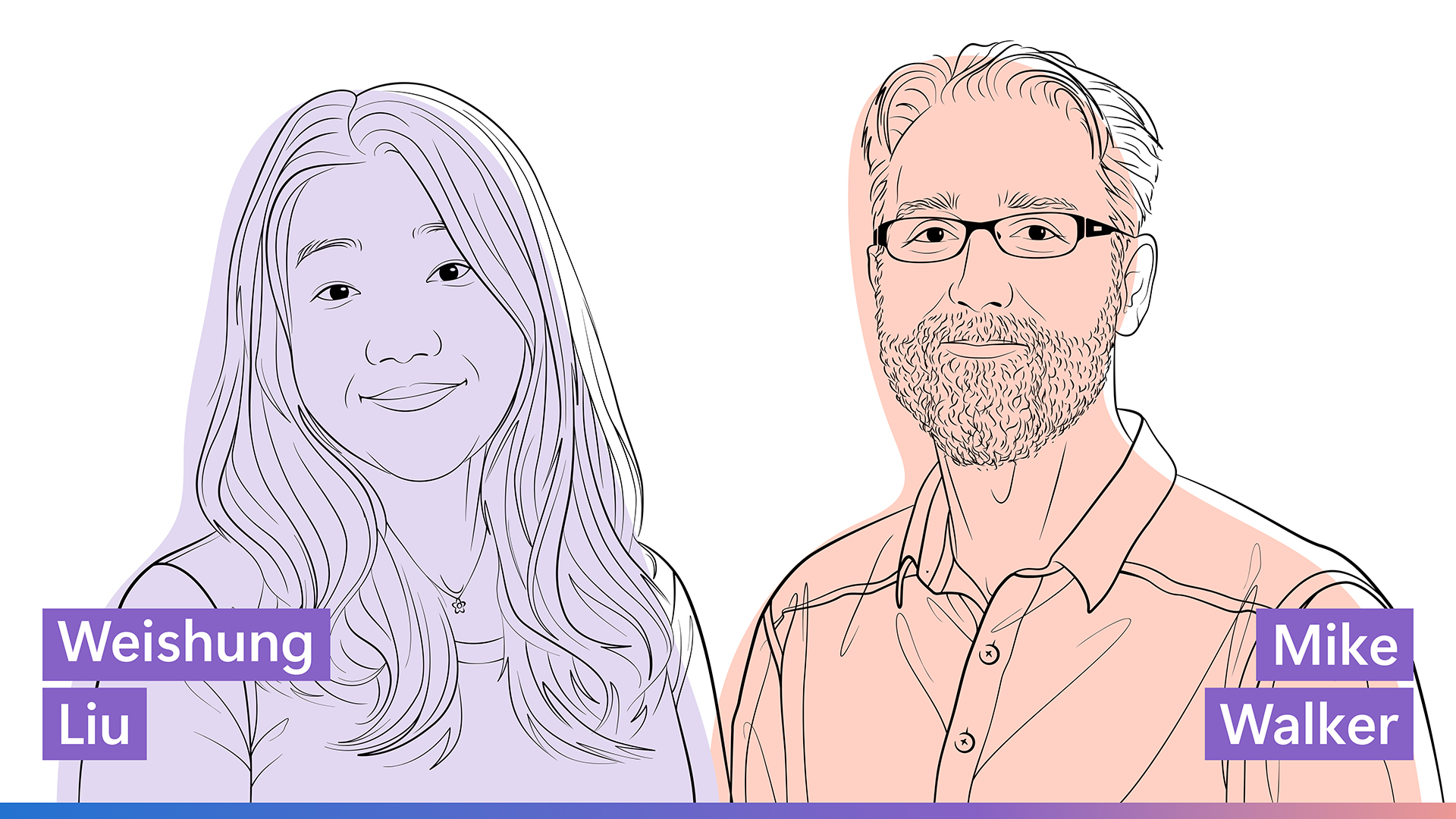
Research Manager Mike Walker reflects on a career spanning hacker culture, cybersecurity, and AI, sharing lessons about trust, teamwork, leadership, and why solving difficult problems requires curiosity, judgment, agility—and an understanding of the rules. The post Learn the rules: The hacker mindset appeared first on Microsoft Research.
Learn how Google Antigravity and our Cheminformatics Skills accelerate drug discovery workflows, search compounds, and propose novel rigidified macrocycles.
MIT News · Artificial Intelligence· news.mit.eduOct 28, 2026
Professor Paris Smaragdis develops computers with superhuman hearing for applications like speech recognition, music understanding, and environmental monitoring.
MIT News · Artificial Intelligence· news.mit.eduOct 27, 2026
Prabha Jha used her experience with MIT Open Learning’s program for senior executives to develop AI solutions for her employer, Verizon, and to write a book.