TERRA: Learning Transportable Latent Actions through Temporal Effect Representation and Relational Alignment
Tianxingjian DingMubarak ShahYu Tian
Oct 2026
Machine LearningComputer VisionRobotics
Abstract
Latent actions supervise robot policies with action-like codes inferred from visual transitions, and their usefulness hinges on two questions: what a code keeps from a transition, and whether it still means the same thing when reused in a different initial state. The first is a tension in time: an endpoint difference discards how motion unfolds, while the full sequence admits nuisance variation. The second is left open by reconstruction, which only ever observes a latent together with the state it came from. We argue that both questions can be answered in the same place. TERRA (Temporal Effect Representation and Relational Alignment) describes a transition by a compact temporal effect, its net feature change together with a low-order within-window dynamics component, and learns a continuous latent from this effect. The same effect space then serves as the reference for reuse: Effect-Anchored Transport (EAT) decodes a latent in other initial states and anchors the resulting effect to the one observed at its source, so that the latent is shaped by what it does across contexts rather than only by the transition it came from. With frozen linear readers, TERRA predicts actions more accurately than UniVLA and a LAPA-style baseline, degrades more slowly under visual distractors, and keeps transported transitions faithful to the donor action as the recipient context moves farther away; a same-budget control shows that these gains come largely from EAT. At matched pretraining scale, the complete system reaches 93.4% average success on LIBERO, compared with 91.8% for UniVLA.
This publication proposes a definition and a classification of agile software development approaches and analyses ten software development methods that can be characterized as being "agile" against the defined criterion.
P. Abrahamsson, O. Salo, Jussi Ronkainen et al.· arXiv.org· 727 citations· ⚡54
The study shows that agile practices improve both informal and formal communication, but indicates that, in larger development situations involving multiple external stakeholders, a mismatch of adequate communication mechanisms can sometimes even hinder the communication.
M. Pikkarainen, Jukka Haikara, O. Salo et al.· Empirical Software Engineeri...· 401 citations· ⚡48
The results indicate that software engineering work practices are chosen opportunistically, adapted and configured to provide value under the constrains imposed by the startup context.
Nicolò Paternoster, Carmine Giardino, M. Unterkalmsteiner et al.· Information and Software Tec...· 394 citations· ⚡54
The possibility of inferring high-dimensional data inference in a model that consists of a prior and an auxiliary differentiable constraint given some additional information is considered, thereby allowing a range of potential applications in adapting models to new domains and tasks.
Alexandros Graikos, Esmeralda S. Whitammer, N. Jojic et al.· Neural Information Processin...· 316 citations· ⚡15
Exploring how generative AI could make machine vision more accessible to businesses. The post GenEye in a Box: Making Machine Vision Something You Can Just Ask For appeared first on GPT-Lab.
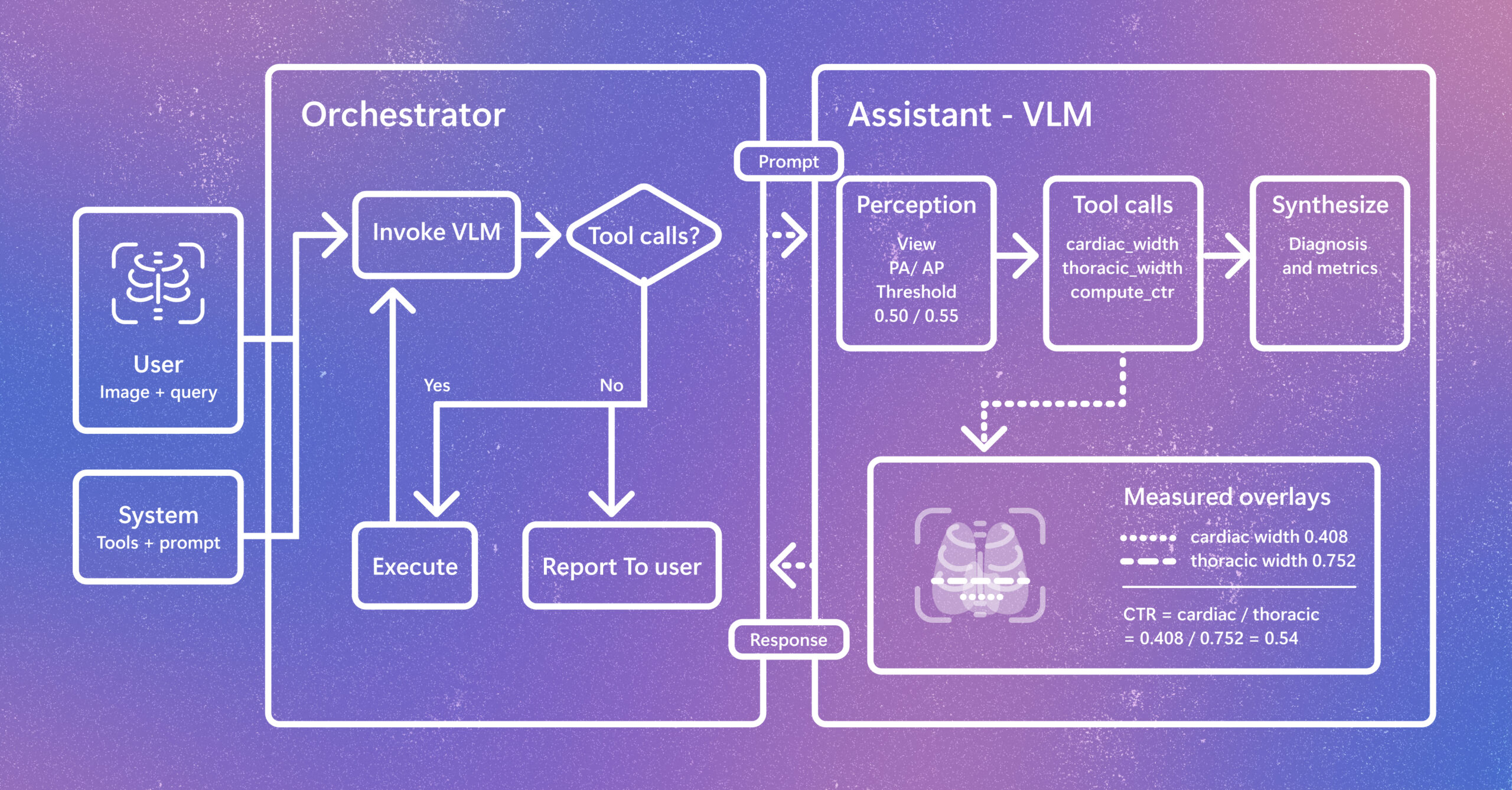
Radiology AI is evolving beyond report generation. CARE-X explores a unified approach that combines flexible reasoning, calibrated predictions, and measurement-based tools for chest X-ray interpretation. The post Introducing CARE-X: Towards Clinically Useful Radiology VLMs with Auxiliary Supervision, Reward-Aligned Learning, and Tool-Augmented Measurement appeared first on Microsoft Research.