Forecasting rare, high-cost events in multivariate time-series systems is hard because their precursors are seldom observed, so a purely data-driven model has little to learn from. The engineers who run these systems, however, hold knowledge that precedes such events, information absent from the scarce labels. We call...
Jonas Petersen, Pratik Jawahar, Riccardo Maggioni et al.· 0 citations
Language model agents increasingly operate over long interaction streams, requiring online adaptation to distribution shifts through continual learning. However, existing agent harnesses typically either evolve their states only through forward information flow or rely on additional replay or validation data for harnes...
Yu-Xin Xiao, Zhi-Yun Lu, Jian-Yu Wang et al.· 0 citations
Efficient autoregressive generation is increasingly limited by the memory footprint of the key-value (KV) cache, which grows linearly with sequence length, batch size, and model depth. Existing approaches such as Multi-Query Attention (MQA), Grouped-Query Attention (GQA), Multi-Head Latent Attention (MLA), and Tensor P...
Bahareh Nikpour, Hossein Rajabzadeh, Maryam Dialameh et al.· 0 citations
The results support pretrained TimesFM as a strong initial forecasting baseline for this building, with XGBoost as a competitive locally fitted alternative as a competitive locally fitted alternative.
A. Vasulkar, S. K. Freire, Arie-Willem de Leeuw et al.· 0 citations
Reach audiences
Advertise in front of researchers, engineers, and readers.
Autoregressive decoding is less suited to non-causally ordered data, e.g., cross-references or future dependencies, since their outputs cannot be revised post hoc, unlike iterative human reasoning. Diffusion LLMs partially mitigate this limitation but still cannot flexibly insert or remove arbitrary numbers of tokens f...
Shu Ishida, Aliasghar Khani, Tianyu Zhang et al.· 0 citations
The goal of circuit discovery is to decompose a monolithic neural network into tiny modular subnetworks which are interpretable in the sense that each does an identifiable subtask. We develop a practical method for composing arbitrarily many circuits into a single model. We propose a greedy, density-scaled composition...
Small language models trained on a single local machine leave little room for architectural trial and error. Kairos combines bidirectional gated-DeltaNet linear attention and sliding-window attention over shared projections (LiZAttention2), block-wise Attention-Residual aggregation, a sparse Mixture-of-Experts (MoE) fe...
Vision-language-action (VLA) models increasingly incorporate intermediate reasoning to improve robotic manipulation, yet existing approaches primarily reason about observed states without explicitly anticipating future scene evolution. Extending such reasoning to explicit future rollouts at every inference step, howeve...
Shenglan Li, Zhendong Mi, Hengyi Zhu et al.· 0 citations
On-policy self-distillation promises to replace the sparse outcome signal of verifiable-reward RL with dense token-level credit: a teacher conditioned on the reference solution scores the student's own rollout, and the resulting distributional shift is distilled back into the policy. We investigate whether this scoring...
Mayug Maniparambil, Ayush Rai, Ekansh Verma et al.· 0 citations
Long-context serving runs out of KV memory before the hardware reaches its useful throughput. HiSparse stores history in host memory and fetches only the selected entries, but it uses one cache budget at every load and does not handle draft-model speculative decoding such as DSpark and DFlash2. We present Adaptive DHiS...
Many machine learning approaches are two-level: an expert selects a class of methods, within this class the choice of key components is critical and usually manual. This paper addresses the automatic tuning of these components and proposes a framework transferable across models of different nature. The multi-agent larg...
Ivan Moloshnikov, Dmitry Kunitsyn, Alexander Sboev et al.· 0 citations
AI systems are making rapid progress in mathematics, but this progress is hard to measure. Benchmarks of solved problems saturate, and in benchmarks of open problems each problem can be resolved for the first time only once. We present SqueezeBench, a benchmark that is resilient to saturation: a success raises the bar...
Pablo Manrique, Hai Xia, Stefan Szeider· 0 citations
Learn how Google DeepMind and GovTech Singapore uses lightweight on-device Gemma models to intercept conversational scams in private chats with zero cloud data egress.
MIT News · Artificial Intelligence· news.mit.eduOct 13, 2026
Machine-learning networks can learn without detailed instructions from a designer. Those that do may offer insight into how the brain reorganizes itself during learning.
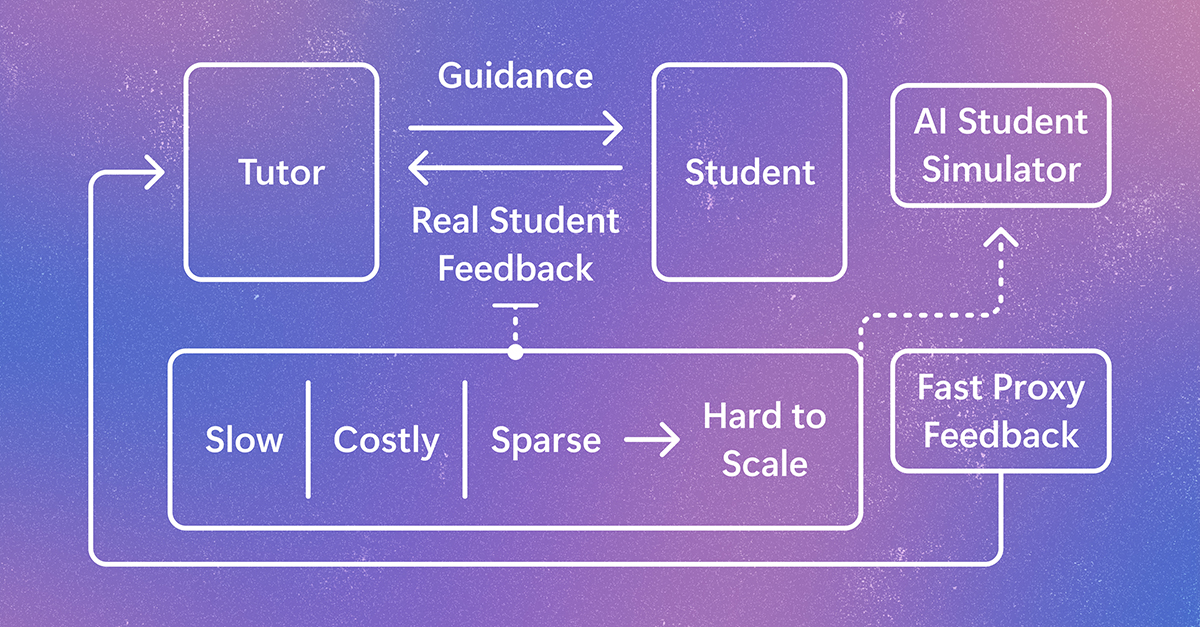
StudentSim is a research system for evaluating and improving AI tutoring tools before they are tested with learners. It models how individuals may engage with tutors, giving feedback to improve tutor performance across subjects like chess, writing, and mathematics. The post Simulating student learning for better AI tutoring appeared first on Microsoft Research.
Exploring how generative AI could make machine vision more accessible to businesses. The post GenEye in a Box: Making Machine Vision Something You Can Just Ask For appeared first on GPT-Lab.
We use cookies to run the site and, with your consent, for analytics and to show ads.
See our Cookie Policy.