Recent AI systems have achieved strong results on a wide range of benchmarks, yet these gains have not translated into economically meaningful deployment across many professional domains. We argue that this gap is largely an evaluation problem: widely used benchmarks lack sustained performance measurement on real and e...
Yiyou Sun, Xinyang Han, Weichen Zhang et al.· 0 citations
Modeling ultra-long user sequences involves a difficult trade-off between efficiency and effectiveness. While current paradigms rely on either item-specific search or item-agnostic compression, we propose UxSID, a framework exploring a third path: semantic-group shared interest memory. By utilizing Semantic IDs (SIDs)...
Hongwei Zhang, Qiqiang Zhong, Junfeng Shu et al.· 0 citations
We introduce FactoryBench, a benchmark for evaluating time-series models and LLMs on machine understanding over industrial robotic telemetry. Q&A pairs are organized along four causal levels (state, intervention, counterfactual, decision) instantiating Pearl's ladder of causation, and span five answer formats: four str...
Yanis Merzouki, Coral Izquierdo, Matei Ignuta-Ciuncanu et al.· 0 citations
Interpreting machine learning model predictions is a central challenge, particularly for black-box vision models. Concept-based attribution methods interpret models using human-understandable concepts. Existing concept-based methods can only interpret classification and regression models. They require access to model w...
Bhanu Tokas, Rahul Nair, Rockwell Jackson et al.· 0 citations
Reach audiences
Advertise in front of researchers, engineers, and readers.
While deep learning models for tabular data have recently received significant research attention, the choice of objective functions for regression tasks remains an understudied degree of freedom. Several lines of research offer alternatives to the standard Mean Squared Error (MSE), but differences in datasets, backbon...
Danil Rudenko, Georgii Bulgakov, Nikolay Kartashev et al.· 0 citations
Production recommender systems have feature-lifecycle asymmetry: adding new features must produce gains on some metric, while feature removal must not regress any metric. In practice, feature deprecation is hard to prioritize as a feature can fail to be removed if it interacts with other features, its importance change...
Vishnu Arun, Adam Obeng, Tianyou Wang et al.· 0 citations
Discrete graph diffusion models (GDMs) corrupt the graph structure by adding noise independently to nodes and edges under a Markovian noise model. In the unconditional setting without node features, an equivariant denoiser trained on a single graph is able to generate novel graphs and sample-level metrics such as edge...
State-space models (SSMs) maintain a fixed-size recurrent state, but reading and writing it at every decoding step can bottleneck hybrid models. This eager state management causes large state I/O with low arithmetic intensity, leaves speculative decoding no cheap rollback, and feeds state quantization error into subseq...
Ze-Wei Liou, Harris Nover, Amey Naik et al.· 0 citations
Low-bit inference on accelerators with native 4-bit support requires quantizing both weights and activations to realize the full throughput gains these formats provide. While post-training weight quantization has been extensively studied, activation quantization remains considerably more challenging and typically requi...
Discrete graph diffusion models corrupt graph structure through independent edge updates with a Markovian noise model. Combined with the exchangeability requirement on the output distribution, the terminal prior is necessarily an Erd\H{o}s--R\'enyi (E-R) random graph. This has a fundamental consequence for unconditiona...
Adarsh Jamadandi, Nicolas Keriven, Aline Roumy· 0 citations
Training long-horizon language model agents requires assigning credit to intermediate decisions from sparse terminal feedback. Within a finite group of sibling rollouts, useful action comparisons depend on their context, evidence for both alternatives, and how that evidence enters learning. We propose Matched-Context G...
Chen-Xu Zhang, Yao-Rui Shi, Wen-Long Zhang et al.· 0 citations
Cooperative multi-agent tasks often impose constraints on a shared objective or collective safety. A team level violation cost function can measure this constraint outcome, but does not distinguish which agents' actions most strongly influence that violation. We present SafeDiSTL, a constrained multi-agent reinforcemen...
Learn how Google DeepMind and GovTech Singapore uses lightweight on-device Gemma models to intercept conversational scams in private chats with zero cloud data egress.
MIT News · Artificial Intelligence· news.mit.eduOct 13, 2026
Machine-learning networks can learn without detailed instructions from a designer. Those that do may offer insight into how the brain reorganizes itself during learning.
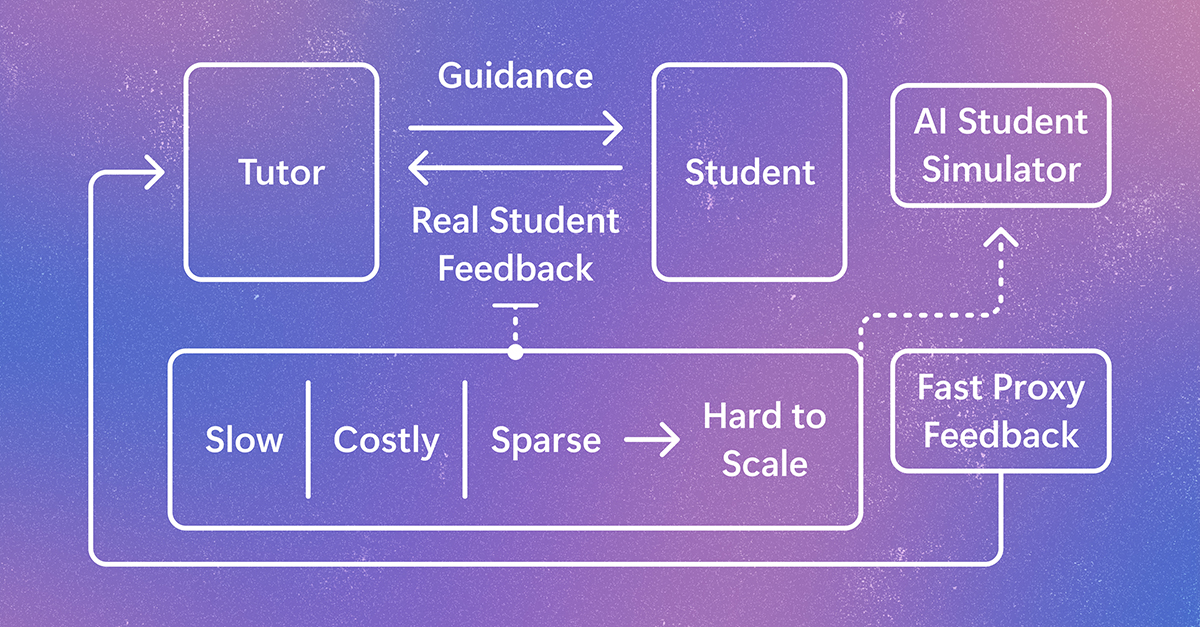
StudentSim is a research system for evaluating and improving AI tutoring tools before they are tested with learners. It models how individuals may engage with tutors, giving feedback to improve tutor performance across subjects like chess, writing, and mathematics. The post Simulating student learning for better AI tutoring appeared first on Microsoft Research.
Exploring how generative AI could make machine vision more accessible to businesses. The post GenEye in a Box: Making Machine Vision Something You Can Just Ask For appeared first on GPT-Lab.
We use cookies to run the site and, with your consent, for analytics and to show ads.
See our Cookie Policy.