Continuous random node features increase the expressivity of message-passing neural networks (MPNNs), but existing theoretical analyses are not fine-grained enough to capture their limitations, particularly in approximating functions across graph sizes or under a fixed number of random bits. We develop a population-lev...
Robert R. Nerem, Mitchell Black, Antonis Vasileiou et al.· 0 citations
Automatic differentiation (AD) is a cornerstone of modern machine learning. Since all AD frameworks implicitly fix a basis of Euclidean space to define gradients and Jacobians, they natively process mathematical objects that are arrays of a fixed set of coordinates. This makes it awkward to express objects such as rota...
Alex Guerra, Joshua Aduol, Yaqian Tang et al.· 0 citations
Machine-learning models for perovskite solar cells are typically evaluated using random data splits, which we show systematically leak information through massive internal duplication. Because nearly two-thirds of curated devices share their exact recipe with another, random splits primarily reward the mere recall of h...
We propose NV-Tesseract-AD, a curriculum learning-enhanced conditional diffusion framework for multivariate time-series anomaly detection. Our central hypothesis is that reconstruction difficulty can be explicitly structured along two complementary axes, masking severity and diffusion noise level, and that training fro...
Aditi Gautam, Manikandan Ravikiran, Saira Qureshi et al.· 0 citations
Reach audiences
Advertise in front of researchers, engineers, and readers.
Parameter-efficient continual learning updates a restricted subset of adapter parameters to incorporate sequential tasks while limiting catastrophic forgetting. Gradient attribution is a common rule for selecting that subset, but it requires an additional backward pass over calibration data. We identify a parameter-poo...
Yu Sun, Junwei Zhou, Zuodong Xiang et al.· 0 citations
We interpret Transformer networks as learned approximations to a hybrid probabilistic-inference procedure that combines max-product Loopy Belief Propagation (LBP) with Expectation--Maximization (EM). In this view, a Transformer performs inference in partially observed Markov Random Fields (MRFs) whose structure and par...
Gradient-based attribution provides input-specific information about model parameters, but computing it via backpropagation for many samples is expensive, while static importance scores discard input dependence. We derive KPSA (Kernelized Parameter Sensitivity Atlas) from a block decomposition of the empirical neural t...
Davide Wiest, Ahanaf Hasan Ariq, Abdul Monaf Chowdhury· 0 citations
Parameter-efficient fine-tuning has hundreds of methods, usually compared by parameter count and benchmark score. We compare them as maps. A pretrained checkpoint is a base point in weight space, and a weight-space method is a smooth map from a small parameter space that starts at that point. These maps form a slice ca...
Xiaoyu Li, Zhizhou Sha, Chiwun Yang et al.· 0 citations
Neural surrogates that forecast a physical field from sparse, noisy sensors read a window of nearby sensors and a history of past snapshots. Practitioners choose both by comparing fitted models with each other. Such comparisons cannot tell a model's shortfall from missing information. We measure the trade-off between w...
Federated Large Language Models (FedLLMs) are promising to deliver privacy-preserving, collaborative intelligence. The decentralized training process is vulnerable to Byzantine attacks that corrupt semantic consistency and factual resilience through malicious model updates. This paper presents a new resilience strategy...
We consider the problem of learning to generate data while satisfying a prescribed \emph{sample-wise} constraint with a user-specified probability of constraint satisfaction. Starting with a population-level constrained negative log-likelihood minimization and using a flow-matching (FM) parameterization, under regulari...
Zhengyan Huan, Peter Y. Lu, Shuchin Aeron· 0 citations
Molecular machine learning evaluates out-of-distribution performance with structure disjoint splits, a construction rule fixed once at the scale its library happened to have: threshold a pairwise distance, then assign whole connected components to folds. For predicting structures from mass spectra, the field has conver...
Tomo Oga, Devesh Shah, Cailum M. K. Stienstra et al.· 0 citations
Learn how Google DeepMind and GovTech Singapore uses lightweight on-device Gemma models to intercept conversational scams in private chats with zero cloud data egress.
MIT News · Artificial Intelligence· news.mit.eduOct 13, 2026
Machine-learning networks can learn without detailed instructions from a designer. Those that do may offer insight into how the brain reorganizes itself during learning.
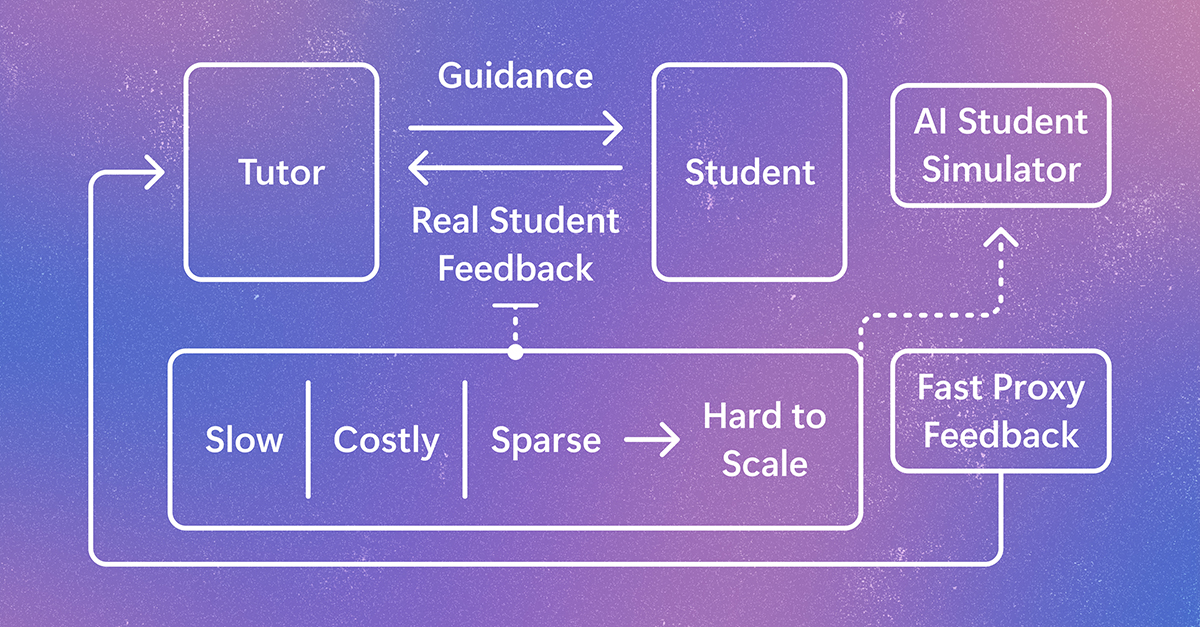
StudentSim is a research system for evaluating and improving AI tutoring tools before they are tested with learners. It models how individuals may engage with tutors, giving feedback to improve tutor performance across subjects like chess, writing, and mathematics. The post Simulating student learning for better AI tutoring appeared first on Microsoft Research.
Exploring how generative AI could make machine vision more accessible to businesses. The post GenEye in a Box: Making Machine Vision Something You Can Just Ask For appeared first on GPT-Lab.
We use cookies to run the site and, with your consent, for analytics and to show ads.
See our Cookie Policy.