Matching repair after utility changes can reuse valid observations, but new evaluations must respect matching capacity and may return out of order. We study announced invalidations with bounded, possibly reward-dependent reporting delays and pending evaluations that do not occupy future matching capacity. Residualload...
He Sun, Junyuan Mao, Wenhao Jiang et al.· 0 citations
Minimax optimization is fundamental to adversarial learning yet suffers from severe stability challenges, often manifesting as persistent limit cycles or divergence. This paper investigates these instabilities through the lens of continuous-time dynamical systems. By modeling training dynamics as a second-order Ordinar...
Tabular foundation models (TFMs) based on prior-data fitted networks typically use sampled hard query labels, leaving avoidable sampling variability in pretraining. A key observation is that intermediate generator states can reveal label uncertainty beyond a sampled outcome. We propose Generator-state-Informed Supervis...
Zhangyang Peng, Jingze Shi, Tongyi Zhang et al.· 0 citations
Federated Direct Preference Optimization (FedDPO) enables privacy-preserving alignment of language models across distributed agents without centralizing sensitive preference data. However, existing FedDPO analysis assumes all clients converge to a single shared policy, which is fundamentally at odds with the heterogene...
Zhan-Hong Jiang, Soumik Sarkar· 0 citations
Reach audiences
Advertise in front of researchers, engineers, and readers.
Accurate estimation of reservoir properties from seismic data remains challenging when well-log labels are sparse but three-dimensional seismic observations are abundant. We present CoGameReg, a cooperative-game-based semi-supervised regression framework that uses contribution-weighted predictions of heterogeneous regr...
Non-autoregressive multi-step forecasting (NAF) enables time series foundation models to predict an entire future horizon in a single forward pass. Despite its strong sequence modeling capabilities, RWKV-7 exhibits long-horizon degradation in our NAF experiments. In this setup, future patches are represented as missing...
Qingwen Lin, Boyan Xu, Shifeng Xie et al.· 0 citations
Existing convergence guarantees for non-log-concave sampling with stochastic gradient Langevin Monte Carlo (SG-LMC) typically assume globally Lipschitz gradients and uniformly bounded noise variance. Both assumptions can fail even in elementary sampling problems, and relaxing them better reflects practical applications...
M. Berk Sahin, Ege C. Kaya, Arda Fazla et al.· 0 citations
In maximum entropy and behavior-constrained reinforcement learning (RL), the optimal policy is given by a Boltzmann distribution. Generating samples from this distribution can be challenging, as it is often complex and multimodal. While flow policies trained with flow matching provide a powerful framework for represent...
Denis Blessing, Onur Celik, Gerhard Neumann· 0 citations
Reasoning post-training draws on offline demonstrations and policy-generated rollouts, yet conventional supervised fine-tuning (SFT) followed by reinforcement learning (RL) separates their objectives and limits continued reuse of collected responses. We propose \textbf{Cross-Behavior Policy Optimization} (CBPO), which...
Du Cheng, Jun-Yu Lu, Jing-Fan Zhang et al.· 0 citations
Outcome-supervised group-relative policy optimization (GRPO) assigns the same advantage to every token in an LLM agent trajectory, leaving useful and unhelpful decisions undifferentiated. Hindsight credit assignment (HCA) can refine this feedback, but its estimates rely on trajectories containing informative alternativ...
Debajoy Mukherjee, Jeremy Carleton, Sushil Vemuri et al.· 0 citations
The shock response spectrum (SRS) characterizes the peak responses of single-degree-of-freedom systems to transient acceleration. Because the mapping from an acceleration time series (waveform) to its SRS is many-to-one, inverse synthesis seeks candidate waveforms consistent with a prescribed spectrum. We extend an ear...
Adam Watts, Charles Young, Ryan Bowering et al.· 0 citations
RDMA can reduce communication overhead in distributed machine learning systems, but realizing these benefits in production requires more than replacing TCP. Variable-size messages, concurrent connections, bursty incasts, and service failures introduce challenges that hardware offload alone cannot address. This paper re...
Yibo Huang, Yi Cui, Yukai Huang et al.· 0 citations
Learn how Google DeepMind and GovTech Singapore uses lightweight on-device Gemma models to intercept conversational scams in private chats with zero cloud data egress.
MIT News · Artificial Intelligence· news.mit.eduOct 13, 2026
Machine-learning networks can learn without detailed instructions from a designer. Those that do may offer insight into how the brain reorganizes itself during learning.
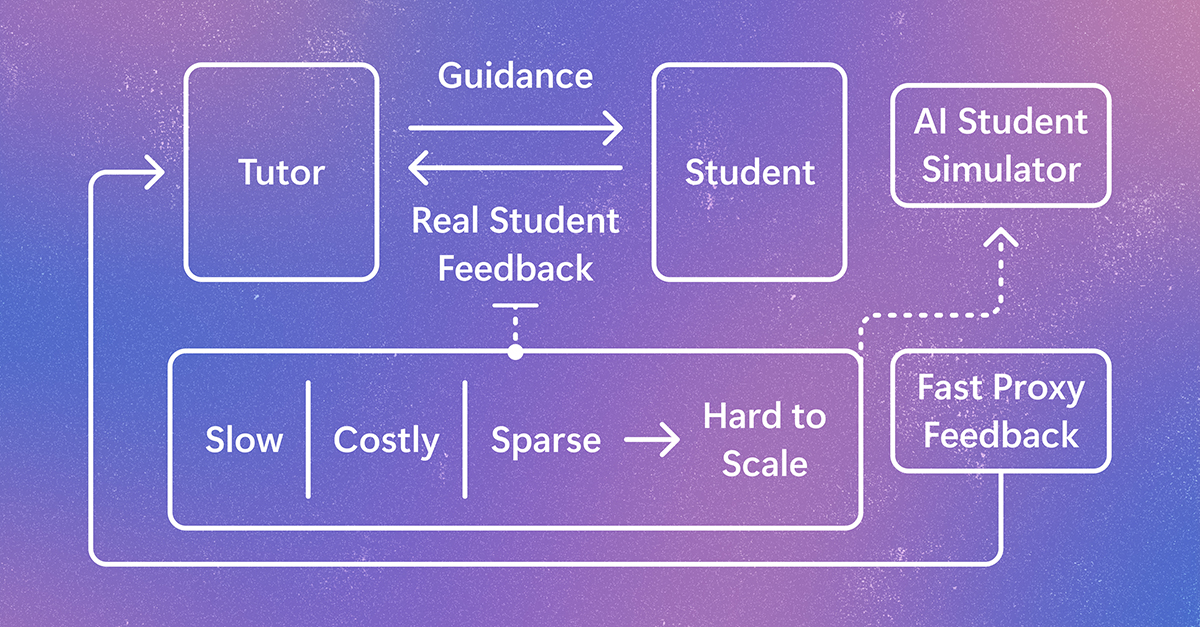
StudentSim is a research system for evaluating and improving AI tutoring tools before they are tested with learners. It models how individuals may engage with tutors, giving feedback to improve tutor performance across subjects like chess, writing, and mathematics. The post Simulating student learning for better AI tutoring appeared first on Microsoft Research.
Exploring how generative AI could make machine vision more accessible to businesses. The post GenEye in a Box: Making Machine Vision Something You Can Just Ask For appeared first on GPT-Lab.
We use cookies to run the site and, with your consent, for analytics and to show ads.
See our Cookie Policy.