DASH is introduced, which supervises the conditional and unconditional branches independently and an anchor term regularises the conditional prediction toward ground-truth noise, and the teacher's final learned per-timestep curriculum transfers into the student as a frozen prior.
A. Shafi, Kazi Saeed Alam, Sk. Imran Hossain et al.· arXiv.org· 1 citation
Focusing on the autonomous driving safety-critical case of pedestrian detection in the dark, it is shown how synthetic low-light samples can be used to better characterize the performance of a state-of-the-art object detection model as a function of the scene illumination.
V. Pais, Malena Mendilaharzu, Daniele Faccio et al.· arXiv.org· 0 citations
This work proposes a VQA-based fine-tuning strategy that trains models to answer structured questions about visual content rather than relying solely on captions or simple instructions, which encourages deeper visual grounding and reasoning.
Tanzila Rahman, Renjie Liao, Leonid Sigal· 0 citations
NanoVDR exploits query--document asymmetry by decoupling the two encoding paths: a frozen 2B VLM teacher indexes documents offline, while a distilled text-only student as small as 69M parameters encodes queries at inference, and the resulting NanoVDR-S-Multi (DistilBERT, 69M) retains 95.1% of teacher quality.
Zhu Liu, Yao Zhang, Yuntian Xiao· arXiv.org· 1 citation
Reach audiences
Advertise in front of researchers, engineers, and readers.
This work proposes DesignAsCode, a novel framework that reimagines graphic design as a programmatic synthesis task using HTML/CSS, incorporating a Plan-Implement-Reflect pipeline, incorporating a Semantic Planner to construct dynamic, variable-depth element hierarchies and a Visual-Aware Reflection mechanism that optim...
The results suggest that explicitly regulating representation geometry is an effective complement to optimization balancing, and provide evidence that geometry-aware regularization can improve multimodal learning across diverse architectures and domains.
Zixuan Xia, Hao Wang, Peng-Cheng Weng et al.· 1 citation
Extensive experiments on MS-COCO across three representative diffusion backbones demonstrate that TPSO substantially improves diversity, boosting performance from 1.10 to 4.18, while maintaining image quality with only a modest inference-time overhead.
Debin Meng, Chen Jin, Zheng Gao et al.· 3 citations
This work investigated geo-biases in a Eurocentric driving dataset (Cityscapes) on the fine-grained localization task of instance segmentation and found that instance segmentation models trained on European driving scenes (Eurocentric models) were geo-biased.
Rahul Nair, Gabriel Tseng, Esther Rolf et al.· 2025 IEEE/CVF Conference on...· 0 citations
CON decomposition is introduced, which quantifies how much of a layer's variance each concept explains given all other concepts and the outcome, and how much none of them explains, yielding layer-comparable, calibrated scores that suppress false positives.
Roshan Prakash, Marco Simnacher, Manuel Pfeuffer et al.· 0 citations
SERUM is the first system to produce interpretable process models from unstructured egocentric screen video without manual annotation, opening a scalable pathway for user modeling and behavioral understanding in the wild.
Andy J. Phu, Karin de Langis, James C Mooney et al.· arXiv.org· 0 citations
The OISD framework is proposed, which improves reasoning by transferring on-policy predictive signals from the final layer to intermediate representations and employs signed advantage-weighted Jensen--Shannon alignment to distill informative intermediate representations while preserving policy consistency under a unifi...
Xin-Yu Liu, Darryl C. Jacob, Yang Zhou et al.· arXiv.org· 0 citations
These results suggest that in diversity-aware multi-armed bandits, e.g., for generative model selection, exploration can arise intrinsically from the objective's geometry, particularly for widely used metrics such as FID and Vendi where tight confidence bounds are difficult to construct.
Exploring how generative AI could make machine vision more accessible to businesses. The post GenEye in a Box: Making Machine Vision Something You Can Just Ask For appeared first on GPT-Lab.
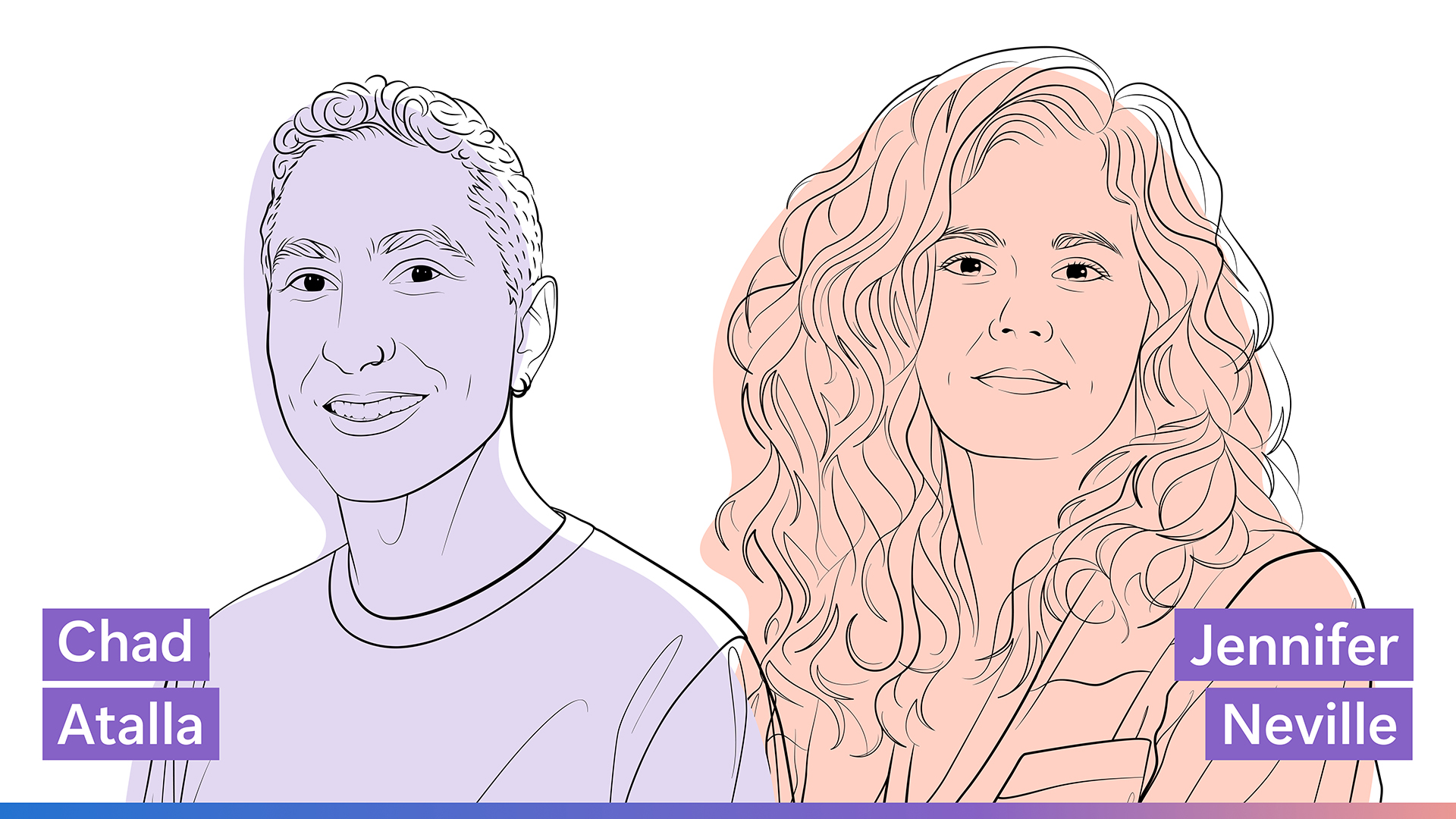
Jennifer Neville did not want to go into computer science—but that’s exactly where she landed. Neville discusses the starts and stops that led to her professional sweet spot and her work identifying “surprising failures” making it hard for AI to handle complexity. The post What AI gets wrong and what failure teaches us appeared first on Microsoft Research.
Computer scientist, entrepreneur, and philanthropist will collaborate with the MIT Schwarzman College of Computing to advance AI and scientific discovery.