From the Hugging Face Hub to robot hardware with Strands Agents and LeRobot
More from the blog
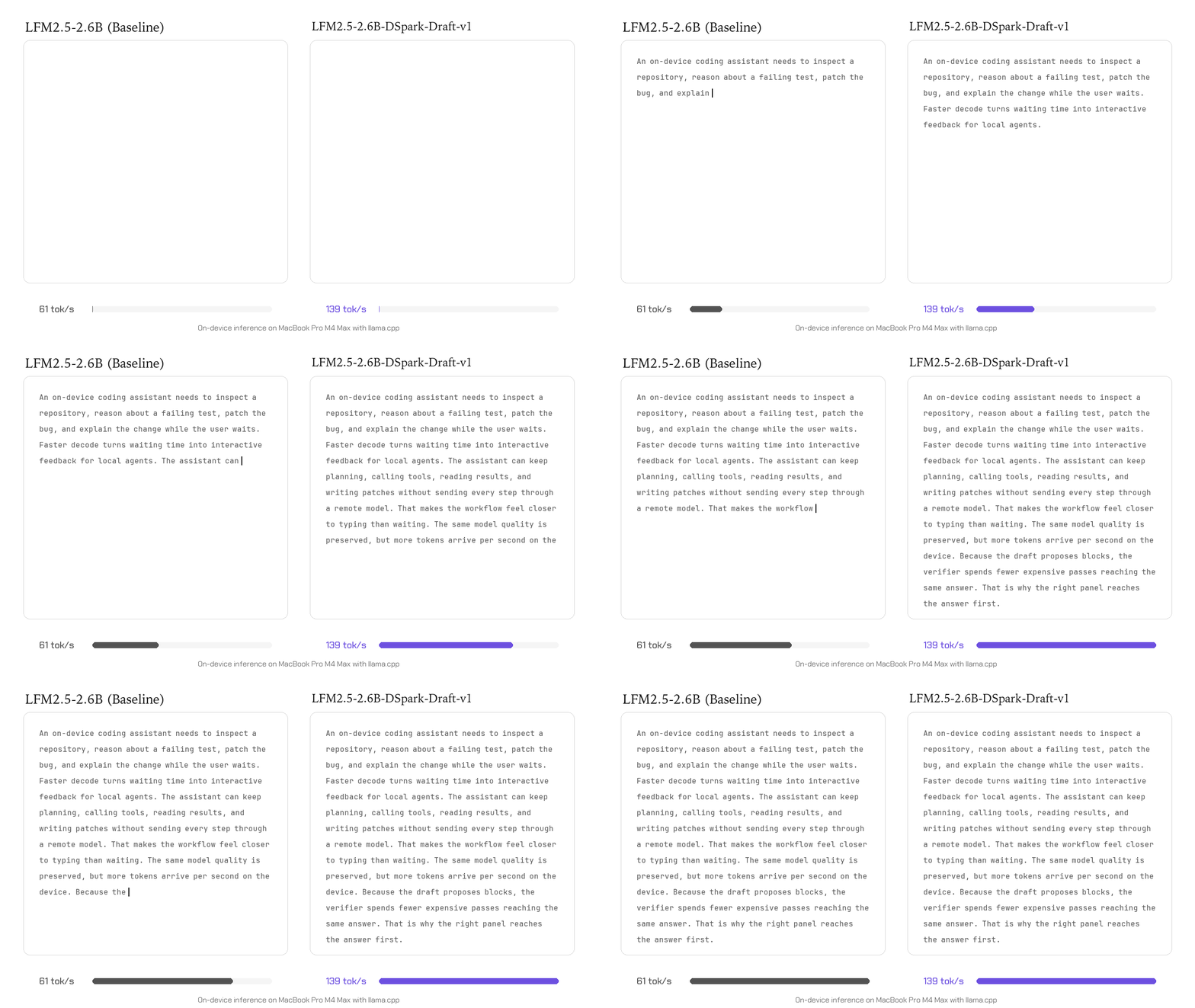
Up to 3.2x Faster Inference with LFM2.5-DSpark
A Blog post by Liquid AI on Hugging Face

How Much Memory Does Your Agent Actually Need?
A Blog post by IBM Research on Hugging Face

Same Cluster, 33 Points More Utilization: What Changed Was the Order
A Blog post by Dharma-AI on Hugging Face
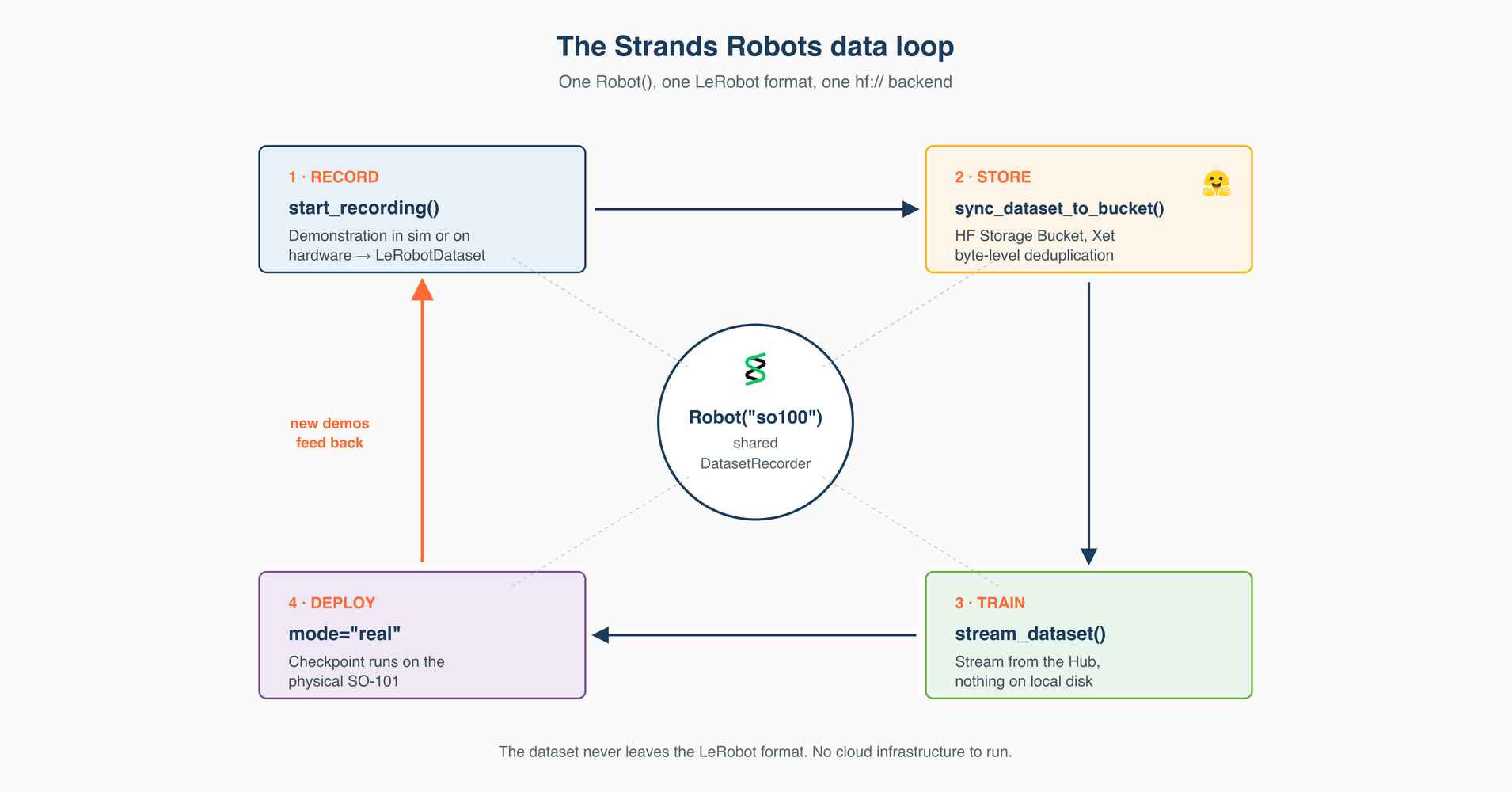
Record, train, and deploy from one place with Strands Agents, LeRobot, and Hugging Face Storage Buckets
A Blog post by Amazon on Hugging Face
Related papers
A Metamorphic Artificial Age Score Decision-Support Prototype for Flight-Log-Based Drone Propeller Health Monitoring
Drone propeller faults can create safety and reliability risks when their effects are distributed across multiple flight-log channels rather than appearing as a single diagnostic signal. This paper proposes a Metamorphic Artificial Age Score (AAS) decision-support prototype for flight-log-based drone propeller health monitoring. Using selected historical real flight logs from the 2024 DronePropA public dataset, the framework computes six health-related indicators from raw MATLAB matrices: trajectory tracking error, attitude instability, thrust-command burden, motor-command imbalance, ESC-command instability, and battery-level stress. These indicators are normalized relative to a healthy baseline and evaluated through candidate scoring policies, metamorphic adequacy relations, and a redundancy-adjusted AAS formulation. In this context, AAS is used as a structural policy-adequacy and burden measure rather than as a chronological age measure. A controlled retrospective evaluation was performed using one healthy baseline and three defective propeller cases under the same speed profile and trajectory. The healthy case was assigned to routine monitoring. The Severity 1 case was dominated by ESC-command instability and assigned to maintenance review. The Severity 2 case reached maximum motor-command and ESC-command burden, while the Severity 3 case reached maximum trajectory tracking error; both triggered mandatory inspection. The results show that propeller fault effects may appear through different operational channels, supporting the need for a multi-indicator decision-support layer for post-flight maintenance prioritization and autonomous-system oversight.
GigaBrain-WBC-0.5: A Behavior World Model for Robust Whole-Body Control with Environment Interaction
GigaBrain-WBC-0.5, the first Behavior World Model for humanoid whole-body control, is presented, which trains a causal Transformer to jointly predict its next action, next state, and the distribution over its next latent behavior command, so the network that acts also models how the environment shapes what it can do next.
The Role of Grid Cells in Reducing Spatial Aliasing in Hippocampal Place Representations
Spatial aliasing occurs when two or more distinct locations produce highly similar place-cell representations, primarily due to environmental symmetry or repetitive structures. This issue is most pronounced when place representations are constructed solely from boundary vector cell (BVC) inputs, because symmetric or repetitive structures can yield indistinguishable sensory patterns across multiple locations in an environment. This work introduces grid cell signals to mitigate spatial aliasing in such settings. Because grid cells contribute periodic, internally generated spatial signals that vary independently of environmental geometry, they play a key role in disambiguating perceptually identical locations. We integrate multiple modules of analytically constructed grid cells with BVC-driven place cells and show that this leads to a 94--99% reduction in spatial aliasing relative to a BVC-only baseline across three environments: an open environment without obstacles; an environment with a cross-shaped central obstacle creating high visual symmetry; and a maze environment. The greatest improvement occurs in the environment with the highest visual symmetry. These results indicate that grid cells provide information complementary to boundary-based inputs, yielding more reliable place representations in geometrically ambiguous environments.
Orienteering Problem with Uncertain Time-Varying Rewards: Framework and Benchmark for Everyday Service Robotics
We present the orienteering problem with uncertain time-varying rewards (OP-UTVR), a novel variant of the orienteering problem (OP). While most existing OP formulations assume rewards to be known in advance, practical applications involve uncertain and time-varying rewards, as with shifting customer demand for delivery agents. OP-UTVR relaxes this assumption by allowing agents to estimate reward dynamics from observations and forecast future rewards. This enables informed routing decisions despite stochastic reward changes and inevitable prediction errors. We address this problem using three planners that differ in planning horizon and online adaptivity, and derive theoretical bounds on their performance under reward stochasticity. We further introduce a mobile service robot benchmark for OP-UTVR, where a robot navigates among pedestrians in indoor environments. Experiments reveal trade-offs between planning horizon and adaptivity, and demonstrate the effectiveness of long-horizon planning with online adaptation.