Skip to content
#gene editing Open access

Molecular Scissors With a Search Bar: A Contemporary Synthesis Review of CRISPR and the Editing of the Genome

Sep 2026 · Zenodo (CERN European Organization for Nuclear Research)
CRISPR and Genetic Engineering

Abstract

This article presents a narrative review of CRISPR and the Editing of the Genome in the context of Biology. The literature on this topic has expanded substantially over recent decades, yet it remains fragmented across subfields, methods, and national research traditions. Drawing on an interpretive synthesis of representative contributions, the review reconstructs the historical development of the area, examines the conceptual foundations and definitional disputes that organize its debates, and maps the contemporary landscape of research, including the methodological shift toward data-intensive approaches and the institutional pressures that shape publication practice. Particular attention is given to the role of CRISPR and gene editing as organizing themes, and to the conditions under which findings from different research traditions can be brought into productive comparison. The review identifies three synthetic conclusions: the literature is cumulatively strong but organizationally weak; methodological pluralism is better understood as a resource than as a defect; and the growing practical salience of the topic raises the stakes of its unresolved conceptual questions. An agenda for future work is proposed, emphasizing integrative research designs, transparent synthesis practices, and the protection of definitional and infrastructural work on which cumulative progress depends. The article is intended as both a reference map for newcomers and a provocation for specialists in Biology.

View source

Similar papers

#computer vision Conference Aug 2008

A Preliminary Roadmap for Empirical Research on Agile Software Development

Some claim that especially in the field of agile software development the research lags years behind of the practice. In this paper, we characterize the status and main challenges for research on agile software development, and propose a preliminary roadmap, focusing on providing more empirical research, primarily on e...

Torgeir Dingsøyr, T. Dybå, P. Abrahamsson · 92 citations · ⚡7
#computer vision Book Open access Mar 2017

On the Unhappiness of Software Developers

The results indicate that software developers are a slightly happy population, but the need for limiting the unhappiness of developers remains, and 219 factors representing causes of unhappiness while developing software are identified.

D. Graziotin, Fabian Fagerholm, Xiaofeng Wang et al. · 84 citations · ⚡6
#computer vision Open access Feb 2018

Lean Internal Startups for Software Product Innovation in Large Companies: Enablers and Inhibitors

This study investigates how Lean internal startup facilitates software product innovation in large companies and identifies its enablers and inhibitors, and shows the potential of the method-in-action framework to investigate the Lean startup approach in non-startup context.

Henry Edison, Nina M. Smørsgård, Xiaofeng Wang et al. · 78 citations · ⚡6
#computer vision Review Apr 2024

AI-powered Code Review with LLMs: Early Results

The goal is to not only refine the accuracy of the LLM-based tool but also to underscore its potential in streamlining the software development lifecycle through proactive code improvement and education.

Z. Rasheed, Malik Abdul Sami, Muhammad Waseem et al. · 62 citations · ⚡3
#computer vision Conference Aug 2008

Scrum in a Multiproject Environment: An Ethnographically-Inspired Case Study on the Adoption Challenges

Agile methods continue to gain popularity. In particular, the Scrum method appears to be on the verge of becoming a de-facto standard in the industry, leading the so called Agile movement. While there are success stories and recommendations, there is little scientifically valid evidence of the challenges in the adoptio...

A. Marchenko, P. Abrahamsson · 59 citations · ⚡11

Related blog posts

Microsoft Research Blog Nov 5, 2026

Formally verifying agent-written full-stack web apps with PDD Kit

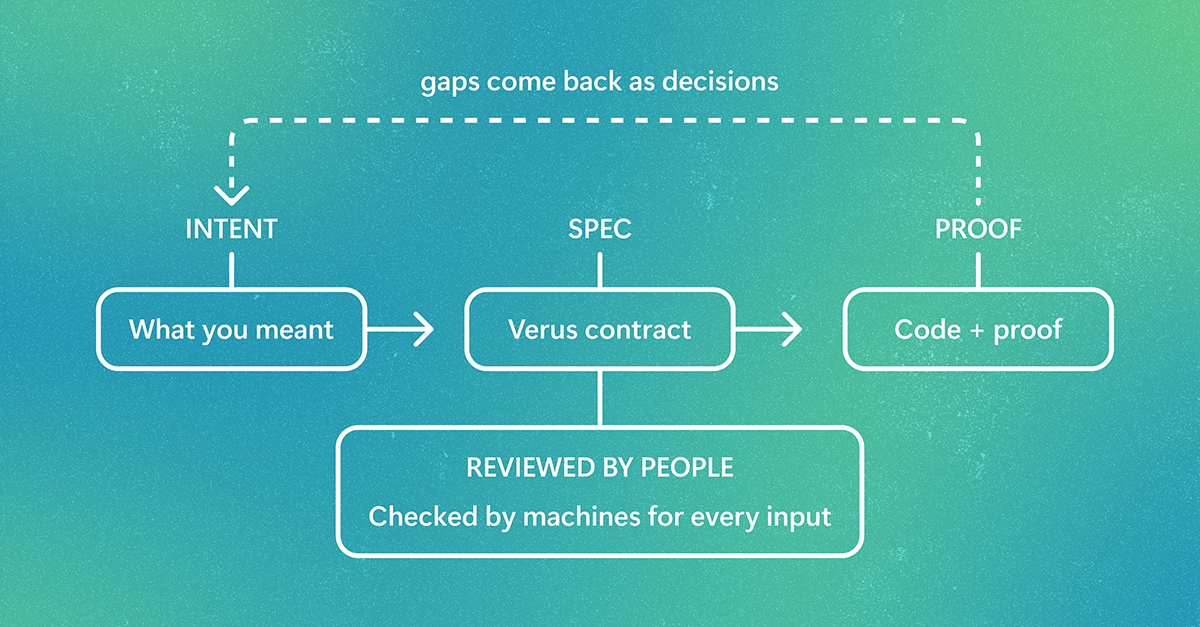
AI agents can generate code at a scale that’s hard for humans to review line-by-line. PDD Kit helps ensure the code is doing what the developer intended by creating formal specifications and testing against them. It converts developer intent into a Verus specification, proves AI-generated code meets it for every input, and uses tests where proofs aren't practical. Developers review intent, not every line. The post Formally verifying agent-written full-stack web apps with PDD Kit appeared first o…

Microsoft Research Blog Oct 29, 2026

Microsoft Research Focus – Edition #97

Host Sowbhagya Suresh shares some of the latest news and cutting-edge research from across Microsoft—from understanding the challenges facing coding agents to uncovering how people use AI at work and improving extended-range weather forecasting. The post Microsoft Research Focus – Edition #97 appeared first on Microsoft Research.

We use cookies to run the site and, with your consent, for analytics and to show ads. See our Cookie Policy.