
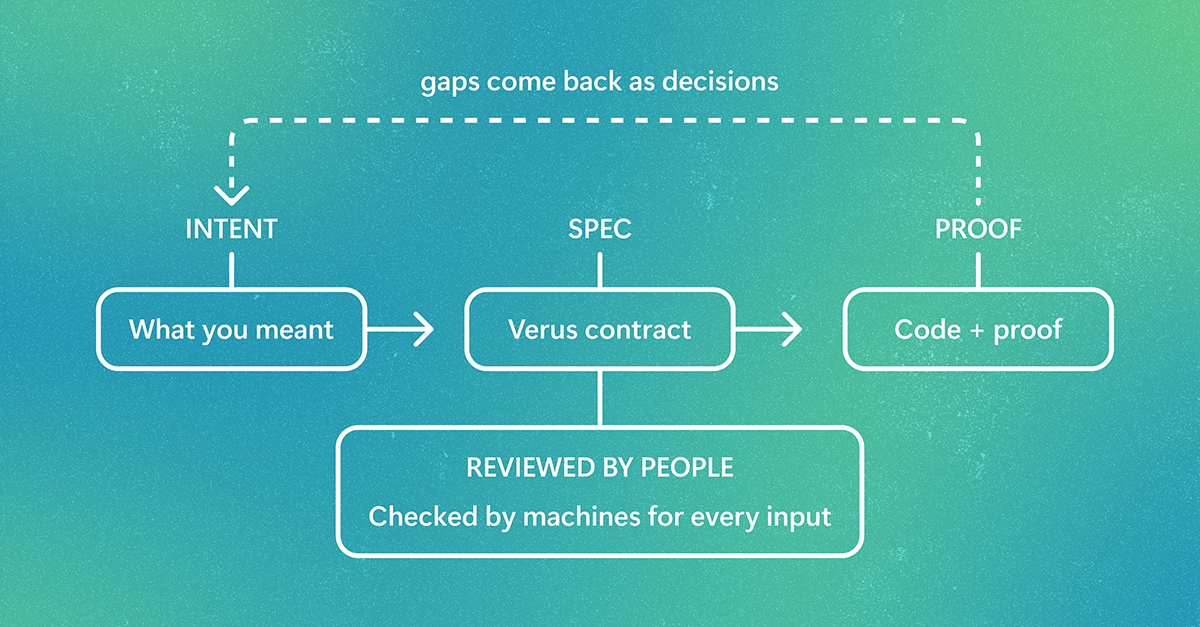
Formally verifying agent-written full-stack web apps with PDD Kit
AI agents can generate code at a scale that’s hard for humans to review line-by-line. PDD Kit helps ensure the code is doing what the developer intended by creating formal specifications and testing against them. It converts developer intent into a Verus specification, proves AI-generated code meets it for every input, and uses tests where proofs aren't practical. Developers review intent, not every line. The post Formally verifying agent-written full-stack web apps with PDD Kit appeared first o…
More from the blog
Agentic cheminformatics with Google Antigravity
Learn how Google Antigravity and our Cheminformatics Skills accelerate drug discovery workflows, search compounds, and propose novel rigidified macrocycles.

From synthetic enterprise data evaluations to real Microsoft Copilot AI confidence
Evaluating Microsoft Copilot at enterprise scale requires test data that captures the full complexity of real organizations, yet real enterprise data contains sensitive information that cannot be used for evaluation under any circumstances. The post From synthetic enterprise data evaluations to real Microsoft Copilot AI confidence appeared first on Microsoft Research.

 GPT-Lab
· gpt-lab.eu
Oct 30, 2026
Black October? The Week AI Changed the Cybersecurity Conversation
Critical flaws, compromised release channels and agentic AI threats landed within days of each other in mid-October 2026. Why “Black October” may say more about how well we now find weaknesses than about the attacks themselves. The post Black October? The Week AI Changed the Cybersecurity Conversation appeared first on GPT-Lab.

Microsoft Research Focus – Edition #97
Host Sowbhagya Suresh shares some of the latest news and cutting-edge research from across Microsoft—from understanding the challenges facing coding agents to uncovering how people use AI at work and improving extended-range weather forecasting. The post Microsoft Research Focus – Edition #97 appeared first on Microsoft Research.
Related papers
AI-powered Code Review with LLMs: Early Results
The goal is to not only refine the accuracy of the LLM-based tool but also to underscore its potential in streamlining the software development lifecycle through proactive code improvement and education.
Can Large Language Models Serve as Data Analysts? A Multi-Agent Assisted Approach for Qualitative Data Analysis
The proposed LLM-based multi-agent system automates qualitative data analysis process, creating opportunities for researchers and practitioners, and future improvements focus on enhancing multilingual performance and integrating continuous expert feedback.
Large Language Model Evaluation Via Multi AI Agents: Preliminary results
A novel multi-agent AI model is introduced that aims to assess and compare the performance of various LLMs, and initial results indicate that the GPT-3.5 Turbo model's performance is comparatively better than the other models.
A Multiple Case Study of Artificial Intelligent System Development in Industry
This investigation revealed different types of AI systems and different AI development approaches, but it is common that business opportunities involving with AI systems are not validated and there is lack of business-driven metrics that guide the development ofAI systems.