Nov 2026· Proceedings of the 3rd Workshop on Trusted Computing and Artificial Intelligence applied to Cybersecurity· 0 citations· 6 references
TL;DR
It is argued that reproducibility should be treated as a security property for code-defined hardware, firmware, and software artifacts, and this claim is evaluated in the Field-Programmable Gate Array (FPGA) setting.
Abstract
Hardware Security Modules (HSMs), secure elements, and Root of Trusts (RoTs) protect cryptographic operations and secrets, but their hardware artifacts and implementation flows are often difficult to verify independently. This paper argues that reproducibility should be treated as a security property for code-defined hardware, firmware, and software artifacts, and evaluates this claim in the Field-Programmable Gate Array (FPGA) setting. We present a minimal FPGA-based HSM building block composed of a RISC-V processor, a coherent-sampling oscillator True Random Number Generator (TRNG), and a hardware Secure Hash Algorithm (SHA)-256 module. The design is instantiated with VexRiscv and Ibex to assess portability across open RISC-V control cores. A Nix flake pins the hardware-generation, verification, synthesis-input, and firmware dependencies, enabling auditors to rebuild the generated Register-Transfer Level (RTL), reproduce the OpenTRNG verification workflow, execute firmware-level tests, and validate the SHA-256 module through known-answer tests. The result is a reproducible and auditable FPGA-based security substrate whose guarantees hold up to the explicit synthesis boundary, where proprietary vendor tooling remains a residual trust assumption.

Software piracy and reverse engineering cause significant damage to intellectual property: the commercial value of unlicensed software installed worldwide has been estimated at over USD 46 billion. Traditional protection methods rely on static encryption keys or on obfuscation, and they are not resistant to modern anal...
Z. Kozhakhmet, A. Myrzatay, Alissa Ryzhova et al.· Scientific Journal of Astana...· 0 citations
Dynamic-language virtual machines store compiled functions as garbage-collected heap objects, yet embedded and field-programmable gate array (FPGA) integrity mechanisms check code only at load time or ignore whether memory holds live code. picoStella, a proof-of-concept FPGA-targeted virtual machine, reauthenticates li...
Elmin Marevac, E. Kadušić, Nataša Živić et al.· Electronics· 0 citations
This work focuses on detecting (low-level) vulnerabilities in masked FPGA designs through experimental and tool-assisted evaluation and shows how to formally abstract, unveil, and mitigate such leakages, thereby enabling a security-aware FPGA design flow that spans from the behavioral to the physical level.
Nicolai Müller, Daniel Lammers, Simon Osterheider et al.· IACR Transactions on Cryptog...· 0 citations
The growing deployment of Internet of Things (IoT) devices, embedded systems, and hardware security platforms has increased the demand for lightweight cryptographic architectures capable of delivering strong security under stringent area and power constraints. Although the Advanced Encryption Standard (AES) is widely a...
M. M. Hasan, Raisa Ahmed, Md. Tawfiq Amin et al.· Discover Electronics· 0 citations
Secure firmware updates are critical for embedded and Internet of Things (IoT) devices, as any failure during the update process can render the system permanently unavailable. Existing secure boot solutions often depend on dedicated hardware security modules or offer only limited recovery mechanisms, which are impracti...
Duc-Tho Mai, Manh-Thang Nguyen, Van-Phuc Dang et al.· REV Journal on Electronics a...· 0 citations
This work presents an open-source, reproducible RTL implementation and evaluates three architectures under identical conditions at 256 and 512 bits, using neither DSP blocks nor BRAM, and finds Architecture B is the stronger option for resource-rich platforms where speed comes first.
N. Glazyrina, Nikita Nakonechnyy, R. Ibrayev et al.· Electronics· 0 citations
Related blog posts
Microsoft Research Blog· microsoft.comNov 12, 2026
What's new in research at Microsoft? Host Anson Ho explores the latest, including AI-powered universal translation, a breakthrough in a 31-year-old mathematics challenge, and advances making AI coding agents faster and more efficient. The post Microsoft Research Focus – Edition #98 appeared first on Microsoft Research.
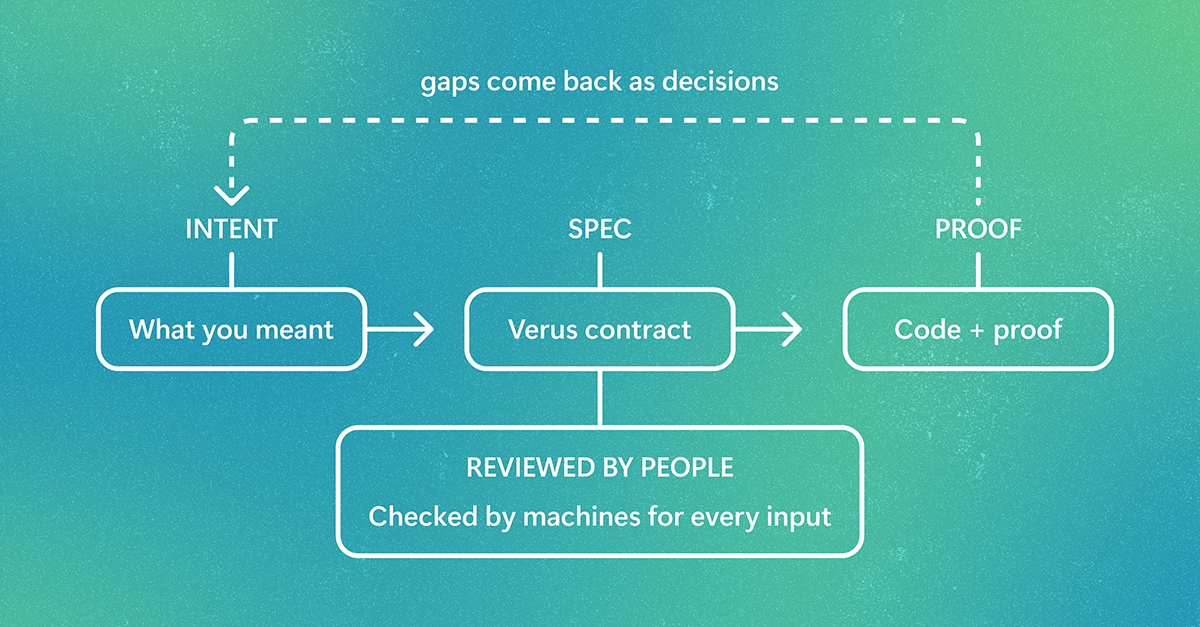
AI agents can generate code at a scale that’s hard for humans to review line-by-line. PDD Kit helps ensure the code is doing what the developer intended by creating formal specifications and testing against them. It converts developer intent into a Verus specification, proves AI-generated code meets it for every input, and uses tests where proofs aren't practical. Developers review intent, not every line. The post Formally verifying agent-written full-stack web apps with PDD Kit appeared first o…