Commercial language model APIs return only text, allowing a provider to cut costs by quietly routing a fraction of user requests to a cheaper substitute model while billing for the advertised one. Detecting such partial substitution is challenging because honest providers also alter the output distribution through undocumented decoding and serving choices, such as temperature scaling, sampling truncation, repetition and presence penalties, and default system prompts, forcing an audit to test against a composite null of legitimate configurations rather than a single reference. Our key insight is that these legitimate variations primarily shift response typicality across the entire batch, whereas partial substitution injects individual responses that remain anomalous under the claimed model. Building on this, we introduce API-TAIL, a typicality audit that first absorbs batch-level shifts by aligning a single effective temperature to center standardized surprisal scores across the audited batch, and then flags the endpoint if the number of remaining tail responses exceeds a threshold calibrated across legitimate configurations. Evaluated on real-world API responses and constructed substitution mixtures, API-TAIL controls false alarms across diverse honest providers and detects low-rate partial substitution with a small query budget. Under a common composite calibration, it outperforms the adapted rank- and MMD-based audit baselines.
Supporting data, adapters, predictions and code for the article *Low-Cost LoRA Fine-Tuning of Small Language Models for Multi-Step Arithmetic Reasoning* by Jake O'Grady, Asena Isik Gürhan, Chee Fong Ting and Effirul Ramlan (University of Galway). We generated 20,000 GSM8K-derived arithmetic problems with step-by-step s...
O'Grady, Jake, Gürhan, Asena Isik, Chee, Fong Ting et al.· Zenodo (CERN European Organi...· 465 citations
The results are packaged in the Greenfield Startup Model (GSM), which explains the priority of startups to release the product as quickly as possible, and the need to shorten time-to-market, by speeding up the development through low-precision engineering activities.
Carmine Giardino, Nicolò Paternoster, M. Unterkalmsteiner et al.· IEEE Transactions on Softwar...· 178 citations· ⚡14
Software startup companies develop innovative, software-intensive products within limited timeframes and with few resources, searching for sustainable and scalable business models.
M. Unterkalmsteiner, P. Abrahamsson, Xiaofeng Wang et al.· e-Informatica Software Engin...· 157 citations· ⚡17
This study conducts a case survey study based on the secondary data of the major pivots happened in 49 software startups, and demonstrates that customer need pivot is the most common among all pivot types.
Sohaib Shahid Bajwa, Xiaofeng Wang, Anh Nguyen-Duc et al.· Empirical Software Engineeri...· 127 citations· ⚡15
The comparison of adopter and non-adopter sample reveals three potential adoption inhibitor, security, data privacy, and portability, which underlines the importance of the technical and security perspectives for research investigating the adoption of technology.
Nattakarn Phaphoom, Xiaofeng Wang, S. Samuel et al.· Journal of Systems and Softw...· 111 citations· ⚡8
Objective There is dearth of information on the timeliness of antenatal care (ANC) uptake. This study aimed to determine the timely ANC uptake by a medically trained provider (MTP) as per the World Health Organization (WHO) recommendations and the country guideline. Methods Cross-sectional survey was done with 2,731 wo...
B. Sarker, Musfikur Rahman, T. Rahman et al.· PLoS ONE· 89 citations· ⚡7
Related blog posts
Microsoft Research Blog· microsoft.comNov 16, 2026
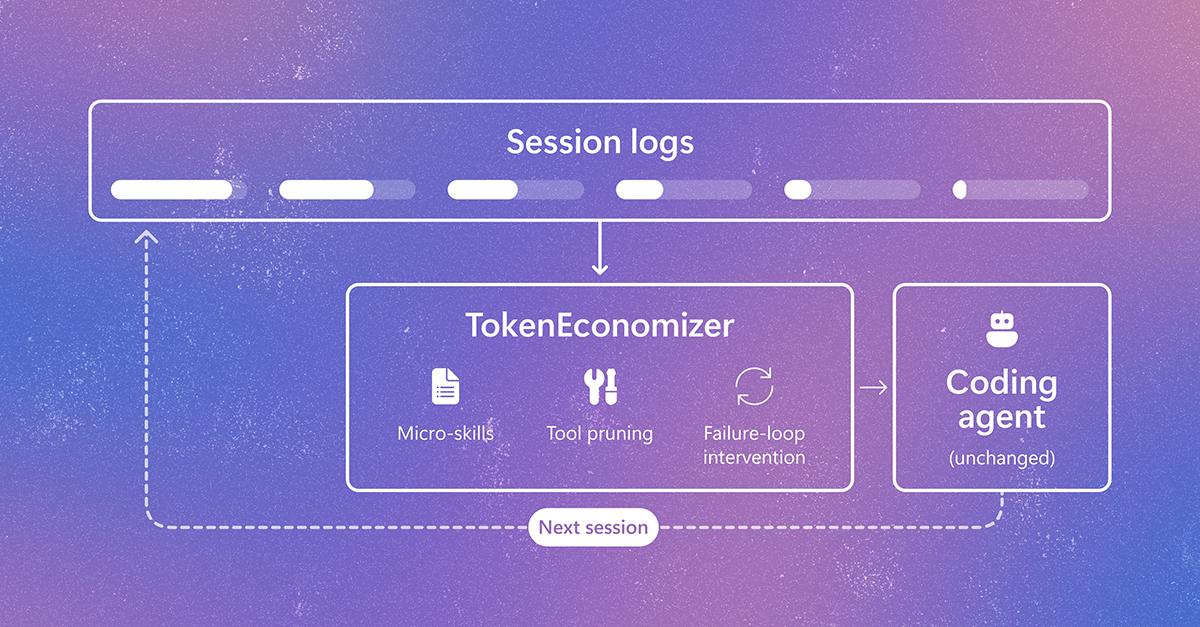
AI coding agents are increasingly help developers fix bugs and build features largely on their own, but every interaction with their models consumes tokens. In each session, an agent sends instructions, tool descriptions, and session history to its model. Most efforts to reduce this cost focus on individual tasks. Yet developers return to the same […] The post TokenEconomizer: Learning from Experience to Make AI Coding Agents More Efficient appeared first on Microsoft Research.
MIT scientists developed a training method to generate models that simulate the effects of human activities on climate much more quickly than other approaches.
We use cookies to run the site and, with your consent, for analytics and to show ads.
See our Cookie Policy.