May 2015· Journal of Systems and Software· Vol 103, pp. 167-181· 111 citations· ⚡ 8 influential· 81 references
Computer ScienceBusiness
TL;DR
The comparison of adopter and non-adopter sample reveals three potential adoption inhibitor, security, data privacy, and portability, which underlines the importance of the technical and security perspectives for research investigating the adoption of technology.
Abstract
In the context of cloud computing, risks associated with underlying technologies, risks involving service models and outsourcing, and enterprise readiness have been recognized as potential barriers for the adoption. To accelerate cloud adoption, the concrete barriers negatively influencing the adoption decision need to be identified. Our study aims at understanding the impact of technical and security-related barriers on the organizational decision to adopt the cloud. We analyzed data collected through a web survey of 352 individuals working for enterprises consisting of decision makers as well as employees from other levels within an organization. The comparison of adopter and non-adopter sample reveals three potential adoption inhibitor, security, data privacy, and portability. The result from our logistic regression analysis confirms the criticality of the security concern, which results in an up to 26-fold increase in the non-adoption likelihood. Our study underlines the importance of the technical and security perspectives for research investigating the adoption of technology.
The paper uses the technology–organization–environment (TOE) framework to investigate the determinants of cloud adoption intention among firms operating in the upstream oil and gas industry. The issues of security, regulatory uncertainty, and trust deficit continue to delay cloud implementation despite the clear benefits offered by cloud computing technology. Survey data were collected from 190 credentialed information technology professionals and decision makers drawn from the Society of Petroleum Engineers and the LinkedIn Upstream Oil & Gas professional community. Multiple linear regression and factor analysis were employed to test three composite technology–organization–environment predictors against behavioral adoption intention. The final model accounted for 49.8% of variance in adoption intention (F(3, 186) = 63.535, p < .001, Adj. R2 = .498). Notably, environmental trust, fostered by confidence in cloud providers and regulatory clarity, emerged as the most influential factor, encouraging a sense of security and optimism about digital transformation.
Moses Osareme Bernard, Sukhen Dey· International Journal of Clo...· 0 citations
Examination of critical factors influencing cloud computing adoption using a framework based on technological, organizational, and environmental dimensions indicates that cloud computing improves scalability, resource utilization, collaboration, business continuity, and decision-making while reducing operational and maintenance costs.
Priya Kapoor· International Journal of Inn...· 0 citations
This study examined the factors hindering the adoption of cloud computing in selected Higher Learning Institutions in Tanzania. The study was guided by the Technology–Organization–Environment (TOE) framework and the Technology Acceptance Model (TAM). A quantitative research approach employing a descriptive research design was adopted. Data were collected using structured questionnaires from 56 teaching and non-teaching staff with Information and Communication Technology (ICT) backgrounds drawn from the Tanzania Institute of Accountancy (TIA), Institute of Accountancy Arusha (IAA), and Institute of Finance Management (IFM). The collected data were analyzed using descriptive statistics and multiple regression analysis with the Statistical Package for Social Sciences (SPSS) version 25. The findings revealed that technology readiness had a positive and statistically significant influence on cloud computing adoption, indicating that institutional technological preparedness is the most important determinant of adoption. The study concludes that strengthening technology readiness through improved ICT infrastructure, institutional capacity, and technical competencies is essential for accelerating cloud computing adoption in Tanzanian Higher Learning Institutions. The study recommends increased investment in ICT infrastructure, continuous staff capacity building, the development of supportive national cloud computing policies, and stronger collaboration between higher learning institutions and cloud service providers to facilitate successful digital transformation.
Thomson Sanga· Journal of Policy and Develo...· 0 citations
The present research investigates the factors associating with the adoption rate cloud computing among employees working in the three different sectors IT services, Finance and Manufacturing located in Andhra Pradesh, India. The study applied the random sampling technique on sample size ${N} = {1 9 8}$ adopting the technology acceptance model (TAM) with its extended version prepared by (Davis et al., 1989, Venkatesh & Davis, 2000). The study adopted multi statistical approach including Regression, heatmap, SEM, dendrogram and PCA Biplot analysis. The result demonstrates a rebust model $(\mathrm{C F I}={0. 9 9 3}; \mathrm{R M S E A}={0. 0 3 2})$ high lighting factors such as perceived benefits as the primary drivers under behavioral intention while the factors such as perceived riosks and costs have been evaluated as the primary barriers for adoption intention of cloud computing technologies. The model successfully explained $60.5\%$ of behavioral intention variance with $83.4\%$ of actual usage variance. While the principal component analysis showed nuance with respect to the intention – usage gap. Highlighting even with high intention scores the usage remains heavily low with relation to the industry background. This research provides multi-dimensional approach on the adoption intention and shows how Andhra Pradesh is should shift its focus on value demonstration and risk mitigation including industry specific concerns in order to increase the effective integration of the adoption rate of cloud computing technologies in firms.
Anu Priya George, N. Subash, Valantina Stephen et al.· International Conference on...· 0 citations
This research aims to explore the impact of various factors on the adoption and application of big data in small and medium-sized enterprises (SMEs) operating in the service sector in the Hashemite Kingdom of Jordan. The research employs a quantitative analytical methodology, grounded in the theory of technology, organization, and environment. The research aims, firstly, to assess the impact of various technical, organizational, and environmental factors on the adoption and use of big data, and secondly, to explore the moderating role of information quality. The research population comprises Jordanian SMEs operating in the service sector. This study was conducted with the participation of the company's managers and executives, and included a sample of 271 individuals. A questionnaire was used to collect the required data, which was then analyzed using the SmartPLS structural equation modeling technique. According to the study's findings, several technical, organizational, and environmental factors positively influence big data implementation processes. Furthermore, the study revealed a significant moderating effect of information quality. In other words, the study concluded that the successful adoption of big data by SMEs is possible if there is integration between the various dimensions of the TOE framework and information quality, particularly in the areas of management and organization. This will contribute to raising the efficiency of the Jordanian services sector and enhancing its competitiveness.
Unknown authors· International Journal of Adv...· 0 citations
Cloud-based accounting platforms such as Zoho Books have become increasingly common among small and medium enterprises (SMEs) seeking affordable, scalable, and automated financial management tools. Businesses moving from manual bookkeeping or legacy on-premise systems frequently encounter data-migration difficulties, staff resistance, limited digital and financial literacy, integration gaps, data-security and vendor-trust concerns, subscription cost pressure, and statutory compliance demands such as India's Goods and Services Tax (GST) regime. This chapter adopts a descriptive, literature-based research design, synthesising the Technology Acceptance Model (TAM), the Unified Theory of Acceptance and Use of Technology (UTAUT), the Technology-Organisation-Environment (TOE) framework, Diffusion of Innovation (DOI) theory, and the Model of Innovation Resistance (MIR), alongside more than two dozen empirical studies on cloud accounting adoption across India, Southeast Asia, South Asia, the Middle East, Europe, and East Asia. A thematic analysis across ten challenge categories is presented, supported by comparative tables benchmarking Zoho Books against alternative platforms. The chapter concludes that successful adaptation depends less on the platform's technical capability and more on organisational readiness, staff training, financial literacy, trust, and structured change management sustained beyond initial implementation.
A. P, Ramya Hp· International journal of res...· 0 citations
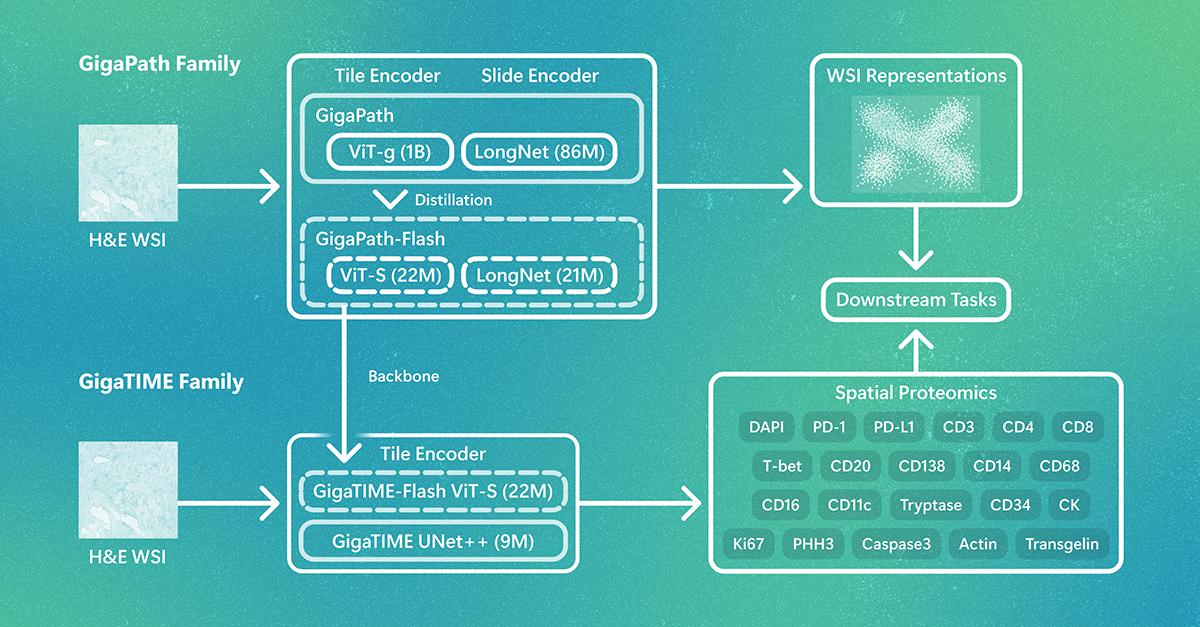
What if pathology foundation models could do more with less? GigaPath-Flash and GigaTIME-Flash cut computational demands while maintaining strong performance, opening the door to larger studies and broader exploration. The post GigaPath-Flash and GigaTIME-Flash: Toward population-scale discovery with efficient pathology foundation models appeared first on Microsoft Research.