LiTEN achieves state-of-the-art accuracy on standard benchmarks, consistently outperforming leading approaches in both precision and speed, and enables comprehensive modeling tasks, ranging from geometry optimization to free energy surface construction, with high computational efficiency for large biomolecules.
Abstract
Accurate atomistic biomolecular simulations are vital for understanding disease mechanisms and drug discovery, yet existing methods struggle to balance quantum-mechanical accuracy with computational scalability. Classical force fields often lack precision, while quantum methods are computationally prohibitive for complex biological systems. Here we show that LiTEN, a scalable equivariant neural network, resolves this dilemma by efficiently modeling complex three- and four-body interactions with linear complexity via Linearly Tensorized Quadrangle Attention. We introduce LiTEN-FF, a foundation model pre-trained on extensive datasets to ensure broad chemical generalization across diverse molecular spaces. We demonstrate that LiTEN achieves state-of-the-art accuracy on standard benchmarks, consistently outperforming leading approaches in both precision and speed. Furthermore, LiTEN-FF enables comprehensive modeling tasks, ranging from geometry optimization to free energy surface construction, with high computational efficiency for large biomolecules. This framework provides a physically grounded, versatile foundation for advanced biomolecular modeling and drug design applications.
By delineating how physics-based priors synergize with data-driven representation learning, this review provides a comprehensive roadmap for generating physically plausible and thermodynamically stable therapeutics, ultimately accelerating the transition of computationally designed molecules from in silico blueprints to viable clinical candidates.
Hao-Bo Xie, Hao Wang, Xiao-Jun Yao et al.· The Innovation Drug Discover...· 0 citations
GeoNet is a physicochemical-principle-guided framework for modeling dual-range atomic interactions that achieves the smallest model size and the shortest training time, demonstrating both superior predictive performance and computational efficiency.
This work presents a hybrid fragmentation-based approach, FragQMMM, that enables efficient and accurate force evaluation for large molecular systems, and successfully reproduces the hydrogen-bond network and preserving the underlying structure-activity relationship.
R. Han, Zonghua Bo, Jiawei Yan· Journal of Chemical Theory a...· 0 citations
The results demonstrate that the mPINN architecture functions as a reliable, physics-constrained ML framework capable of delivering high-fidelity trajectory predictions for complex multi-body molecular systems.
T. Muther, Vuong Van Pham, A. K. Dahaghi· Machine Learning: Science an...· 0 citations
Scoring biomolecular complexes is central to structure assessment and drug discovery, yet the complexes themselves vary widely in pose, size, and molecular composition. A scoring function tuned for one interaction type rarely carries over to another, and most existing methods compound the problem by leaning heavily on task-specific labels. We introduce OmniScore, a universal structure-based framework that learns a shared geometry-aware representation of complexes once and then adapts it to downstream scoring through lightweight task-specific heads. OmniScore couples a graph view and a sequence view of each structure, encodes its three-dimensional geometry, and compresses representations into a compact latent space that a reconstruction module and prediction heads can reuse. We pretrain this backbone on diverse datasets including complexes, monomers, and small molecules with complementary objectives: coordinate recovery, correcting corrupted input tokens, predicting molecular identity, and grounding the representation in structure-level physical quantities. Across the evaluated benchmarks, OmniScore gave the best antibody-antigen and nanobody-antigen quality assessment on all reported metrics compared to state-of-the-art baselines. Its frozen residue embeddings matched the state-of-the-art protein-tokenization method with an average functional-site accuracy of 71.8% on a standard residue-level benchmark. On protein-ligand scoring and ranking benchmarks, it performed on par with methods built specifically for that single task. These results suggest that geometry-aware pretraining can provide a reusable scoring backbone for tasks that depend on interfacial and residue-level structure, within the evaluated settings.
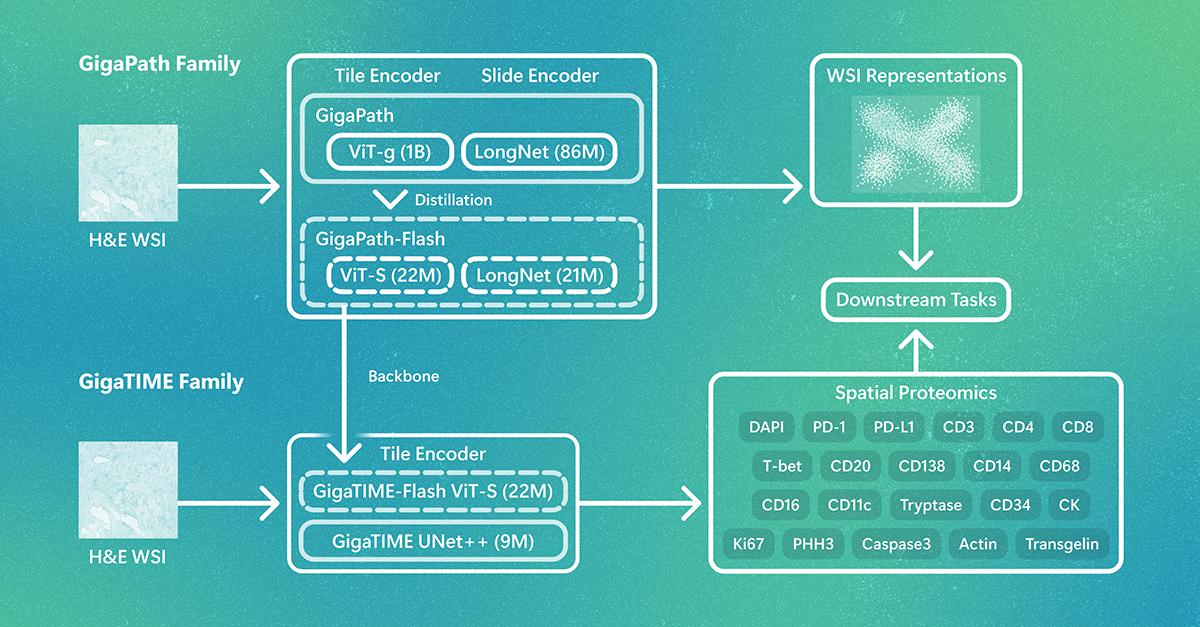
What if pathology foundation models could do more with less? GigaPath-Flash and GigaTIME-Flash cut computational demands while maintaining strong performance, opening the door to larger studies and broader exploration. The post GigaPath-Flash and GigaTIME-Flash: Toward population-scale discovery with efficient pathology foundation models appeared first on Microsoft Research.
We use cookies to run the site and, with your consent, for analytics and to show ads.
See our Cookie Policy.