With the rise of large language models, agentic systems are becoming increasingly autonomous, as they write code, call tools, revise prompts, and propose modifications to their own components. This autonomy raises a fundamental question for safe self-improvement: can an automated gate like a reward model or an automated reviewer reliably decide whether a proposed update should be accepted? The difficulty is structural. The gate must be a terminating, computable procedure, while the property we ultimately care about, namely whether an update is a genuine semantic improvement, depends on potentially unbounded program behavior. We formalize this mismatch by modeling agents as programs and defining improvement in terms of a semantic score that need not be computable. We study two evaluation abstractions. The first is a certifier that approves or rejects an update. The second is a search procedure that, given access to a proposal generator, attempts to output some improving candidate if one exists. We show that, in the fully general setting, no terminating procedure can simultaneously guarantee reliability (never accepting a non-improvement) and non-conservatism (never missing an available improvement): self-referential constructions can force any such gate or searcher to fail. Randomized gates with bounded error face the same limit. We then identify a standard decidable regime used in practice (bounded evaluation and a finite proposal budget) under which exhaustive simulation yields a terminating search procedure with the desired guarantees. We also show the limit of this recovery: a chain of accepted updates can raise the bounded score in every round while the true score falls. Our results draw a boundary between unbounded, universal settings where correctness guarantees collapse and bounded settings where they can be recovered by design.

This paper investigates developing real-world perception for active agents, proposes Gibson Environment for this purpose, and showcases a set of perceptual tasks learned therein.
F. Xia, Amir Zamir, Zhi-Yang He et al.· 2018 IEEE/CVF Conference on...· 1,069 citations· ⚡112
This publication proposes a definition and a classification of agile software development approaches and analyses ten software development methods that can be characterized as being "agile" against the defined criterion.
P. Abrahamsson, O. Salo, Jussi Ronkainen et al.· arXiv.org· 727 citations· ⚡54
The results indicate that software engineering work practices are chosen opportunistically, adapted and configured to provide value under the constrains imposed by the startup context.
Nicolò Paternoster, Carmine Giardino, M. Unterkalmsteiner et al.· Information and Software Tec...· 394 citations· ⚡54
The possibility of inferring high-dimensional data inference in a model that consists of a prior and an auxiliary differentiable constraint given some additional information is considered, thereby allowing a range of potential applications in adapting models to new domains and tasks.
Alexandros Graikos, Esmeralda S. Whitammer, N. Jojic et al.· Neural Information Processin...· 316 citations· ⚡15
It is proved that any global minimizer of the trajectory balance objective can define a policy that samples exactly from the target distribution, and empirically demonstrate the benefits of the trajectories balance objective for GFlowNet convergence, diversity of generated samples, and robustness to long action sequenc...
Esmeralda S. Whitammer, Moksh Jain, Emmanuel Bengio et al.· Neural Information Processin...· 302 citations· ⚡60
Consequences of happiness and unhappiness that are beneficial and detrimental for developers' mental well-being, the software development process, and the produced artifacts are found.
D. Graziotin, Fabian Fagerholm, Xiaofeng Wang et al.· Journal of Systems and Softw...· 236 citations· ⚡13
Machine-learning networks can learn without detailed instructions from a designer. Those that do may offer insight into how the brain reorganizes itself during learning.
MIT News · Artificial Intelligence· news.mit.eduSep 29, 2026
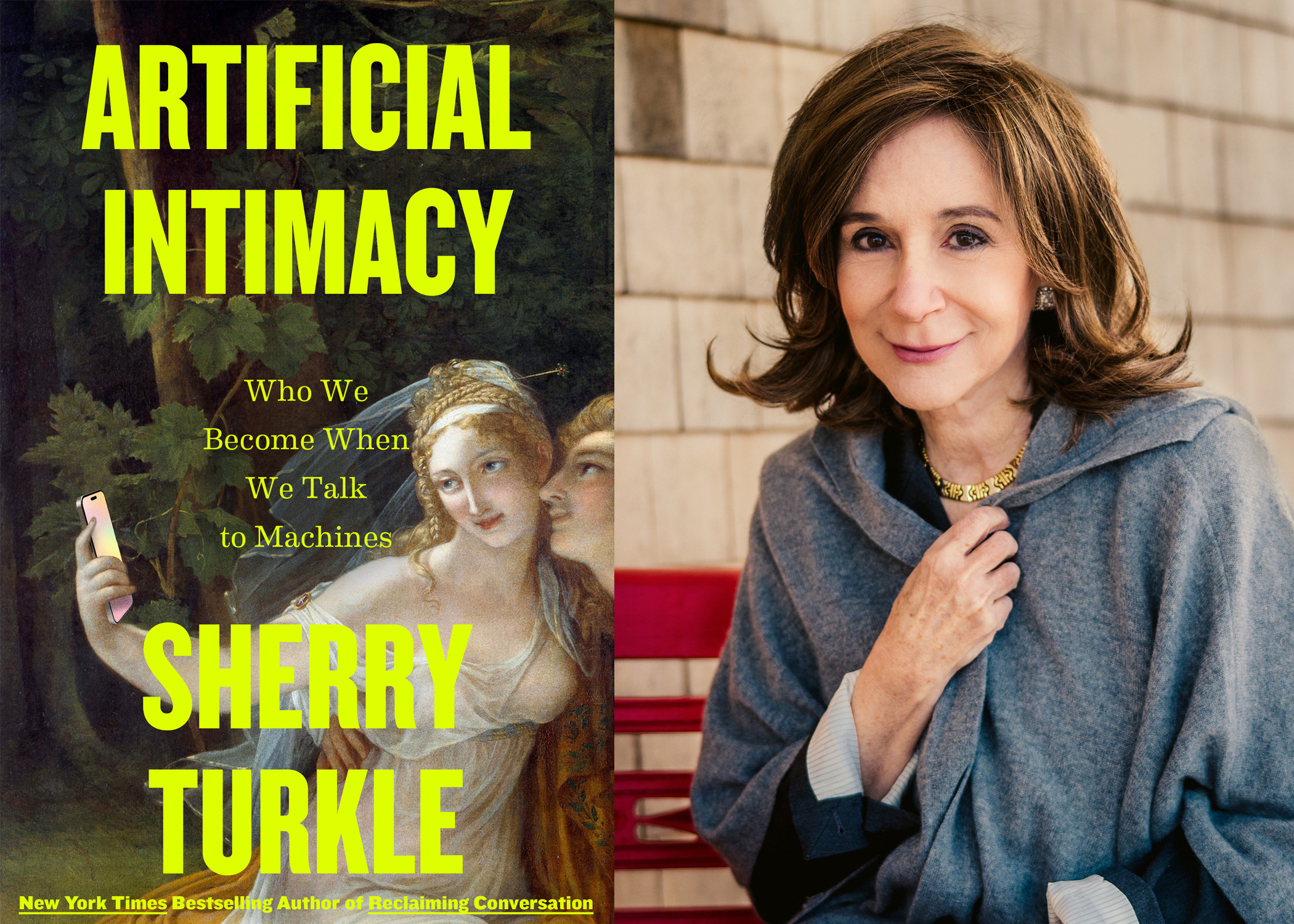
Professor Sherry Turkle’s new book, “Artificial Intimacy,” offers a withering critique of chatbots and the antisocial dynamics she believes they encourage.