Robotic manipulation policies trained via imitation learning, such as Action Chunking with Transformers (ACT), can achieve strong performance under ideal conditions but often remain sensitive to small execution errors and distribution shifts. Correcting these failures typically requires dataset aggregation and full-policy retraining, which is computationally expensive and unsuitable for real-time deployment. In this work, we propose Online Residual Policy Adaptation (ORPA), a framework that enables immediate, feedback-driven correction of robot actions without modifying the underlying policy parameters. ORPA augments a pretrained control policy with a lightweight, feedback-conditioned module that predicts residual adjustments directly in joint space, allowing the system to adapt its behavior at runtime. We evaluate ORPA on a set of precision-sensitive manipulation tasks using the ALOHA platform, demonstrating improvements in success rate and recovery from small perturbations compared to baseline control policies and rule-based inverse kinematics corrections.
This survey reviews representative Transformer-based autonomous driving models and organizes them by task role, sensing configuration, and architectural design and analyzes how efficiency constraints reshaping model design choices in practice affects deployability, robustness, and safety.
IntentVLA is introduced, a history-conditioned VLA framework that encodes recent visual observations into a compact short-horizon intent representation and uses it to condition chunk generation and improves rollout stability and outperforms strong VLA baselines.
Shijie Lian, Bin Yu, Xiaopeng Lin et al.· arXiv.org· 6 citations
The results clearly demonstrate that FlowCorrect learns from very few demonstrations and enables fast, sample-efficient, incremental, human-in-the-loop corrections of generative visuomotor policies at deployment time in real-world robotics.
Edgar Welte, Yitian Shi, R. Wolf et al.· arXiv.org· 4 citations
It is found that current models often generate visually coherent videos, but struggle with constraint reasoning, counterfactual grounding, physical interaction, and unsafe-instruction suppression, and results show that visual quality and surface-level instruction following are insufficient for trustworthy robotic video world modeling.
Huiqiong Li, Jia-Yu Wang, Zhiting Mei et al.· arXiv.org· 4 citations
A real-time semantic navigation framework for Unmanned Aerial Vehicles (UAVs) focused on improving time efficiency in the Object Goal Navigation (ObjectNav) task, using a Large Language Model that interprets user-provided natural language instructions and performs semantic reasoning over detected objects and spatial context to prioritize high-probability search regions.
Marin Maletic, Marijana Peti, T. Petrović et al.· European Conference on Mobil...· 3 citations
Experiments on simulated and real-world benchmarks demonstrate that SCALE improves state-of-the-art VLAs and outperforms existing TTS methods while maintaining single-pass efficiency.
Hyeonbeom Choi, Daechul Ahn, Youhan Lee et al.· arXiv.org· 3 citations
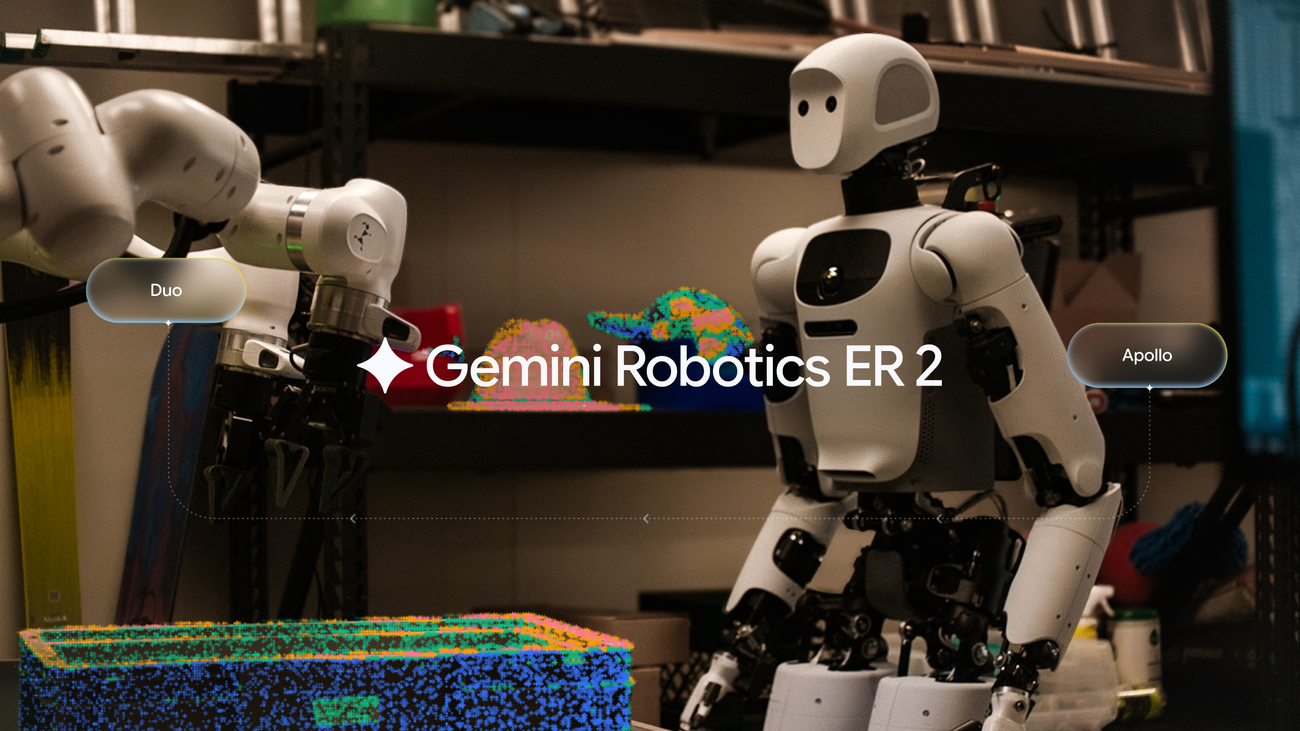
Gemini Robotics ER 2 helps robots reason, collaborate, and solve real-world tasks. It represents a step change in video understanding, tool orchestration, and multi-robot collaboration for robotic applications.
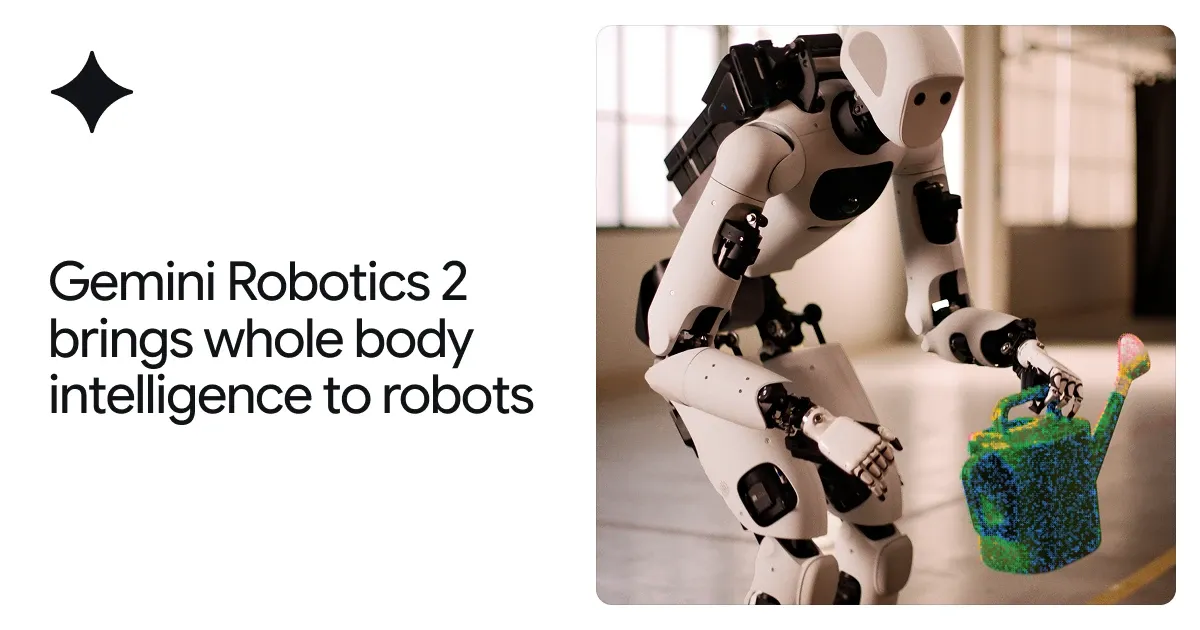
From feet to fingertips — we are teaching robots intelligent whole-body control, fine dexterity, and teamwork to complete a broad range of complex tasks.
We use cookies to run the site and, with your consent, for analytics and to show ads.
See our Cookie Policy.