Skip to content

GraphLLM4CTR: Large Language Model-Enhanced Graph Neural Networks for Click-through Rate Prediction in Recommender Systems

Oct 2026 · ACM Transactions on Knowledge Discovery from Data · 0 citations · 96 references
Recommender Systems and Techniques

Abstract

Click-through rate (CTR) prediction is a crucial task to estimate the probability that users will click on items in online platforms. Recently, researchers have incorporated semantics derived from large language models (LLMs) into representations of users and items in graph neural networks (GNNs) framework to facilitate CTR prediction. However, existing hybrid GNNs-LLMs models predominantly treat GNNs and LLMs as two independent components, and suffer from the ineffective modality alignment between graph and textual representations. To address these issues, we propose LLMs-enhanced GNNs for CTR prediction (GraphLLM4CTR), where LLMs coordinate message passing in GNNs by infusing layer-wise semantics into message updates and graph representation learning. Specifically, we design a multi-view contrastive alignment (MVCA) method to transform graph and prompt-based embeddings into modality-aware representations and achieve modality alignment through intra-view and inter-view contrastive learning. Moreover, we propose a LLMs-based message coordinator (LBMC) that projects graph representations into an aligned latent space and incorporates LLMs with learnable adapters to regulate semantic-injected graph representation learning. Subsequently, we present a hybrid-expert mechanism with gating networks to adaptively aggregate representations for CTR prediction. Experiments conducted on three public datasets (i.e., MovieLens-1M, BookCrossing, and Amazon-Sports) demonstrate the superiority of GraphLLM4CTR over state-of-the-art baselines in terms of AUC and Logloss, and validate the adaptability of MVCA to topological properties and of LBMC to text qualities, and the dynamic balance of the hybrid-expert mechanism. Finally, we conduct analysis of space and time complexity, and computational efficiency of GraphLLM4CTR during training and inference stages, which indicates that GraphLLM4CTR can achieve the optimal AUC-latency trade-off and a linear scalability with the number of nodes and of edges in constructed graphs.
Read PDF

Similar papers

#computer vision Conference Aug 2008

Scrum in a Multiproject Environment: An Ethnographically-Inspired Case Study on the Adoption Challenges

Agile methods continue to gain popularity. In particular, the Scrum method appears to be on the verge of becoming a de-facto standard in the industry, leading the so called Agile movement. While there are success stories and recommendations, there is little scientifically valid evidence of the challenges in the adoptio...

A. Marchenko, P. Abrahamsson · 59 citations · ⚡11
#computer vision Open access Sep 2012

Making the leap to a software platform strategy: Issues and challenges

A comprehensive taxonomy of the challenges faced when a medium-scale organization decided to adopt software platforms is provided, namely: business challenges, organizational challenges, technical challenges, and people challenges.

Yaser Ghanam, F. Maurer, P. Abrahamsson · 41 citations · ⚡3
#machine learning Open access Mar 2024

Integration of molecular coarse-grained model into geometric representation learning framework for protein-protein complex property prediction

MCGLPPI, a novel geometric representation learning framework that combines graph neural networks (GNNs) with the MARTINI molecular coarse-grained (CG) model to predict overall PPI properties accurately and efficiently, offers an effective and efficient solution for PPI overall property predictions.

Yang Yue, Shu Li, Yihua Cheng et al. · 15 citations

PepPCBench is a Comprehensive Benchmarking Framework for Protein-Peptide Complex Structure Prediction

PepPCBench enables a robust evaluation of PFNN-based methods and supports their continued development for peptide-protein structure prediction, and highlights the influence of peptide length, conformational flexibility, and training set similarity on prediction accuracy.

Si-Long Zhai, Huifeng Zhao, Ji-Ke Wang et al. · 13 citations · ⚡1
#machine learning Open access Sep 2025

Unified and explainable molecular representation learning for imperfectly annotated data from the hypergraph view

OmniMol is presented, a framework using hypergraphs to improve predictions of molecular properties, addressing challenges of imperfect data annotation and enhancing model explainability, and achieves state-of-the-art performance in properties prediction.

Bowen Wang, Junyou Li, Donghao Zhou et al. · 11 citations

Related blog posts

Microsoft Research Blog Jul 13, 2026

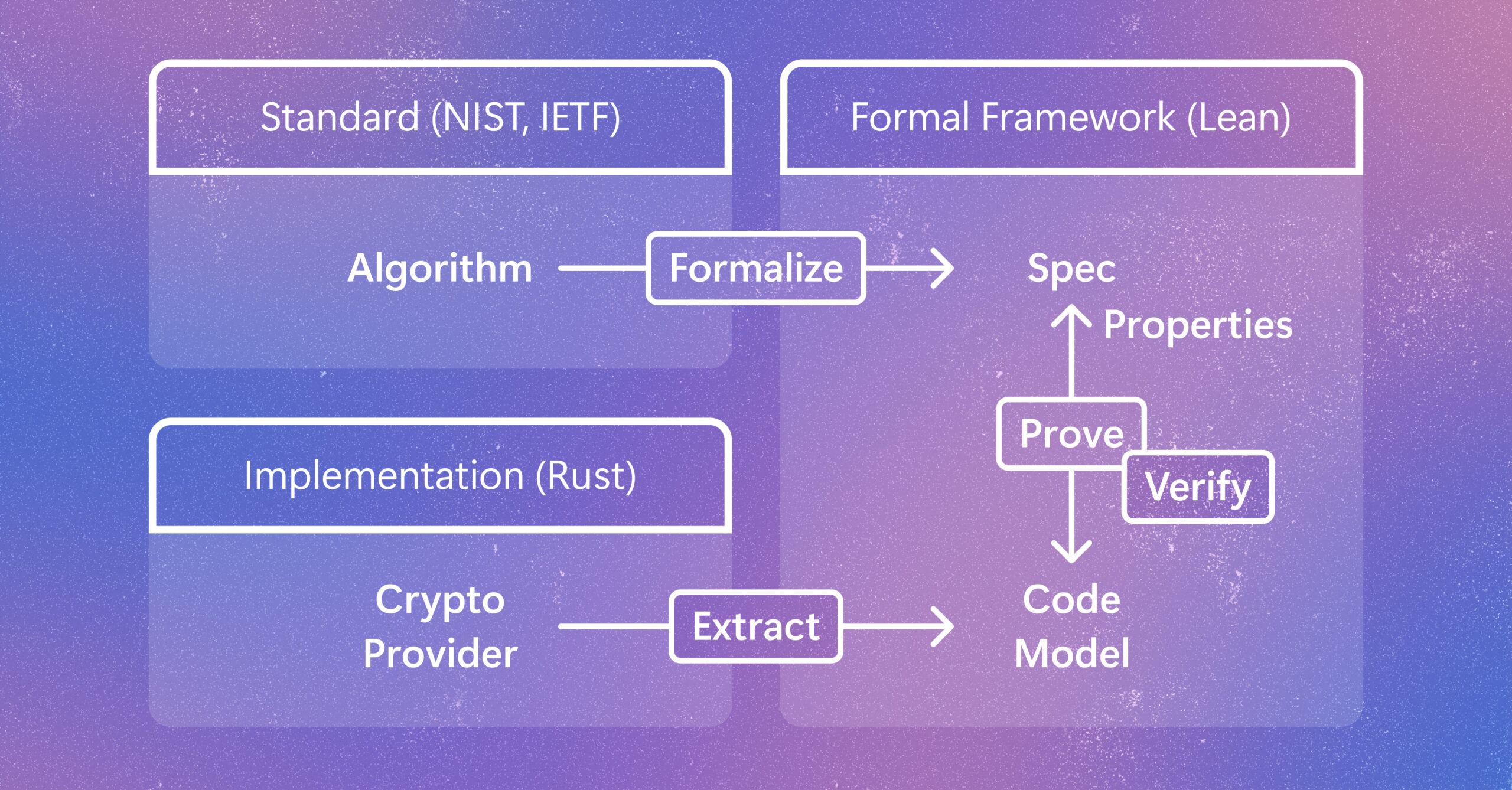
Verifying Rust cryptography in SymCrypt, from standards to code

Cryptographic code supports vital protections in modern computing systems. Learn how a new method helps verify code as developers write it while preserving speed and adaptability as it gets implemented and evolves. The post Verifying Rust cryptography in SymCrypt, from standards to code appeared first on Microsoft Research.

We use cookies to run the site and, with your consent, for analytics and to show ads. See our Cookie Policy.