Skip to content

RefCon: Iterative Refinement and Contrastive Memory Extraction for Context-Evolving Agent

Sep 2026 · arXiv.org · Vol abs/2609.39143 · 0 citations · 37 references
Computer Science

TL;DR

This work proposes RefCon, which combines sequential self-refinement with parallel self-contrast to extract higher-quality memories without gold labels, and generalizes across model scales and to software engineering tasks, where it surpasses even ground-truth baselines.

Abstract

Long-horizon agent interactions generate useful but noisy experience, and retraining models to absorb it is expensive. Context-evolving agents therefore need memory extraction methods that improve with more test-time compute without relying on gold labels. We propose RefCon, which combines sequential self-refinement with parallel self-contrast to extract higher-quality memories without gold labels. Evaluated on AppWorld and BFCL-V3 across multiple context-evolving agent frameworks, RefCon delivers strong and consistent gains, including relative improvements of 21.6% on ACE and 16.6% on ReMe over no-scaling baselines, while a diversity-focused variant (DivCon) achieves a 35.5% gain on ReasoningBank. RefCon consistently outperforms existing baselines without ground-truth labels, and generalizes across model scales and to software engineering tasks, where it surpasses even ground-truth baselines. We further analyze the accuracy-token trade-off and scaling behavior, showing RefCon maintains favorable efficiency and continues to improve as more trajectories are used, unlike diversity-only scaling which saturates earlier.

View source

Similar papers

Self-Designed Evaluators and Warm Memory for Long-Horizon Agents

SelfSuite is presented, in which the agent's own base model, given only the world's public materials, designs a small evaluation suite of weighted judges and grounded per-task briefs, freezes it, and uses it to gate a keep-best retry and to label a typed, outcome-tracked memory.

Saeid Asgari, Emre Kıcıman, Leonardo O. Nunes et al. · 0 citations
Preprint Aug 2026

Weighted Memory Tree: Remembering What Matters for Long-Horizon LLM Agents

The results suggest that effective long-horizon agent memory depends less on storing more information than on deciding which information should remain active, and that effective long-horizon agent memory depends less on storing more information than on deciding which information should remain active.

Q. Dao, Purvi Kathalkar, Kenneth Eaton · 1 citation

DolphinBench: Mapping the Pareto Frontier of Agent Memory

DolphinBench is presented, a benchmark that evaluates memory directly through an agent's task completion and requires all evaluations to report total cost and latency alongside accuracy, which enables us to evaluate agent memory systems holistically.

Soumil Rathi, Deshraj Yadav, Taranjeet Singh · 0 citations
#artificial intelligence Preprint Sep 2026

Breaking the Environment Wall: Evolving LLM Agent Environments for Recursive Self-Improvement

Env-Rethink is proposed, a system with 27B post-trained model that supports three main capabilities that adaptively builds Collection Maps and Event Logs to supplement necessary context and evolves environments through virtual event histories that alter environmental states and evidence relationships.

Yu-Kai Wu, Yuan-Jing Yang, Leon Zhou et al. · 0 citations
#artificial intelligence Preprint Oct 2026

REMORY: Learning Residual Memory for Context Compaction

Long-horizon agents compact their history to continue within a finite context window, but a textual summary alone may not support every subsequent decision. We introduce REMORY, a neural memory network that supplements the summary with a bounded sequence of soft memory tokens. Given the history and summary, the network...

Han-Chen Xia, Bao-You Chen, Yu-Tang Ge et al. · 0 citations
#artificial intelligence Preprint Oct 2026

Beyond Memory: Harnessing Long-Horizon Agents with Explicit Belief States

Large language model (LLM) agents can now undertake increasingly complex tasks, but the way they organize interaction history into memory does not ensure a coherent understanding of the current world. We introduce PoS, an inference-time framework that constructs and continually maintains explicit belief states as the a...

Yu Luo, Jia-Min Jiang, Yi-Min Zuo et al. · 1 citation

Related blog posts

Microsoft Research Blog Oct 12, 2026

Simulating student learning for better AI tutoring

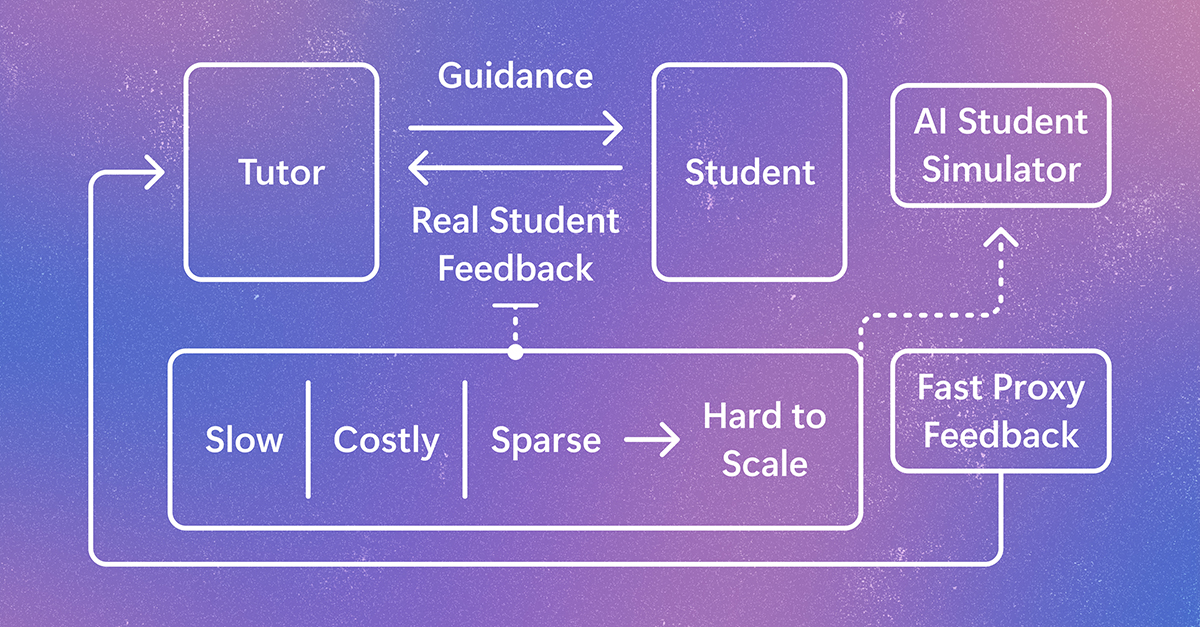
StudentSim is a research system for evaluating and improving AI tutoring tools before they are tested with learners. It models how individuals may engage with tutors, giving feedback to improve tutor performance across subjects like chess, writing, and mathematics. The post Simulating student learning for better AI tutoring appeared first on Microsoft Research.

MIT News · Artificial Intelligence Sep 29, 2026

Who we become when we talk to machines

Professor Sherry Turkle’s new book, “Artificial Intimacy,” offers a withering critique of chatbots and the antisocial dynamics she believes they encourage.

We use cookies to run the site and, with your consent, for analytics and to show ads. See our Cookie Policy.

