Skip to content
#diffusion models Open access

scLDM: a conditional diffusion framework for single-cell perturbation prediction

Sep 2026 · Bioinform. · Vol 42 · 0 citations · 49 references
Computer Science Medicine

TL;DR

Overall, scLDM provides a robust and biologically consistent strategy for in silico perturbation screening, and exhibits strong interpretability, as the learned perturbation embeddings show high functional alignment with known biological mechanisms.

Abstract

Abstract Motivation Accurate prediction of single-cell responses to external stimuli is pivotal for deciphering gene regulatory mechanisms and accelerating data-driven drug discovery. However, effectively capturing the complex, non-linear mapping between intrinsic cell states and external stimuli remains an open problem. Results We propose scLDM, a generative framework based on latent diffusion models for predicting single-cell perturbation responses. scLDM first compresses high-dimensional gene expression into a compact latent space via a variational autoencoder, followed by a conditional diffusion process to generate post-perturbation states, explicitly guided by pre-perturbation cellular state, cell type, and perturbation type. Systematic evaluations on six datasets across diverse biological settings, spanning pharmacological stimulation, viral infection, helminth infection, genetic perturbations, and multi-species immune response contexts, demonstrate that scLDM achieves superior predictive accuracy compared to state-of-the-art methods. Furthermore, the model exhibits strong interpretability, as the learned perturbation embeddings show high functional alignment with known biological mechanisms. Overall, scLDM provides a robust and biologically consistent strategy for in silico perturbation screening. Availability The code is available at https://github.com/samrogers1233/scLDM and archived on Zenodo at https://doi.org/10.5281/zenodo.22658164.

Read PDF

Similar papers

Open access Aug 2026

PerturbLDM: conditional latent diffusion for modelling single-cell perturbation responses

PerturbLDM, a latent-diffusion framework for conditional generation of single-cell transcriptional responses, is introduced, showing support for conditional response generation across data scales and biological settings.

Li-Shan Yu, Kang-Lin Hsieh, Y. Chu et al. · 0 citations
Open access Sep 2026

PerturbBridge: Conditional Latent Schrödinger Bridge for Single-Cell Perturbation Response Prediction

PerturbBridge is proposed, a conditional latent Schrödinger Bridge framework that reformulates stochastic population transport over high-dimensional, sparse geneexpression profiles as bridge learning in a compact cell latent space, and achieves state-of-the-art performance in differential-expression recovery on both be...

Zhi-Hao Liu, Chang-Zhi Jiang, Can Yang et al. · 0 citations
Open access Aug 2026

Predicting Single‐Cell Perturbation Responses Across Biological Contexts With a Deep Generative Model Integrating Optimal Transport

ScPILOT learns a generative latent representation through discriminator‐assisted training and separates perturbation inference into cell‐level response estimation from observed contexts and query‐specific response transfer using latent optimal transport, a query‐conditioned framework for transferring responses to previ...

Jia-Liang Wang, Zi-Qi Liu, Zheng-Qiang Zhang et al. · 0 citations

DRIFT: Disentangled Responsive-Invariant Flow Transport for Single-Cell Perturbation Prediction

Across several benchmarks, this method outperforms the strongest published method in settings involving combinatorial and unseen perturbation prediction, and is the strongest published method in settings involving combinatorial and unseen perturbation prediction.

Mustapha Bounoua, G. Franzese, P. Michiardi · 0 citations

Related blog posts

Microsoft Research Blog Nov 16, 2026

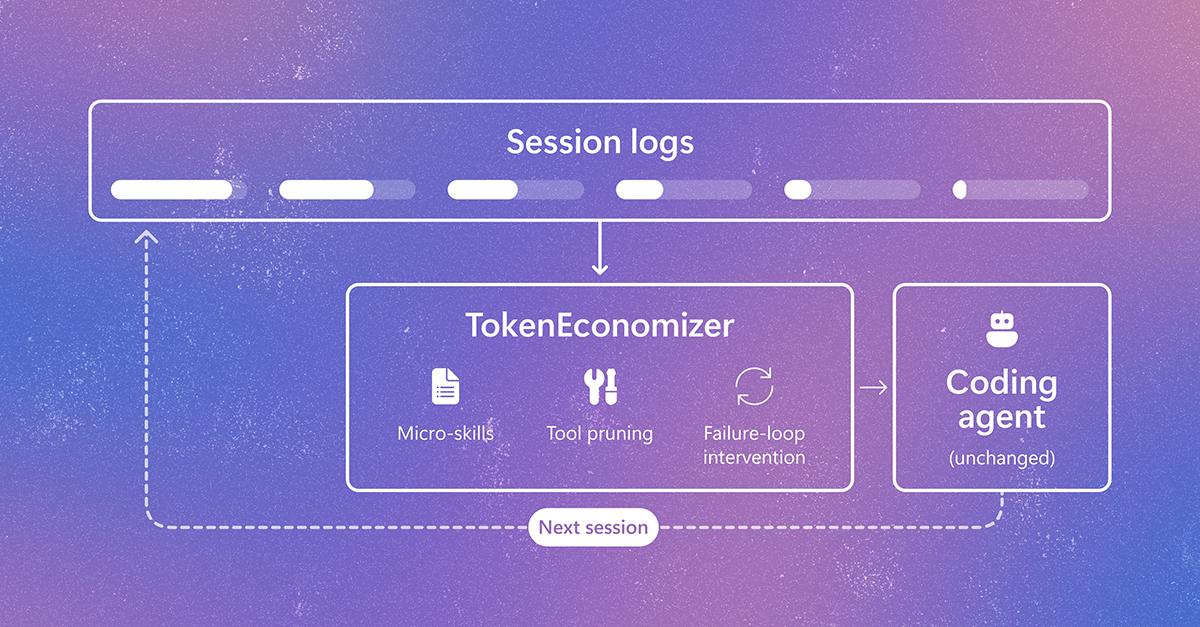
TokenEconomizer: Learning from Experience to Make AI Coding Agents More Efficient

AI coding agents are increasingly help developers fix bugs and build features largely on their own, but every interaction with their models consumes tokens. In each session, an agent sends instructions, tool descriptions, and session history to its model. Most efforts to reduce this cost focus on individual tasks. Yet developers return to the same […] The post TokenEconomizer: Learning from Experience to Make AI Coding Agents More Efficient appeared first on Microsoft Research.

We use cookies to run the site and, with your consent, for analytics and to show ads. See our Cookie Policy.