It is found that most baselines drastically degrade in performance, as they require significant overlap between viewpoints, while AnyView maintains the ability to produce realistic, plausible, and spatiotemporally consistent videos when prompted from $\textit{any}$ viewpoint.
Abstract
Modern generative video models excel at producing convincing, high-quality outputs, but struggle to maintain multi-view and spatiotemporal consistency in highly dynamic real-world environments. In this work, we introduce $\textbf{AnyView}$, a diffusion-based video generation framework for $\textit{dynamic view synthesis}$ with minimal inductive biases or geometric assumptions. We leverage multiple data sources with various levels of supervision, including monocular (2D), multi-view static (3D) and multi-view dynamic (4D) datasets, to train a generalist spatiotemporal implicit representation capable of producing zero-shot novel videos from arbitrary camera locations and trajectories. We evaluate AnyView on standard benchmarks, showing competitive results with the current state of the art, and propose $\textbf{AnyViewBench}$, a challenging new benchmark tailored towards $\textit{extreme}$ dynamic view synthesis in diverse real-world scenarios. In this more dramatic setting, we find that most baselines drastically degrade in performance, as they require significant overlap between viewpoints, while AnyView maintains the ability to produce realistic, plausible, and spatiotemporally consistent videos when prompted from $\textit{any}$ viewpoint. Results, data, code, and models can be viewed at: https://tri-ml.github.io/AnyView/
This publication proposes a definition and a classification of agile software development approaches and analyses ten software development methods that can be characterized as being "agile" against the defined criterion.
P. Abrahamsson, O. Salo, Jussi Ronkainen et al.· arXiv.org· 727 citations· ⚡54
The study shows that agile practices improve both informal and formal communication, but indicates that, in larger development situations involving multiple external stakeholders, a mismatch of adequate communication mechanisms can sometimes even hinder the communication.
M. Pikkarainen, Jukka Haikara, O. Salo et al.· Empirical Software Engineeri...· 401 citations· ⚡48
The results indicate that software engineering work practices are chosen opportunistically, adapted and configured to provide value under the constrains imposed by the startup context.
Nicolò Paternoster, Carmine Giardino, M. Unterkalmsteiner et al.· Information and Software Tec...· 394 citations· ⚡54
The possibility of inferring high-dimensional data inference in a model that consists of a prior and an auxiliary differentiable constraint given some additional information is considered, thereby allowing a range of potential applications in adapting models to new domains and tasks.
Alexandros Graikos, Esmeralda S. Whitammer, N. Jojic et al.· Neural Information Processin...· 316 citations· ⚡15
It is proved that any global minimizer of the trajectory balance objective can define a policy that samples exactly from the target distribution, and empirically demonstrate the benefits of the trajectories balance objective for GFlowNet convergence, diversity of generated samples, and robustness to long action sequenc...
Esmeralda S. Whitammer, Moksh Jain, Emmanuel Bengio et al.· Neural Information Processin...· 302 citations· ⚡60
Exploring how generative AI could make machine vision more accessible to businesses. The post GenEye in a Box: Making Machine Vision Something You Can Just Ask For appeared first on GPT-Lab.
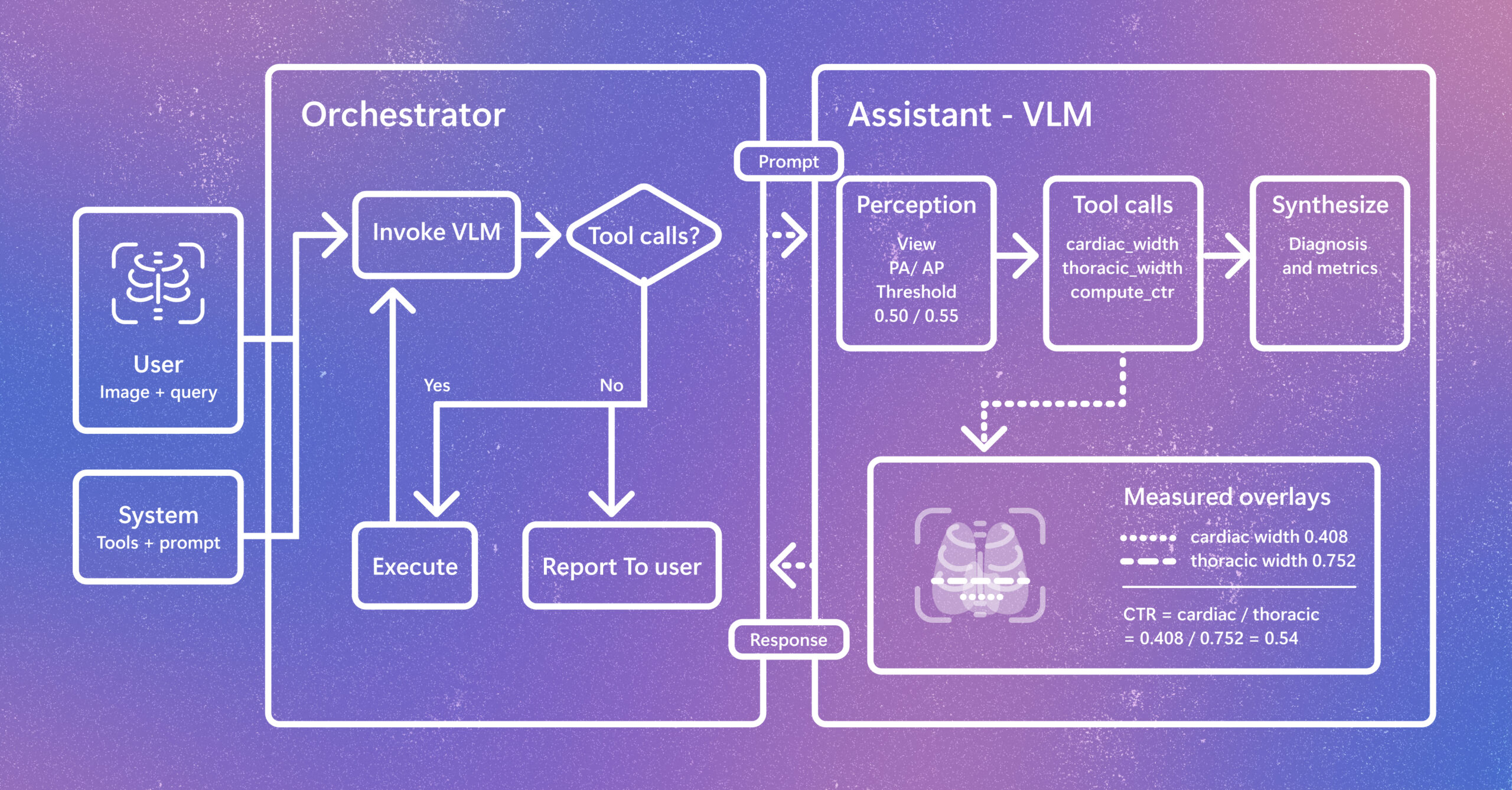
Radiology AI is evolving beyond report generation. CARE-X explores a unified approach that combines flexible reasoning, calibrated predictions, and measurement-based tools for chest X-ray interpretation. The post Introducing CARE-X: Towards Clinically Useful Radiology VLMs with Auxiliary Supervision, Reward-Aligned Learning, and Tool-Augmented Measurement appeared first on Microsoft Research.