Code-only archive for the manuscript on the stability of machine-learning algorithm, feature and hyperparameter selection across random training-test splits in a coronary artery disease cohort. The archive contains selected analysis sources, recorded environment requirements, English-directory path-adaptation and prove...
Meng Li, Xiuze Zhang, Juan Bai et al.· Zenodo (CERN European Organi...· 0 citations
The developed framework is intended as a decision-support tool for pathologist support and screening and prioritisation of suspicious microscopic images and not as a replacement for slide-level diagnosis or immunohistochemistry.
Sourendra Nath Basu, J. Augustine, N. Chaudhary et al.· Journal of Microscopy· 0 citations
Regression testing in continuous integration (CI) helps preserve delivered software value by exposing regressions early, but limited feedback windows make test order consequential. This study evaluates a leakage-safe dynamic test case prioritization framework that reconstructs job–build–commit provenance, combines stri...
Abstract—Programming activities, such as automatic debugging and program repair, are increasingly being supported by Generative Artificial Intelligence (GenAI). However, a rigorous empirical evaluation of the efficacy of various large language models (LLMs) across several debugging phases is necessary. Using a benchmar...
Muhammad adrevi zaki rukmana, Sasmoko Sasmoko, Novtryananda M.S Ghunu et al.· Mendeley Data· 0 citations
Reach audiences
Advertise in front of researchers, engineers, and readers.
It is suggested that while LLMs may offer support in structuring and initiating power analysis, they cannot substitute for expert judgment and underscores the importance of critically evaluating LLM performance in statistically demanding tasks.
Hajung Kim, Jia Qi, Zhe Feng et al.· Journal of Behavioral Data S...· 0 citations
The results demonstrate that EXCODER provides an effective, though imperfect, solution to this problem in automated code generation, offering developers the first way to implement ERC following test-driven development.
Ling-Tao Zhong, Jiyang Zhang, Jayanth Srinivasa et al.· 0 citations
This work presents a hardware-aware deep learning framework for multiclass detection of electrical faults and power quality disturbances in a 400 Hz aerospace power system, establishing simulation-based, accelerator-level feasibility for embedded edge AI in aircraft electrical health monitoring and motivating future en...
Ian Guzmán, R. Babiceanu, Berker Peköz· IEEE Transactions on Aerospa...· 0 citations
Ensuring the dependable operation of modern software systems under dynamic and non-stationary operating conditions remains a major challenge in software reliability engineering. Although recent deep reinforcement learning (DRL)-based approaches have demonstrated promising capabilities for closed-loop adaptation of soft...
Sudhakar Kambhampati, G. V. Krishna· Ceylon Journal of Science· 0 citations
Analysis code and tables for public path-fraction m in Hartman, Kinetic Analysis of Informational Disorder, v2.4 (2026), doi:10.5281/zenodo.22417058. Family A is a synthetic methods check. Family B v1 (Flask/HTTPie tag windows) has zero revert-message commits. Family B v2 (django train, CPython test) has revert-message...
Joshua Hartman· Zenodo (CERN European Organi...· 0 citations
Most European organisations now depend on AI services whose model, hosting, silicon and contract terms sit under the jurisdiction of a foreign state. This reference paper asks what the two governments concerned, the United States and the People's Republic of China, have already done with the power that dependency gives...
Adrian Hollister· Zenodo (CERN European Organi...· 0 citations
ConGen-R (Concrete Generalization and Reliability Tool) is bilingual research software developed to accompany the study “When High Accuracy Fails to Generalize: Source-Aware Validation and Uncertainty Calibration for Concrete Compressive Strength Prediction.” It addresses the risk that random observation-level data spl...
Yao-Ming Hong· Zenodo (CERN European Organi...· 0 citations
This repository contains the de-identified data and analysis code required to reproduce the results reported in "When Evidence Is Not Enough: Experimental Effects on Health Misinformation Endorsement" (N=3,200, between-subjects randomized experiment, 4 conditions: Control, Scientific Evidence, Framing Effect, Social Co...
Jesús Carretero-Bravo, Javier Álvarez‐Gálvez· Zenodo (CERN European Organi...· 0 citations
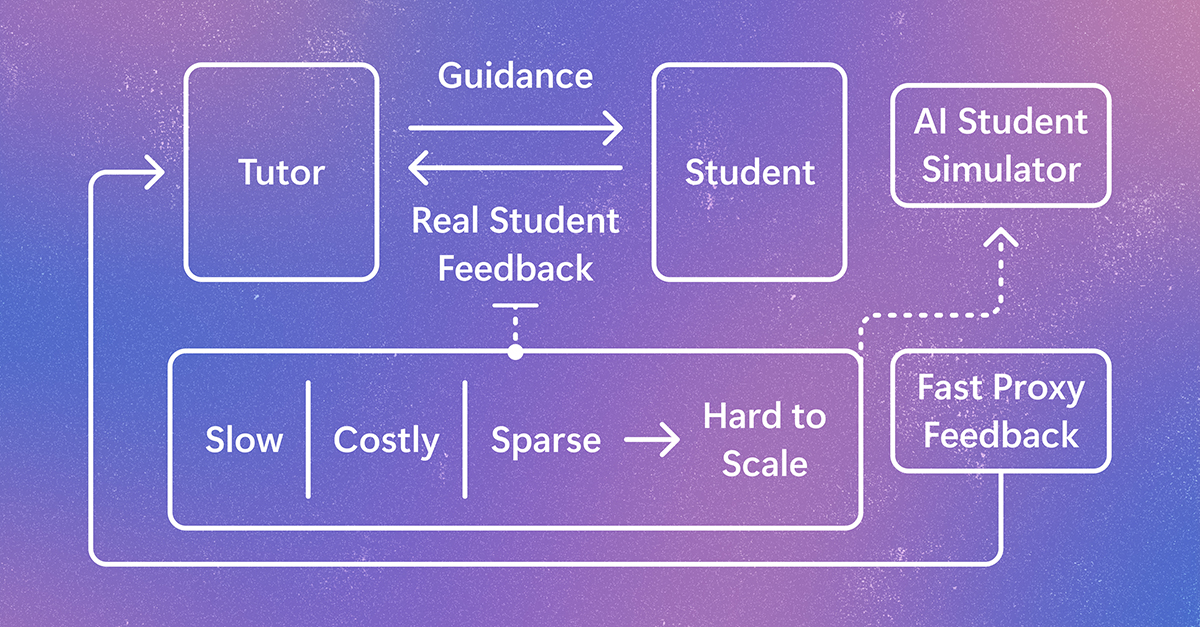
StudentSim is a research system for evaluating and improving AI tutoring tools before they are tested with learners. It models how individuals may engage with tutors, giving feedback to improve tutor performance across subjects like chess, writing, and mathematics. The post Simulating student learning for better AI tutoring appeared first on Microsoft Research.
MIT News · Artificial Intelligence· news.mit.eduOct 6, 2026
Writing as a participant and researcher, PhD student JS Tan SM ’22 has co-authored a new book about the rise of tech worker protests and the employer backlash that followed.
MIT News · Artificial Intelligence· news.mit.eduOct 2, 2026
Writing as a participant and researcher, PhD student JS Tan SM ’22 has co-authored a new book about the rise of tech worker protests and the employer backlash that followed.
Requirements in large systems rarely exist in isolation. Their meaning depends on the wider project context - other requirements, policies, decisions, tests, and implementation details. That becomes especially important when AI is used for review, because spotting a possible conflict or gap is only the beginning. ReqSpace explores how AI, visualisation, and connected project context can help reviewers understand those findings, trace the relationships behind them, and focus on the questions that…
We use cookies to run the site and, with your consent, for analytics and to show ads.
See our Cookie Policy.