Portable mobile-manipulation demonstrations can help alleviate data scarcity for embodied intelligence, but obtaining reliable, low-cost, and robot-free motion supervision from RGB observations remains challenging. Existing approaches often rely on teleoperation or specialized devices equipped with additional sensing h...
Yutian Zhang, Xingrui Xiong, Siyuan Ma et al.· 0 citations
Visual disruptions can arise while a robot is executing a task, leaving a vision-language-action (VLA) policy to respond without knowing the disruption type or timing. We introduce Self-supervised Adaptation from Leftover Trajectories (SALT), which uses the leftover trajectory, the unexecuted part of the previous actio...
Ahin Lee, Jinwoo Seo, Youngsoo Jang et al.· 0 citations
Dexterous manipulation poses a challenging high-dimensional optimization problem, as useful behaviors require coordinated motion across many hand joints. In reinforcement learning (RL) and sampling-based trajectory optimization, exploration commonly relies on independent robot joint perturbations, making coordinated be...
Harsh Gupta, Tyler Ga Wei Lum, Changhao Wang et al.· 0 citations
The ability to interact with articulated objects is essential for embodied intelligent systems, but collecting large-scale real-world demonstrations for these interactions remains challenging due to the precise contact and constraint-following motions involved. Although simulation provides a promising alternative, exis...
Jicong Ao, Shuhan Jiang, Yuling Zhong et al.· 0 citations
Reach audiences
Advertise in front of researchers, engineers, and readers.
Dense 3D mapping with semantic understanding is essential for robotic perception in complex environments. Recent 3D Gaussian Splatting-based mapping approaches enable high-fidelity geometry and efficient open-vocabulary perception, but typically represent semantics as unstructured feature fields that limit object-centr...
Binh Long Nguyen, Kien Nguyen, Clinton Fookes et al.· 0 citations
An electromagnetic (EM) digital twin gives mobile robots wireless situational awareness but depends on material conductivities that change with the environment. Online calibration faces initialization sensitivity and measurement travel costs. We demonstrate a vision-language model (VLM)-guided framework using a Unitree...
Zerui Kang, Yishen Lim, Zhouyou Gu et al.· 0 citations
Self-improving policies continually expose new failure patterns, changing what their judges must be able to verify. However, current fixed judges constrain both optimization feedback and the discovery of useful training examples, limiting further self-improvement. This challenge is even more acute in embodied reasoning...
Zewei Zhou, Rachel Luo, Yulong Cao et al.· 0 citations
Vision-Language Navigation (VLN) enables robots to navigate through environments using natural language instructions, making human-robot interaction intuitive. Traditional VLN models often rely on navigation graphs, 360-degree views, and perfect localization which pose significant challenges when adapting these models...
Chalindu Abeywansa, Sahan Gunasekara, Devindi De Silva et al.· 0 citations
Despite its promise for scaling robot learning, egocentric manipulation data is still scarce today. Collection at scale requires vertically integrating ergonomic hardware with centimeter-precise 3D algorithms, at a precision that has not been publicly demonstrated. To address this gap, we introduce RoboCap, a 250\,g si...
Large language models (LLMs) let users direct heterogeneous multi-robot systems (MRS) through natural language, but make task interpretation, robot assignment, and coordination difficult to inspect and change. Based on a formative study with 12 non-expert users, we developed MRPilot, a mixed reality system organized ar...
Xiaoran Yang, Xun Qian, Yang Zhan et al.· 0 citations
As large language models (LLMs) are increasingly integrated into engineering workflows, students require hands-on experience to learn how to collaborate with them critically. This paper presents a scalable gamified workshop designed for engineering Master's students to practice human-AI collaboration in navigation plan...
R. Zhang, J. C. F. de Winter, T. Dicke et al.· 0 citations
Agent tasks require sequences of interdependent decisions. Autoregressive models support more flexible decision interfaces than conventional classifiers but incur the latency of token-by-token generation. Recent shared-prefix methods reduce this cost by reusing encoded context and scoring multiple decisions in parallel...
Robots are getting smarter, but how can their hardware match that growth? New Microsoft Research findings show that moving AI inference beyond the robot can improve task success, boost efficiency, and support more advanced physical AI workloads. The post Offloaded inference for real-world physical AI robotics appeared first on Microsoft Research.
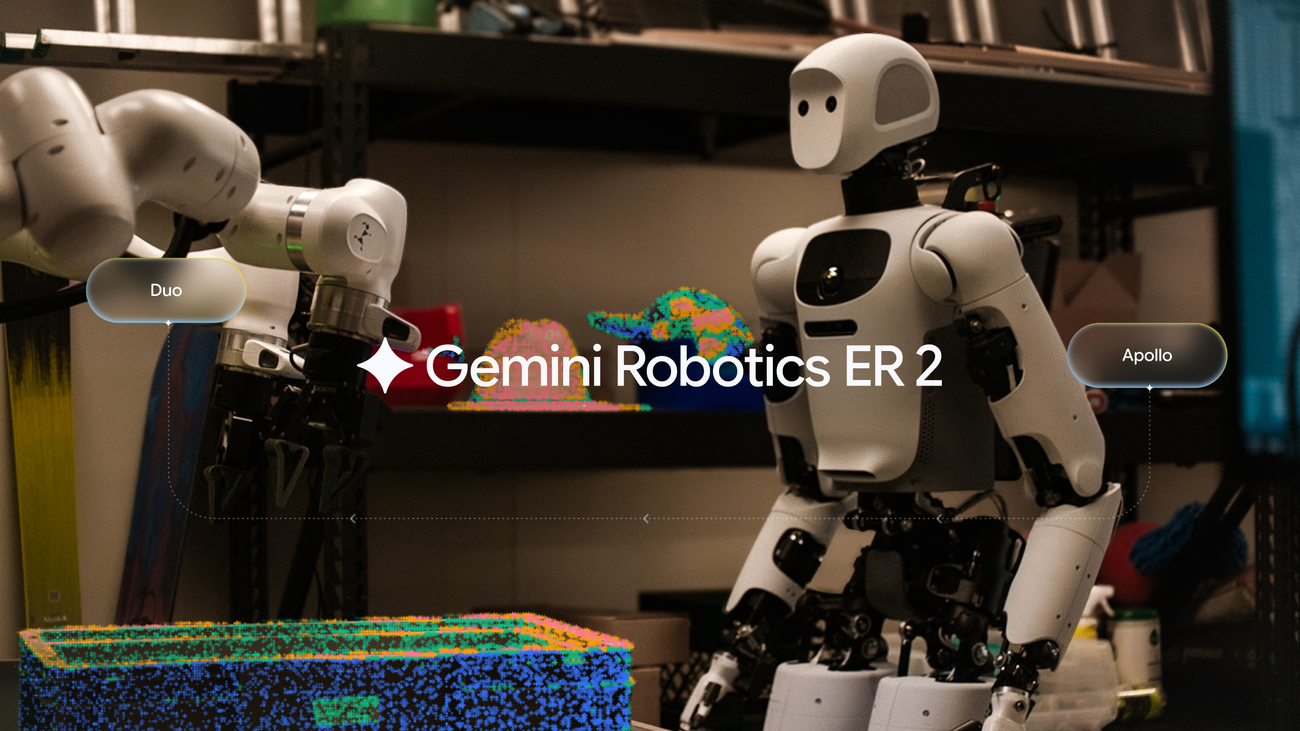
Gemini Robotics ER 2 helps robots reason, collaborate, and solve real-world tasks. It represents a step change in video understanding, tool orchestration, and multi-robot collaboration for robotic applications.
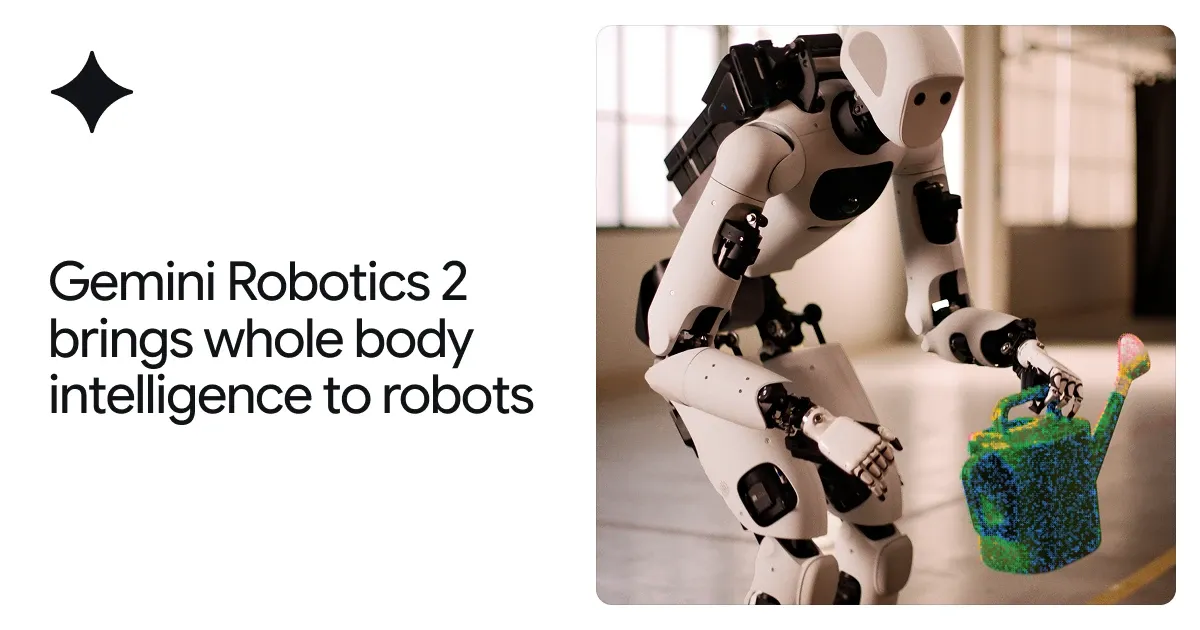
From feet to fingertips — we are teaching robots intelligent whole-body control, fine dexterity, and teamwork to complete a broad range of complex tasks.
We use cookies to run the site and, with your consent, for analytics and to show ads.
See our Cookie Policy.