An operational taxonomy, a coverage comparison against the eight closest surveys, an evaluation loop that isolates the advantage of prediction, and an actionable protocol of four advantage-aware metrics anchored on named testbeds are contributed.
Gaytri Jena, Kapil Wanaskar, Vinija Jain et al.· 0 citations
MISCO is developed, a novel evolutionary framework empowered by deep generative models to optimize VSR designs with theoretical guarantees that represents a step change towards more scalable and reliable soft robot development.
Jun-Ru Song, Huan Xiao, Yang Yang et al.· 0 citations
This work presents RoboLDA, a Bayesian probabilistic model that decomposes VSR morphology generation into a four-level hierarchy:"task-robot-organ-voxel", and is trained via variational inference, which pioneers hierarchical generative modeling of robot morphology.
Jun-Ru Song, Yang Yang, Jing-Dan Shi et al.· 0 citations
The results suggest that the frontier of Physical AI depends not only on stronger action models, but also on executable harnesses that integrate perception, task understanding and reasoning, and action execution into a unified, verifiable, and feedback-driven system.
X. Wang, Wen-Hao Wu, Meng-Hao Zhang et al.· 1 citation
Reach audiences
Advertise in front of researchers, engineers, and readers.
DAWN is a noise-robust perception framework for legged locomotion which builds noise robustness directly into a world model via two modifications: feeding noisy depth to the encoder while keeping clean depth as the reconstruction target, forcing the model to implicitly denoise its input.
Yo-Han Choi, Min-Jun Kim, Jin-Sung Kim et al.· 1 citation
This work proposes an LLM chaining architecture that separates instruction classification and action generation into two specialized stages, reducing per-inference prompt length by approximately 45% while improving planning consistency.
Lucas Da Mota Bruno, Jiahao Sim, Y. Hagiwara· 0 citations
This work proposes embodiment-conditioned safety filtering, in which a Hamilton-Jacobi reachability-based value function and its corresponding safety-maximizing policy are shared across robots, and performs Hamilton-Jacobi reachability analysis directly in latent space so that the learned safety concepts can generalize...
This work introduces a unified formalism for proactive robot assistance, organize it into three levels, and provides a framework to address the highest level of unprompted proactive assistance, and presents a method, GAP, that instantiates the framework, learning from passive observation to anticipate user goals and ac...
Generalization in robotic manipulation requires policies to perform tasks across diverse unseen object instances that vary in shape, size, and pose. However, conventional behavior cloning (BC) methods often overfit to instance-specific geometry and appearance, limiting transfer to novel objects. We introduce KeyGen, a...
Shuxin Cao, Liquan Wang, Masoud Moghani et al.· 0 citations
This paper investigates temporal neural networks for \mbox{end-effector} position \mbox{estimation} of an aerial continuum manipulator (ACM) operating under aerodynamic effects induced by the unmanned aerial vehicle (UAV). An experimental dataset is collected under stationary (\mbox{rotor-off}) and \mbox{free-hovering}...
Latent world models are typically trained to predict factual transitions, whereas model predictive control (MPC) must compare alternative actions from the same state. A model can therefore achieve low factual prediction error yet poorly distinguish candidate actions. We introduce AD-WM, an action-discriminative joint-e...
Jia-Bin Qiu, Zi-Xuan Chen, Hong-Ye Cao et al.· 0 citations
ART is a tool-injection framework that tunes any VLA model to leverage off-the-shelf tool modules for low-level vision, high-level affordance, and embodiment enhancement, and ART reduces the complexity of the action solution space through tool-use, which improves generalizability across different tasks but also reduces...
Ding-Ge Yi, Yanzhao Yu, Xi-Li Dai et al.· 1 citation
Robots are getting smarter, but how can their hardware match that growth? New Microsoft Research findings show that moving AI inference beyond the robot can improve task success, boost efficiency, and support more advanced physical AI workloads. The post Offloaded inference for real-world physical AI robotics appeared first on Microsoft Research.
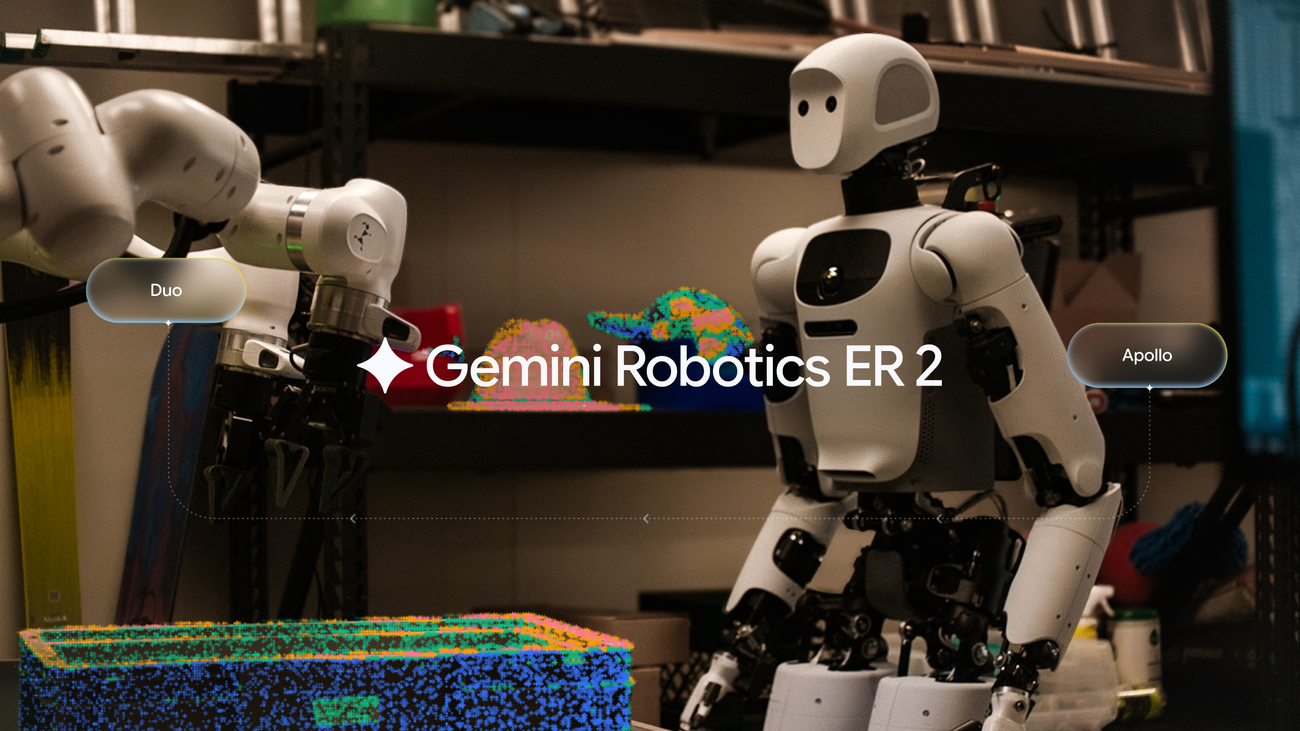
Gemini Robotics ER 2 helps robots reason, collaborate, and solve real-world tasks. It represents a step change in video understanding, tool orchestration, and multi-robot collaboration for robotic applications.
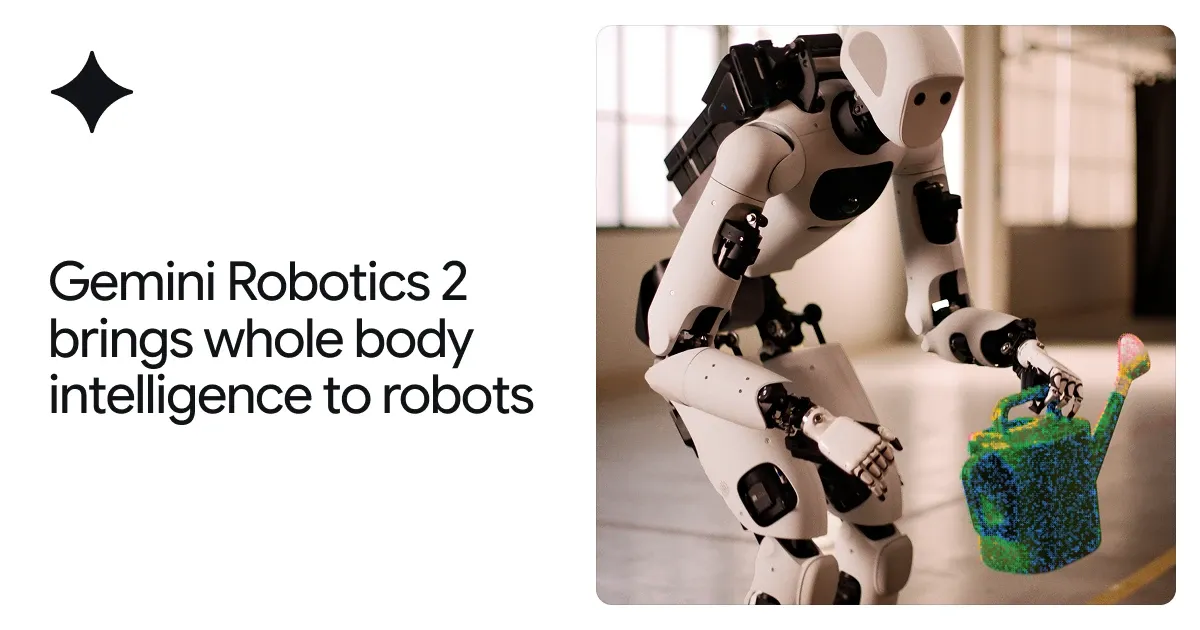
From feet to fingertips — we are teaching robots intelligent whole-body control, fine dexterity, and teamwork to complete a broad range of complex tasks.
We use cookies to run the site and, with your consent, for analytics and to show ads.
See our Cookie Policy.