It is demonstrated that the fixed reality modality affects HRI results, and dynamically changing the modality along the RVC improves them, highlighting the value of adaptive XR interfaces for human-robot symbiosis.
Carl Tornberg, Alicia Torck, Lotfi El Hafi et al.· 0 citations
This paper presents a control interface that uses a commercial XR pen to command a semi-autonomous mobile robot in Augmented Reality (AR), and shows that the XR pen significantly outperforms the other methods in task selection time with the most consistent selections, supporting XR-based control as an intuitive alterna...
Alicia Torc, Carl Tornberg, Éric Piette et al.· 0 citations
This work proposes Multi-Objective Human-in-the-loop Bayesian Optimization (MO-HILBO), which builds on explicit multi-objective Bayesian optimization to efficiently infer a personalized set of Pareto-optimal controllers.
Neil C. Janwani, Matthew T. Lerner, Aaron J. Young et al.· 0 citations
The Neural Action Codec is introduced, which treats short robot action trajectories as multi-channel 1D signals and compresses them using a multi-scale RVQGAN architecture and achieves high reconstruction fidelity and higher average success rates than binning, FAST, and prior VQ-based tokenizers at comparable or better...
Ahad Jawaid, Yunan Xiang· arXiv.org· 0 citations
Reach audiences
Advertise in front of researchers, engineers, and readers.
It is argued that critic architecture deserves explicit treatment as a design variable in multi-objective humanoid RL, and specify the single-variable ablation needed to establish its causal contribution.
An online model-based reinforcement learning framework that learns a probabilistic dynamics ensemble model from scratch for sampling-based model predictive control and achieves higher sample efficiency than the evaluated model-based reinforcement learning baselines is presented.
Claudio Canales, Nan Fang, Marco Hutter et al.· 0 citations
Results show that lightweight channel-aware adaptation can recover a substantial fraction of the robustness of a much larger communication interface while broadening quality-valid operation under constrained wireless conditions.
Rajat Bhattacharjya, Minwoo Kim, Arnab Sarkar et al.· 0 citations
Under matched encoders and training settings, CoFL-S consistently outperforms baselines across planner frequencies in the continuous-time Habitat benchmark, and zero-shot real-world closed-loop deployment further shows its advantage over the evaluated baselines beyond simulation.
This paper proposes Hide-and-Seek, a framework that formulates VLA failure detection as a coarsely supervised learning problem that achieves state-of-the-art multi-task failure detection performance with a practical accuracy--timeliness trade-off under conformal prediction, and generalizes well to both seen and unseen...
S. Park, Wendi Li, Changdae Oh et al.· arXiv.org· 8 citations
A topology-driven Multi-Agent Reinforcement Learning (TD-MARL) framework to coordinate multi-robot systems to avoid entanglement is proposed and the full simulation experiments show that the method is better than the current advanced deep reinforcement learning (DRL) method in terms of convergence and anti-winding effe...
H. Le, Sheng-Xuan Wang, Mo Chen et al.· arXiv.org· 0 citations
This work proposes GPERT, a framework to address the trade-off between accuracy and temporal resolution in event-based 3DGS, by decouple the rendering into two branches: event-by-event geometry (depth) rendering and snapshot-based radiance (intensity) rendering, by using ray-tracing and the image of warped events.
Kai Kohyama, Yoshimitsu Aoki, Guillermo Gallego et al.· arXiv.org· 0 citations
Endpoint-Constrained Optimization (ECO), a lightweight postprocessing layer that anchors the trajectory to the vehicle's executed history, preserves the policy's predicted endpoint, and reshapes the intermediate waypoints to improve feasibility is introduced.
Brayden Zhang, Mahsa Golchoubian, Igor Gilitschenski et al.· 0 citations
Robots are getting smarter, but how can their hardware match that growth? New Microsoft Research findings show that moving AI inference beyond the robot can improve task success, boost efficiency, and support more advanced physical AI workloads. The post Offloaded inference for real-world physical AI robotics appeared first on Microsoft Research.
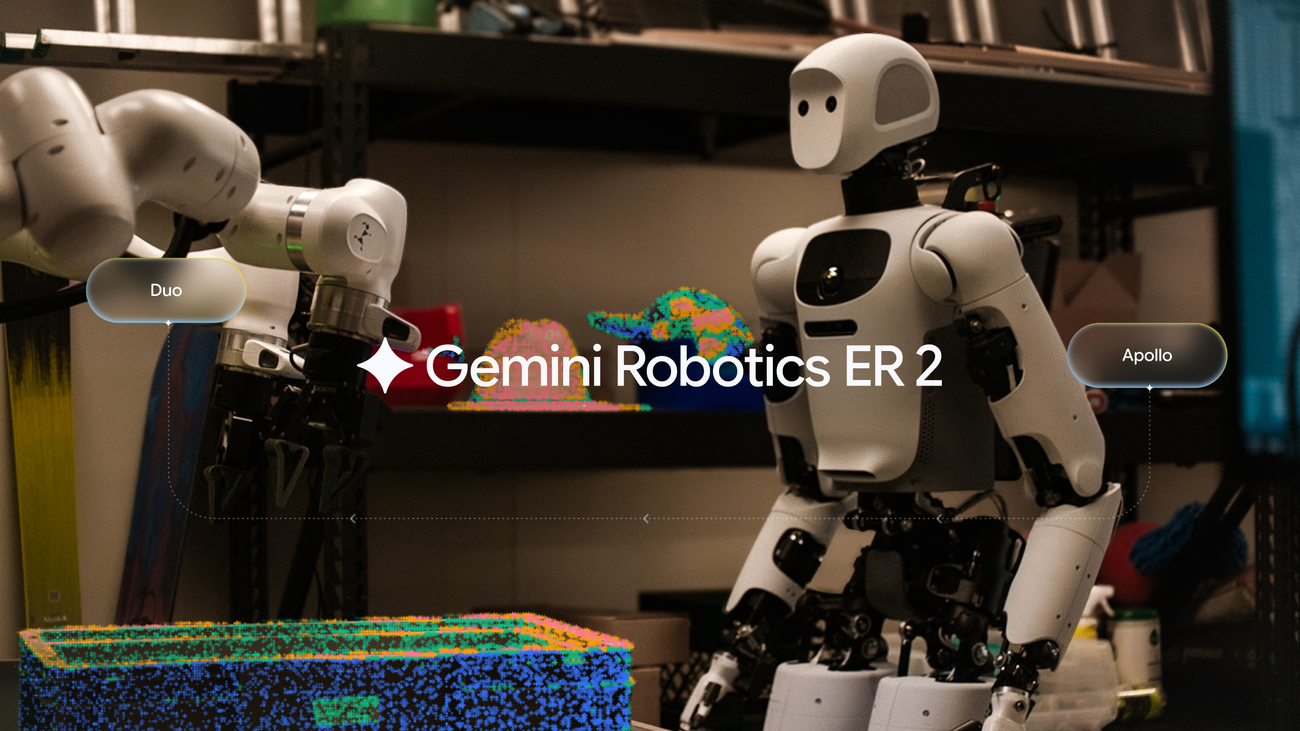
Gemini Robotics ER 2 helps robots reason, collaborate, and solve real-world tasks. It represents a step change in video understanding, tool orchestration, and multi-robot collaboration for robotic applications.
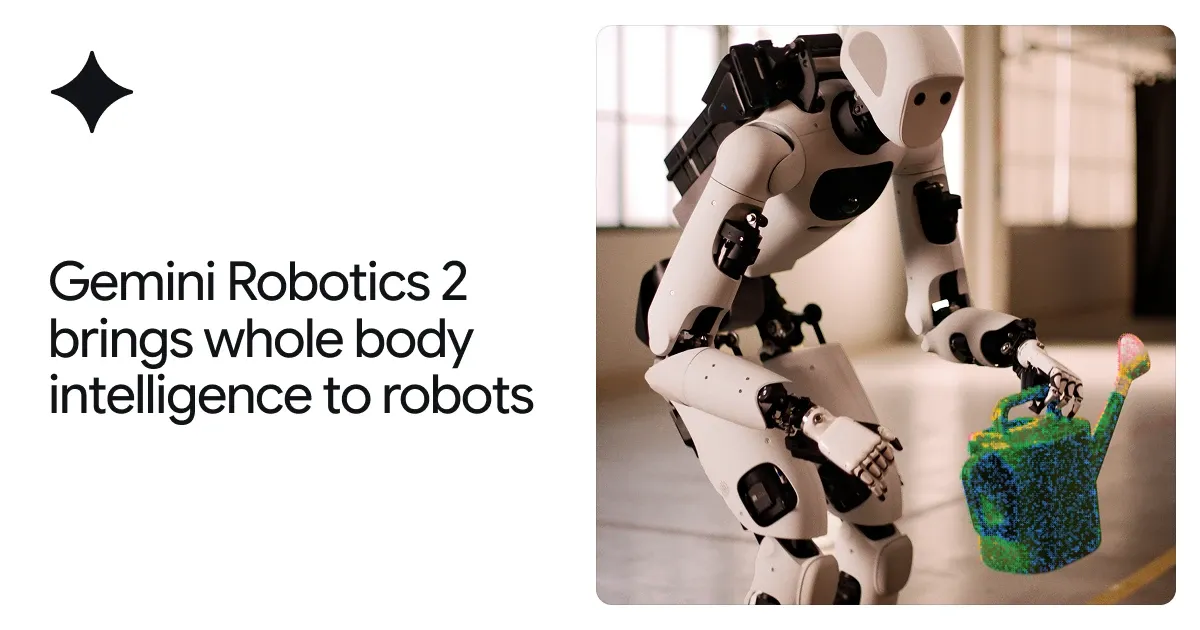
From feet to fingertips — we are teaching robots intelligent whole-body control, fine dexterity, and teamwork to complete a broad range of complex tasks.
We use cookies to run the site and, with your consent, for analytics and to show ads.
See our Cookie Policy.