Robotic-GST is presented, a geometry-aware spatio-temporal behaviour representation and evaluation framework that constructs a Gaussian-SAM robotic environment for real-to-sim policy verification and improves the reliability of real-world manipulation deployment.
Si-Chao Liu, Ze-Kun Wang, Li-Xuan Tang et al.· 0 citations
World-action models can jointly predict future visual observations and robot actions. However, discrepancies may exist between their visual predictions and the consequences implied by generated actions. We observe that WAMs can often generate visually plausible task-completion outcomes before producing action sequences...
Yu-Heng Qiao, Zi-Ran Wei, Xiao-Hang Wang et al.· 0 citations
CodeActionBench is introduced, a benchmark of 25 manipulation tasks that evaluates this capability through agentic Code-as-Policy and provides a controlled testbed for measuring how general-purpose models translate their capabilities into manipulation behavior and for examining typical failure scenarios in that process...
Yiheng Lyu, Xueying Jiang, Wen-Hao Li et al.· 0 citations
This work introduces eVTA, which learns success probabilities from mixed-quality policy rollouts through temporal-difference-style bootstrapping, without expert demonstrations or intermediate annotations, and introduces RL with Evolving Rewards (RLER), a closed-loop framework that adapts eVTA using newly collected roll...
Duo Wu, Hai-Feng Wang, Rongwei Lu et al.· 0 citations
Reach audiences
Advertise in front of researchers, engineers, and readers.
The results demonstrate the feasibility of harness distillation for robotics: intervention experience can be accumulated, refined through execution, and reused across agents to improve manipulation.
Seungyeon Kim, Junhoo Lee, Minkyu Kim et al.· 1 citation
World Action Models (WAMs) are becoming increasingly important and useful for embodied intelligence, as they enable robots to anticipate the consequences of candidate actions before interacting with the physical environment. However, underwater robots are usually subject to passive dynamics, such as inertia, buoyancy,...
Cunhao Zhu, Yifeng Wang, Dongliang Xu et al.· 0 citations
VehDyn provides a systematic foundation for developing driving world models that are physically consistent and visually realistic, and benchmarks 12 state-of-the-art video world models.
Tian-Yi Wang, Wang-Sheng Du, Jia-Zhou Chen et al.· 0 citations
A symmetric Dual-Arm Expert (DAE) architecture built upon a shared Vision-Language Model (VLM) backbone with decoupled, arm-specific expert towers is proposed, providing preliminary evidence of emergent skill generalization from single- to dual-arm tasks (as well as the reverse), together with cross-arm motion-domain s...
Yong-Shen Zhao, Han Gao, Bao-Ping Cheng et al.· 0 citations
DPP enables real-time dynamic manipulation on a single consumer GPU without additional training on dynamic data and constructs a counterfactual observation that places a predicted target position in a familiar robot context, allowing the model to invoke an existing manipulation skill rather than generate a recovery beh...
Sunwoo Park, Won-Sang Lee, Seonghyun Jin et al.· 0 citations
This work argues that their continual coordination under competing demands constitutes an important and underexplored target for modern robot learning and proposes the ethological behavioral substrate as a conceptual lens for studying this form of competence in artificial agents.
VPTwin is proposed, a Real-Sim-Real video prediction framework that anchors real-world future prediction using real-synchronized simulation twins and establishes a predictive planning loop using VPTwin to visually verify VLM-proposed actions and guide reliable real-world execution.
Zheng-Hao Xiao, Min-Ting Pan, Nan-Tian He et al.· 0 citations
Robots are getting smarter, but how can their hardware match that growth? New Microsoft Research findings show that moving AI inference beyond the robot can improve task success, boost efficiency, and support more advanced physical AI workloads. The post Offloaded inference for real-world physical AI robotics appeared first on Microsoft Research.
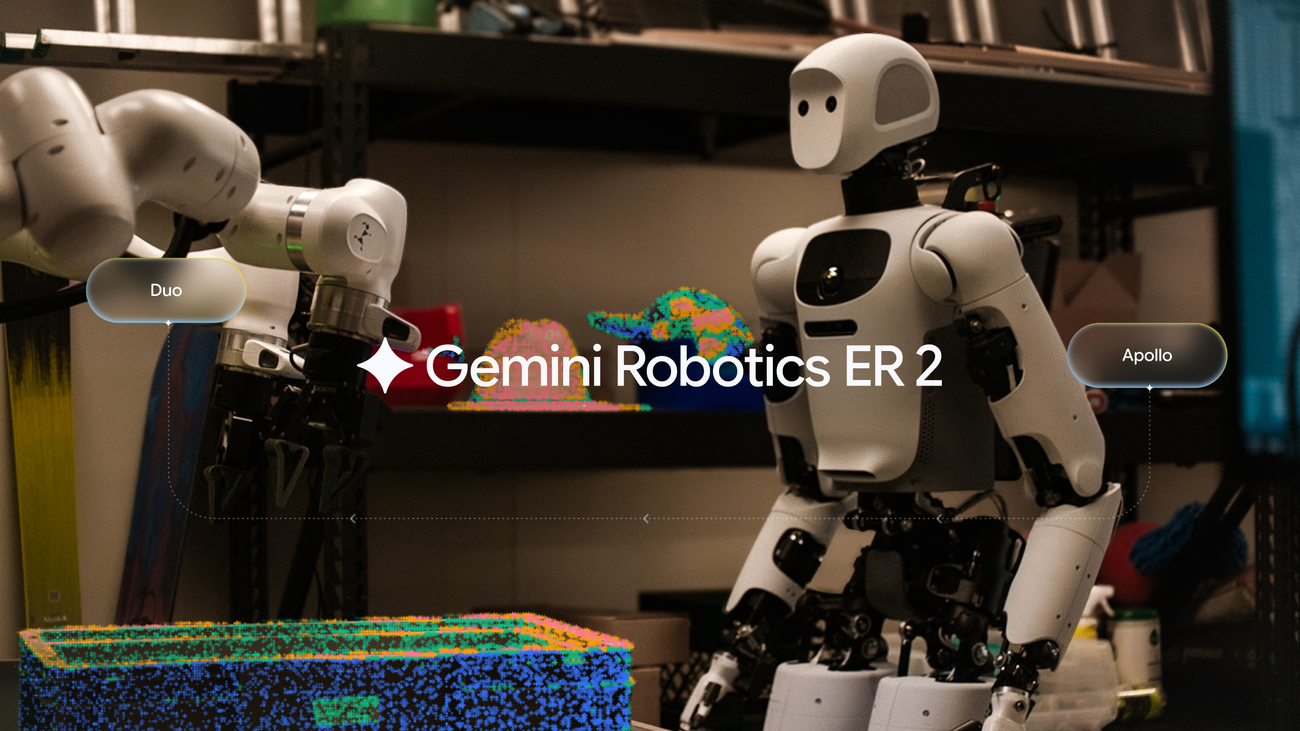
Gemini Robotics ER 2 helps robots reason, collaborate, and solve real-world tasks. It represents a step change in video understanding, tool orchestration, and multi-robot collaboration for robotic applications.
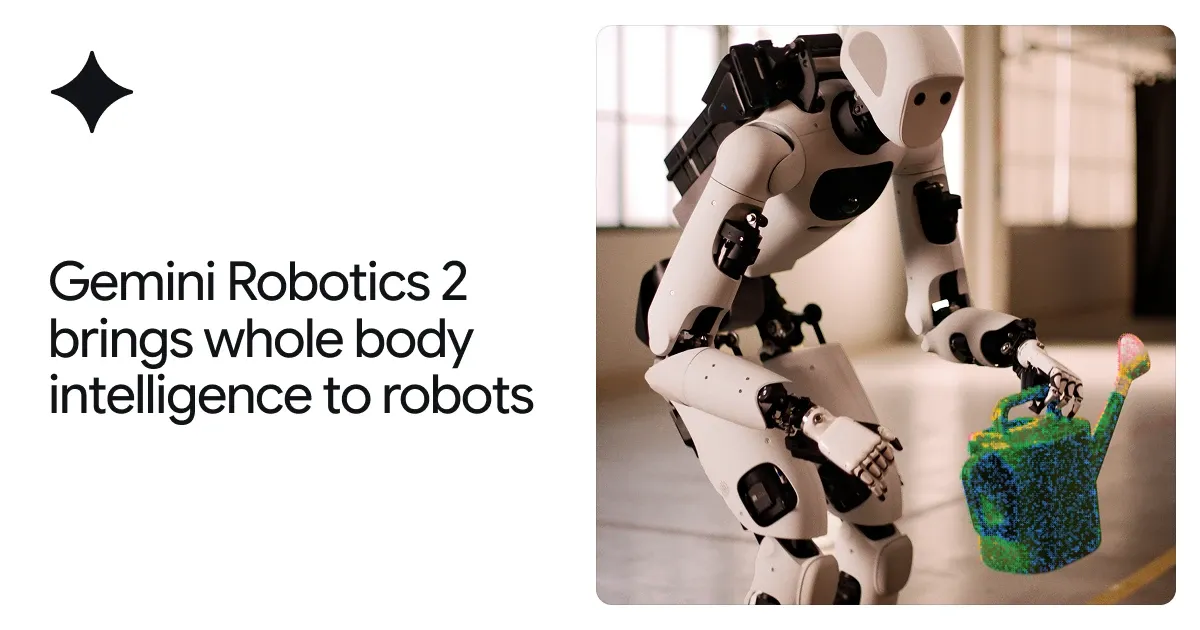
From feet to fingertips — we are teaching robots intelligent whole-body control, fine dexterity, and teamwork to complete a broad range of complex tasks.
We use cookies to run the site and, with your consent, for analytics and to show ads.
See our Cookie Policy.