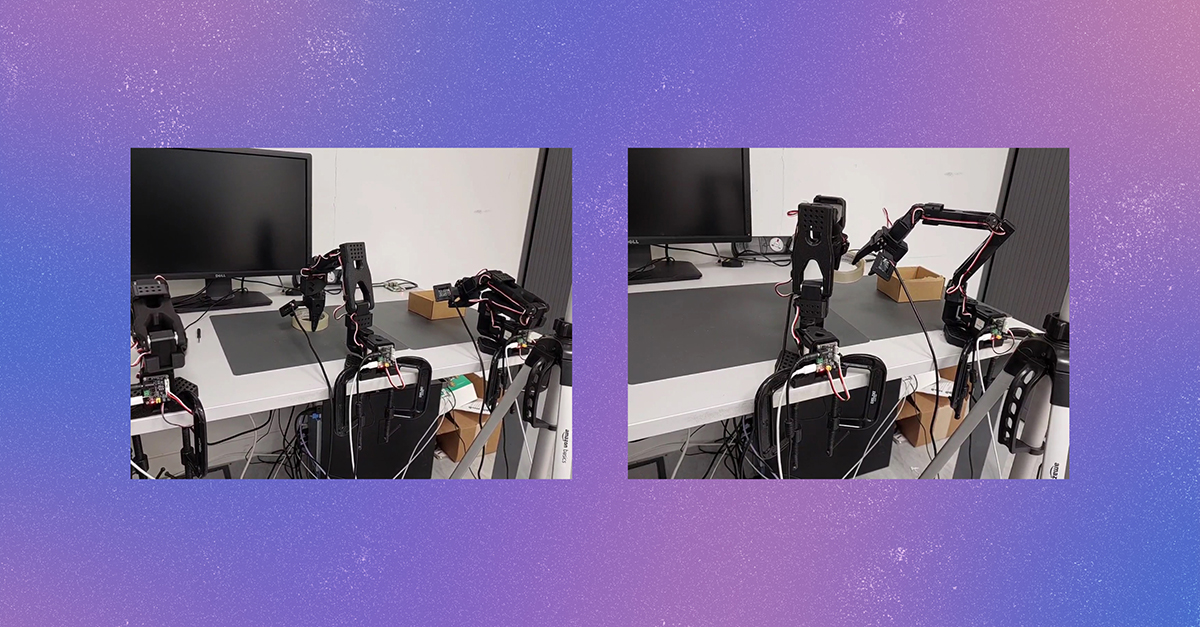
Humanoid robots still struggle to plan contact-rich whole-body manipulation from egocentric RGB and proprioception. Workhorse learns such manipulation from robot-free human demonstrations. A visual planner predicts five-link targets: the poses of the torso, both wrists, and both feet. A reinforcement-learning whole-bod...
Songbo Hu, Qiayuan Liao, Yufeng Chi et al.· 0 citations
Humanoid loco-manipulation of large, heavy objects demands forceful interaction across the entire body. However, such payloads shift a humanoid's center of mass and impose sustained loads across the upper body, challenging balance and command tracking. We present HULK, a whole-body control framework for forceful loco-m...
An Dang, Arturo Flores Alvarez, Yu-Ming Chen et al.· 0 citations
Self-driving laboratories (SDLs) are transforming chemical and materials discovery through closed-loop automation, yet automated infrastructure for physical manipulation of soft, deformable matter remains beyond current robotic platforms. A critical instance is autonomous droplet transport on an open surface, where con...
Interpretability offers a solution to safe autonomy by providing transparency into an agent's underlying decision-making model. Within sequential-decision making tasks, differentiable decision trees (DDTs) are one approach to such interpretability, maintaining automatic-differentiable policies while providing humans wi...
Offline MARL increasingly relies on generative policies to model multimodal joint behavior, typically by distilling a centralized teacher into decentralized one-step actors under the CTDE. We identify a failure mode at the teacher training stage: standard flow-based teachers pair noise with replay targets independently...
Sangmin Lee, Youngju Na, Chanmi Lee et al.· 0 citations
Existing teleoperation systems are often tailored to specific robot hardware and task domains, limiting their scalability and adaptability. We present ModPack, a modular and extensible teleoperation system designed to support diverse robot embodiments and task requirements within a unified framework. At the core of Mod...
Joshua Citron, Renee Zbizika, Zeyi Liu et al.· 0 citations
High-speed off-road autonomy requires precise closed-loop control for a target vehicle while remaining robust across changing terrains. Recent forward kinodynamic (FKD) prediction foundation models suggest a promising path, starting from a generalist model and specializing it to the target platform. However, effective...
Rwik Rana, Jesse Quattrociocchi, Christian Ellis et al.· 0 citations
Robot policies inevitably encounter failures when deployed in real environments. Naive retries often repeat the same mistakes, while many existing recovery methods rely on human intervention. In this paper, we propose Failure-Aware Retry (FAR), a framework that enables robots to learn from previous failures at test tim...
Robotics are expected to support environmental monitoring and disaster detection, where decisions must be made under uncertainty, resource limitations, and strict operational constraints. In critical missions, such as wildfires, robots must not only identify hazardous events with sufficient confidence, but also manage...
Lina Magoula, Nikolaos Koursioumpas, Nancy Alonistioti et al.· 0 citations
World models have recently seen a rapid growth in both their popularity and capability as more data efficient tools for generating robot training data or simulating real world environments, with many works proposing their integration into the robot learning pipeline. While highly practical, in this work we demonstrate...
Ethan Rathbun, Ahmed Agha, Saaduddin Mahmud et al.· 0 citations
Visual world models have shown great potential in learning complex system dynamics. Recent advancements leverage these models as transition functions within Model Predictive Control (MPC) frameworks to solve various control tasks. When applied to robotics, however, they are limited to single-stage tasks such as reachin...
Video world models (WMs) have shown promise for policy evaluation and improvement by imagining realistic future observations conditioned on ego-robot actions. While WMs can model distributions over futures, policy evaluation and improvement typically rely on nominal imaginations, which can miss high-impact outcomes of...
Junwon Seo, Sushant Veer, Ran Tian et al.· 0 citations
Robots are getting smarter, but how can their hardware match that growth? New Microsoft Research findings show that moving AI inference beyond the robot can improve task success, boost efficiency, and support more advanced physical AI workloads. The post Offloaded inference for real-world physical AI robotics appeared first on Microsoft Research.
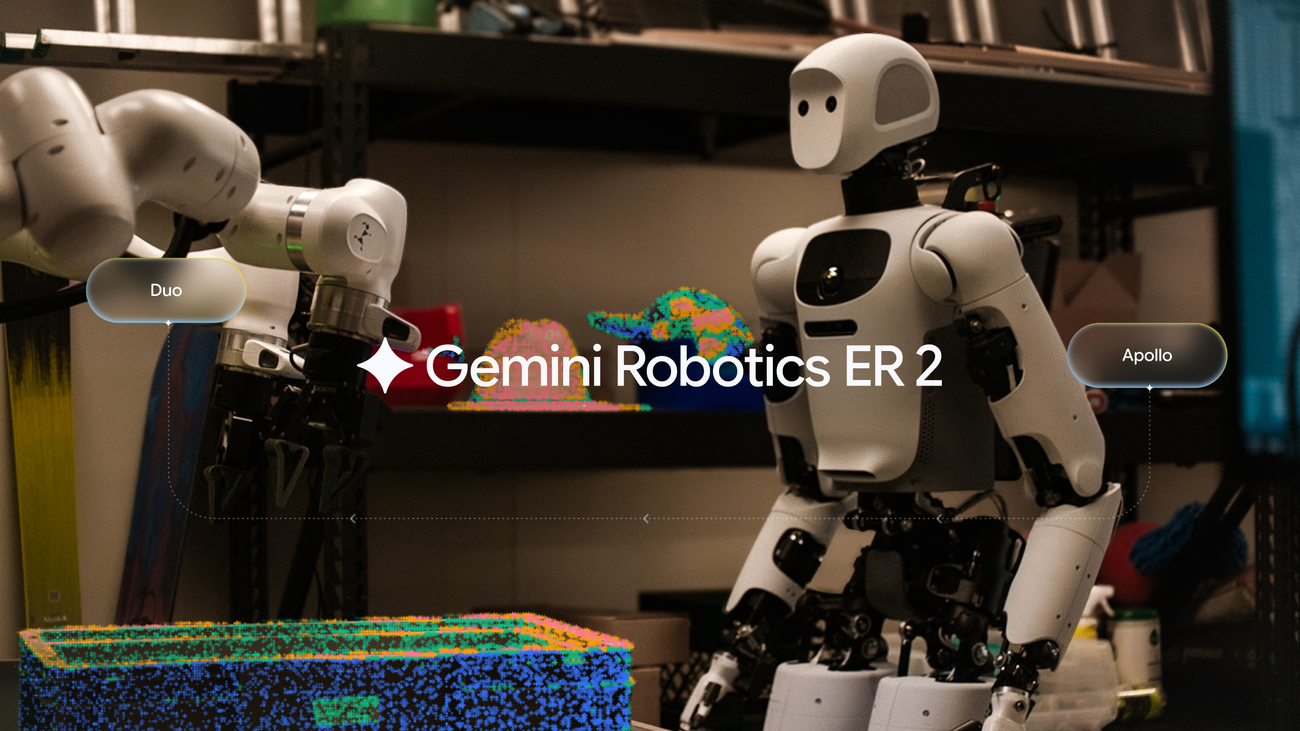
Gemini Robotics ER 2 helps robots reason, collaborate, and solve real-world tasks. It represents a step change in video understanding, tool orchestration, and multi-robot collaboration for robotic applications.
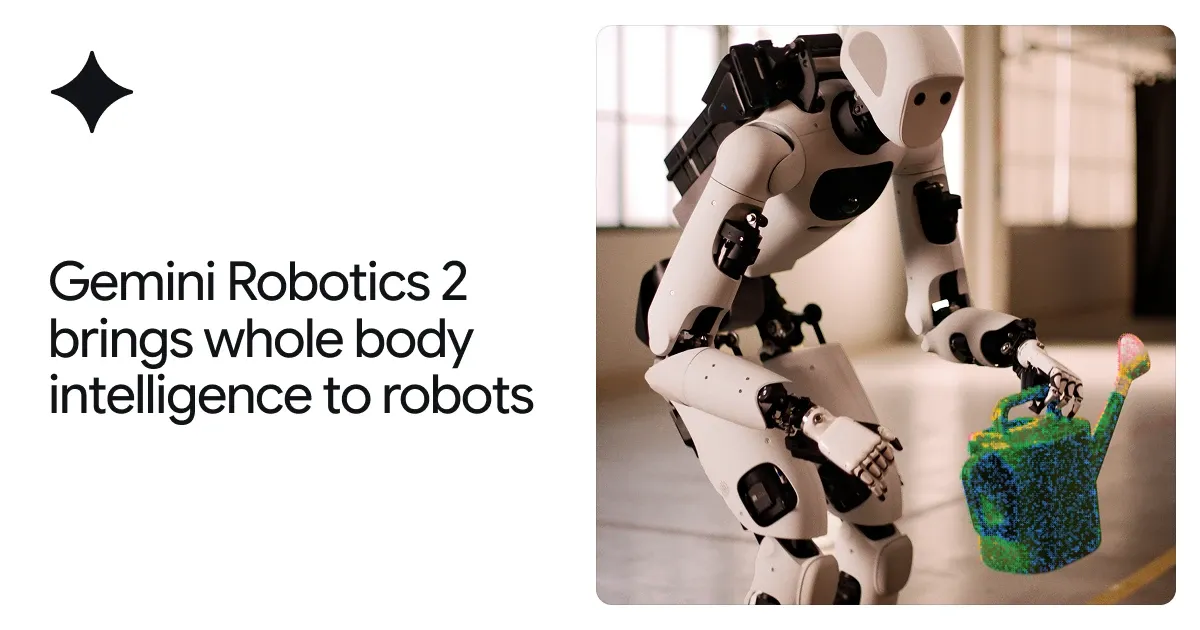
From feet to fingertips — we are teaching robots intelligent whole-body control, fine dexterity, and teamwork to complete a broad range of complex tasks.
We use cookies to run the site and, with your consent, for analytics and to show ads.
See our Cookie Policy.