A lightweight and versatile learned optimizer that dynamically recombines gradient history, represented as averages over disjoint time spans, is presented, which minimizes memory cost of long history, while keeping their contributions independently accessible.
COPC is introduced, an actor--critic method combining token-level ratio masking with two-sided clipped-ratio weighting of TD residuals for return and advantage estimation that achieves the highest reported performance on tool-integrated mathematical reasoning and search, outperforming the strongest reported asynchronou...
Zi-Cheng Hu, Zhi-Jian Zhou, Xuan Zhang et al.· 0 citations
We study finite-horizon online resource allocation with i.i.d. requests and an endogenous Markov state on a finite state space: each action affects the transition of the state that governs future rewards and resource consumption. In this problem, a transient fluid LP benchmark upper bounds the expected reward of every...
Effective traffic signal control (TSC) requires policies that respond to changing traffic demand and network conditions while meeting different control objectives. However, adapting existing strategies often involves repeated manual design and adjustment, making it difficult to systematically explore better control rul...
Leizhen Wang, Peibo Duan, Zhenlin Qin et al.· 0 citations
Reach audiences
Advertise in front of researchers, engineers, and readers.
Wi-Fi sensing promises to turn the everyday wireless signals that already surround us into ubiquitous sensors for human sensing. However, a fundamental obstacle is that CSI is acquired under diverse device-specific configurations, including different subcarrier counts, bandwidths, and carrier bands. Consequently, the r...
Daniel Eckhoff, Hua Kang, Zhi-Tang Chen et al.· 0 citations
Background: Modern software systems increasingly rely on Machine Learning (ML) assets (i.e., pre-trained models, datasets, benchmarks) for building, evaluating, and integrating ML-based systems. However, current exploration, selection and reuse practices of ML assets are not supported by systematic retrieval methodolog...
Alexandra Gonz\'alez, Quim Motger, Xavier Franch et al.· 0 citations
CircuitGate is proposed, a function-aware AIG representation learning framework that advances from gate-level semantics to circuit-level functional modeling, and achieves the best equivalent-gate identification performance, demonstrating strong cross-dataset generalization.
Qi-Fan Zhang, Rui-Jie Li, Fang-Zhou Zhang et al.· 0 citations
Production machine-learning models are derived artifacts of time-bounded training snapshots: a deployed model is a materialized view over a training cut that ages the instant it is built. A common response is to replace the fixed retraining cadence with an adaptive trigger -- a weighted staleness score that retrains wh...
Physics-informed neural PDE solvers adapt their parameters to satisfy governing equations, yet their representational structure typically remains fixed throughout training. This rigidity is poorly matched to PDE solutions with strongly heterogeneous complexity across space and space--time, leaving capacity insufficient...
Chun-Wun Cheng, Bing-Cheng Hu, A. Avilés-Rivero· 0 citations
Geometric and Spectral Alignment (GSA) characterizes trained networks through spectral concentration, physical-channel alignment, support structure, and changes in singular bases. In this paper, we propose CHASE (Channel-Aligned Structure Exploitation) to use these structures in practical model design. CHASE covers six...
Learning systems adapt quickly inside a familiar family of models. The harder step comes earlier: deciding, from observations that could be noise, an exception, a change within the family or structure outside it, whether opening a richer family is worth its cost. We treat this as a costly sequential decision: predictio...
Weihan Li, Xinlei Chen, Junhao Wu et al.· 0 citations
Thermo-mechanical fracture couples transient heat conduction on a cracked domain with a crack that grows as the temperature and the displacement evolve. Neural energy solvers have been proposed for phase-field fracture and later extended to represent a sharp crack through the network input, but heat conduction on the c...
Han Zhang, M. Alamdari, B. Shahbodagh et al.· 1 citation
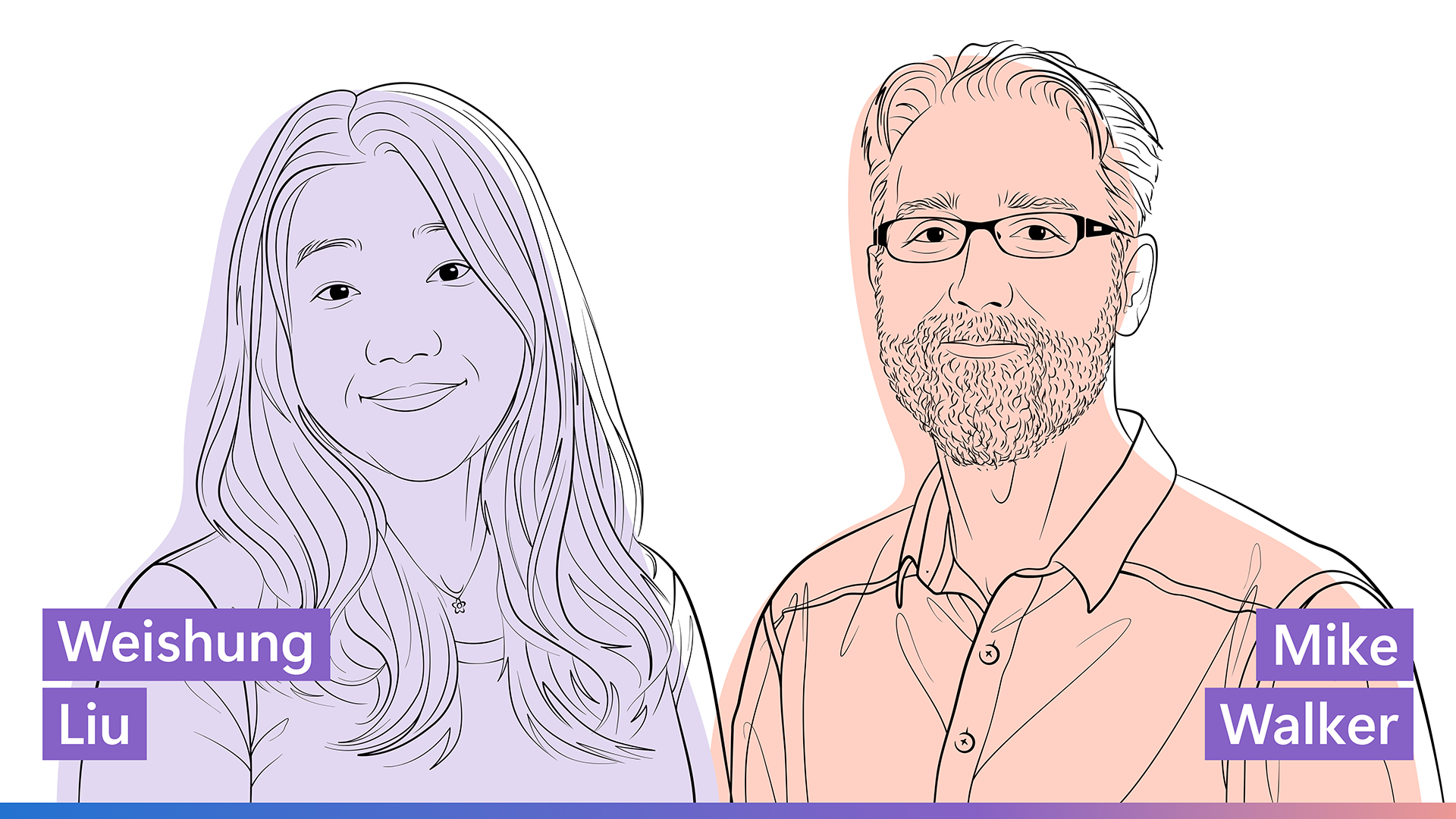
Research Manager Mike Walker reflects on a career spanning hacker culture, cybersecurity, and AI, sharing lessons about trust, teamwork, leadership, and why solving difficult problems requires curiosity, judgment, agility—and an understanding of the rules. The post Learn the rules: The hacker mindset appeared first on Microsoft Research.
Learn how Google Antigravity and our Cheminformatics Skills accelerate drug discovery workflows, search compounds, and propose novel rigidified macrocycles.
MIT News · Artificial Intelligence· news.mit.eduOct 28, 2026
Professor Paris Smaragdis develops computers with superhuman hearing for applications like speech recognition, music understanding, and environmental monitoring.
MIT News · Artificial Intelligence· news.mit.eduOct 27, 2026
Prabha Jha used her experience with MIT Open Learning’s program for senior executives to develop AI solutions for her employer, Verizon, and to write a book.