This work proposes CAFE+FNO, which incorporates Content-Aware Frequency Encoding+ (CAFE+) into Fourier kernel generation, and compares CAFE+FNO with existing FNO variants on five PDE benchmarks and conducts ablation studies on basis configuration, multiplicative composition, and bandwidth learnability.
Offline MARL increasingly relies on generative policies to model multimodal joint behavior, typically by distilling a centralized teacher into decentralized one-step actors under the CTDE. We identify a failure mode at the teacher training stage: standard flow-based teachers pair noise with replay targets independently...
Sang-Min Lee, Youngju Na, Chan-Mi Lee et al.· 0 citations
Tabular data underpin prediction and decision-making in medicine, finance, government and science, but often contain sensitive individual-level information, creating a need for accurate prediction while preserving privacy. Traditional private learning provides formal privacy guarantees, but requires slow dataset-specif...
Talal Alrawajfeh, Cristiana-Diana Diaconu, Ossi Räisä et al.· 0 citations
With the rise of univariate time series foundation models (e.g., Sundial, Timer), initial efforts have been made to extend them to multivariate settings. However, these models mainly focus on modeling correlations among variables. When they are applied to multi-station weather forecasting, two important factors are oft...
Xiao Wang, Changjian Chen, Zhuo Tang et al.· 0 citations
Reach audiences
Advertise in front of researchers, engineers, and readers.
Physical reservoir computing exploits the nonlinear dynamics of physical systems to process time-dependent data with greater energy efficiency than conventional machine learning approaches. However, physical reservoirs have fixed intrinsic response timescales, whereas real-world signals combine deterministic and stocha...
Joshua Donald, Alex Gabbitas, Arthur G. T. Coveney et al.· 0 citations
Effective long-range propagation remains a central challenge in graph neural networks, as increasing a model's propagation depth does not guarantee that distant nodes effectively influence each other. Sheaf neural networks enrich graph propagation through matrix-valued transport between stalks; still, this expressivity...
J. Van Looy, Alessandro Trenta, Alessio Gravina et al.· arXiv (Cornell University)· 0 citations
Can a biological wiring diagram serve as a useful computational substrate beyond the behaviors for which it evolved? We use the publicly released MaleCNS v1.0 connectome, reconstructed from a single adult male Drosophila specimen, as the fixed recurrent topology of an artificial network. We train separate models for bo...
Post-training quantization (PTQ) enables efficient deployment, yet transformer architectures remain challenging to quantize due to nonlinear layers. While existing methods attribute accuracy loss to insufficient numerical precision, often necessitating floating-point fallbacks, we demonstrate that degradation is actual...
Eli S. Levy, Adam Teman, Yoni Pugachov· 0 citations
Training can drive a transformer into a rank collapse: all token representations point in one direction, and learning stops. In a related collapse of attention, a loss term with a bounded corrective force repairs the network during the run. We ask whether such a term repairs rank collapse. We collapse small transformer...
Traffic flow modeling is essential for understanding and predicting the collective dynamics of vehicles on road networks. Cellular automata provide a simple, interpretable yet powerful framework for representing these dynamics via local interaction rules, while retaining the ability to reproduce complex macroscopic tra...
Sample complexity is a widely used metric in sequential decision-making problems, defined as the number of suboptimal decisions during the interaction between the agent and an environment. We study the sample complexity of stochastic multi-armed bandit problems and introduce the expected sample complexity performance m...
It is shown that a natural account of these spectral phenomena emerges when the original setting is understood as a departure from a nearby, otherwise hidden, highly symmetric reference.
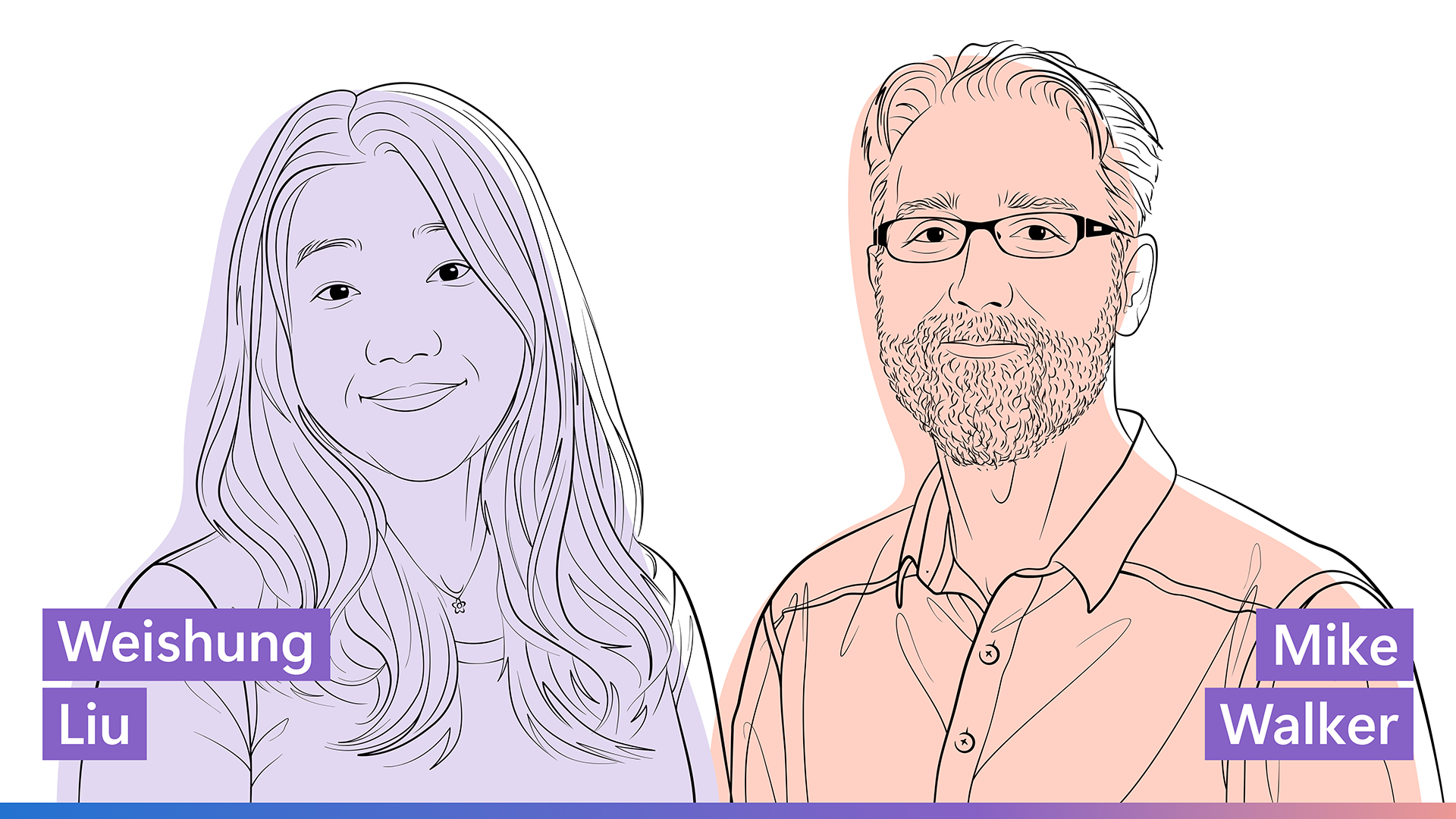
Research Manager Mike Walker reflects on a career spanning hacker culture, cybersecurity, and AI, sharing lessons about trust, teamwork, leadership, and why solving difficult problems requires curiosity, judgment, agility—and an understanding of the rules. The post Learn the rules: The hacker mindset appeared first on Microsoft Research.
Learn how Google Antigravity and our Cheminformatics Skills accelerate drug discovery workflows, search compounds, and propose novel rigidified macrocycles.
MIT News · Artificial Intelligence· news.mit.eduOct 28, 2026
Professor Paris Smaragdis develops computers with superhuman hearing for applications like speech recognition, music understanding, and environmental monitoring.
MIT News · Artificial Intelligence· news.mit.eduOct 27, 2026
Prabha Jha used her experience with MIT Open Learning’s program for senior executives to develop AI solutions for her employer, Verizon, and to write a book.