Universal machine learning force-field generalization to multicomponent environments generated by compositional design remains insufficiently assessed. We construct a benchmark of 7,599 multicomponent configurations inspired by high-entropy design, elemental substitution and anion mixing. Eleven pretrained models are e...
Hong-Wei Du, Ding-Yang Lv, Bao-Le Wei et al.· 0 citations
Acoustic foundation models (AFMs) have democratized acoustic applications, enabling powerful models for tasks ranging from speech recognition to speaker verification with minimal resources. However, the security of applications based on AFMs remains largely underexplored. Our work addresses this gap by proposing the Fo...
Reproducible benchmarking of Large Language Model (LLM) inference is challenging because repeated measurements can vary with execution and system state. We present the Sequential Isolation Methodology, a controlled benchmarking and regression-testing protocol designed to reduce between-run measurement variance while de...
Arnold Olympio, Juan Manuel Servera Bondroit, Wael Abdelmalek et al.· 0 citations
When does distribution alignment help a frozen foundation-model embedding generalize across acoustic domains? For cross-domain mosquito-species classification we report a strength-monotonic law: the stronger an encoder is on the target task, the more its unseen-domain generalization relies on a distribution-alignment (...
Yucheng Gong, Rui Zhou, Binbin Zeng et al.· 0 citations
Reach audiences
Advertise in front of researchers, engineers, and readers.
Kernel methods are among the most powerful tools in machine learning and statistics, with a large number of successful applications. Their immense success stems from the flexible function class associated to each kernel---its reproducing kernel Hilbert space (RKHS)---which facilitates statistical analysis, as well as f...
Jose Cribeiro-Ramallo, Florian Kalinke, Zoltán Szabó· 0 citations
Quantum kernel methods are leading candidates for a practical quantum advantage in machine learning, but assessing that potential requires two quantities usually reported separately: how well a kernel performs on the task, and how far its geometry departs from the classical kernels available for the same problem. We in...
Boaz Micah, Nadia Milazzo, Maissa Beji et al.· 0 citations
We develop a continuous-time deterministic policy gradient framework for reinforcement learning with reflected state dynamics, where the state process is governed by a controlled reflected stochastic differential equation on a hypercube. Under suitable regularity assumptions, we establish the connection between the val...
Token-Pruning accelerates Vision-Language Models by removing redundant visual tokens, yet its safety implications remain underexplored. In this work, we present the first comprehensive safety evaluation of Token-Pruning mechanisms and find that: most pruning strategies significantly degrade safety as pruning ratios inc...
Shuailong Wang, Xinyu Lyu, Shengming Yuan et al.· 0 citations
It is shown that when both market prices and trader valuations are chosen adversarially, sublinear regret is impossible even under full feedback, thereby motivating the stochastic assumption on the valuations.
Maria Elena Vischi, F. Stradi, A. Marchesi· 0 citations
Navigation-aware loss (NAViLoss), a robust and uncertainty-aware objective function for learning-based AUV velocity estimation, is introduced, demonstrating the effectiveness of navigation-aware and uncertainty-adaptive loss design for robust learning-based underwater velocity estimation.
Structured recovery phenomena, such as restricted isometry properties in compressed sensing, have shown that high-dimensional objects can often be reconstructed from remarkably low-dimensional linear measurements. This work develops an analogous recovery framework for low-rank signed measures on $\mathbb{R}^2$, defined...
Self-supervised anomaly detection is a promising paradigm for medical ultrasound, as normal images are often easier to obtain than exhaustive annotations of all possible pathologies. However, most existing evaluations are limited to a single anatomy or task, making it unclear whether models learn a robust notion of nor...
Marco Riedenauer, Daniel Kienzle, Pratik Mayekar et al.· 0 citations
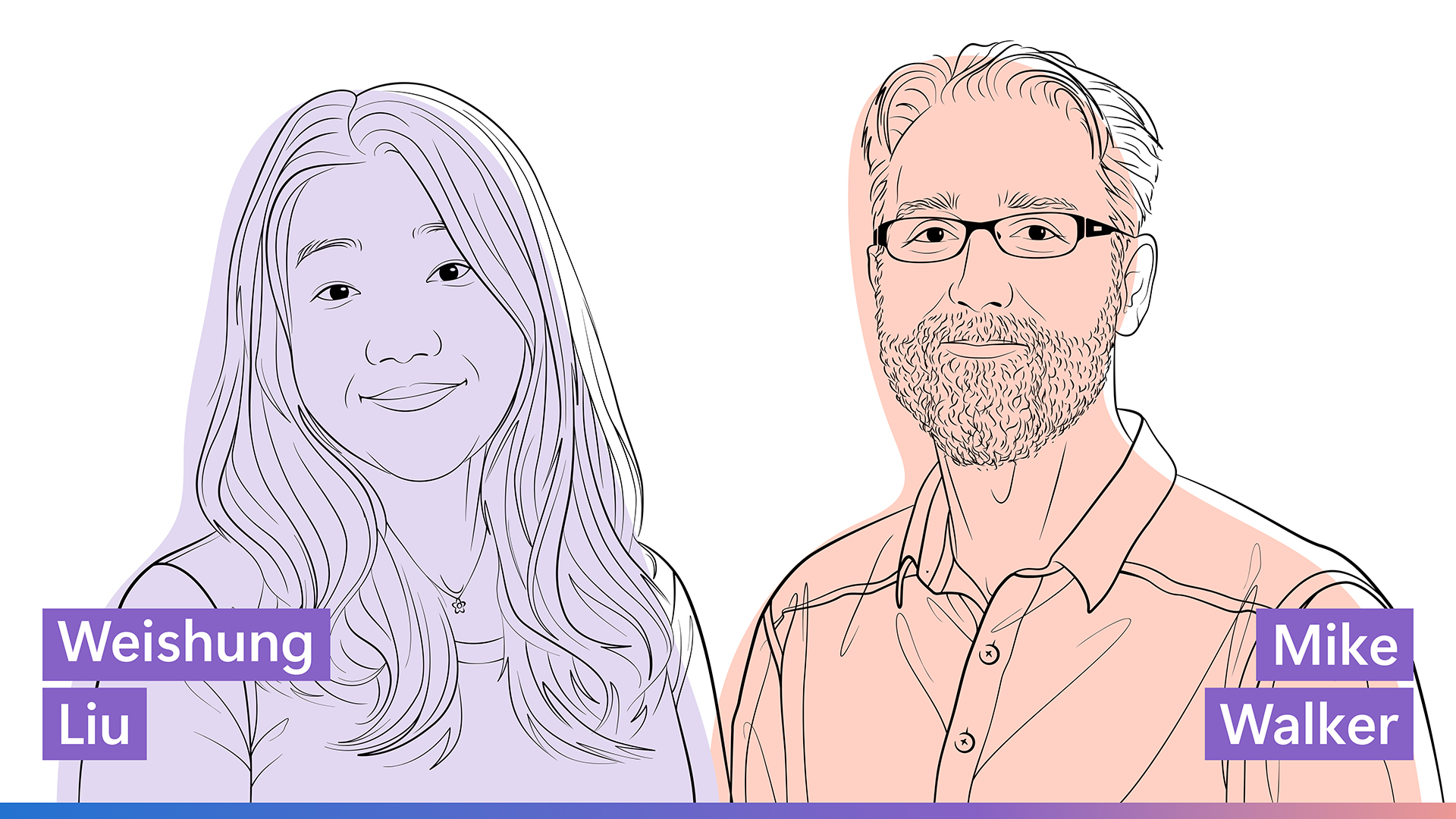
Research Manager Mike Walker reflects on a career spanning hacker culture, cybersecurity, and AI, sharing lessons about trust, teamwork, leadership, and why solving difficult problems requires curiosity, judgment, agility—and an understanding of the rules. The post Learn the rules: The hacker mindset appeared first on Microsoft Research.
Learn how Google Antigravity and our Cheminformatics Skills accelerate drug discovery workflows, search compounds, and propose novel rigidified macrocycles.
MIT News · Artificial Intelligence· news.mit.eduOct 28, 2026
Professor Paris Smaragdis develops computers with superhuman hearing for applications like speech recognition, music understanding, and environmental monitoring.
MIT News · Artificial Intelligence· news.mit.eduOct 27, 2026
Prabha Jha used her experience with MIT Open Learning’s program for senior executives to develop AI solutions for her employer, Verizon, and to write a book.