Generalist robot policies are trained with imitation learning and are bounded by the quality and coverage of their demonstrations. Reinforcement learning can improve and extend them, either by fine-tuning the policy weights or by training a small module to steer the input noise of a frozen generative policy. When tasks...
Bahey Tharwat, Iman Nematollahi, Marvin Alles et al.· 0 citations
Variational quantum circuits (VQCs) are highly sensitive to circuit architecture, yet most quantum machine learning pipelines select a single best design and discard the remaining candidates. This paper addresses whether the structural diversity across quantum circuit search spaces can be used to produce stronger predi...
Jing-Yan Xu, Yuan-Hong Wu, Samuel Yen-Chi Chen et al.· 0 citations
Gaussian process solvers for linear partial differential equations (PDEs) return posteriors rather than point estimates, but they condition only on equality information: the PDE residual, boundary data, and measurements. Many solutions of interest also obey inequality constraints, including nonnegativity, monotonicity,...
Boyuan Deng, Kshitiz Upadhyay, Michael Shields· 0 citations
Variance reduction improves the convergence rate of stochastic non-convex optimization under the average smoothness condition. Existing adaptive variance reduction methods are especially designed for average smoothness and do not adapt to standard smoothness. In this paper, we study how one algorithm can adapt to these...
Wei Jiang, Yibo Wang, Zechao Li· 0 citations
Reach audiences
Advertise in front of researchers, engineers, and readers.
We present new algorithms for stochastic optimization problems in which the objective is neither smooth nor convex, subject to a convex constraint set. Our algorithms return a $(\delta,\varepsilon)$-Goldstein stationary point, as recently defined for constrained problems by Liu et al. (2024), with improved complexities...
Multiple-gradient descent is typically formulated in Euclidean geometry, whereas matrix-aware optimizers use directions induced by other norms. We analyze a single-loop multi-objective method combining a norm-constrained linear minimization oracle with entropic updates of task weights. For any finite-dimensional norm p...
El Mahdi Chayti, Alireza Mirrokni, Martin Jaggi· 0 citations
What can an adversary recover from a model trained with DP-SGD? Its $(\varepsilon,\delta)$ guarantee does not answer this question directly. We derive a distortion bound that can be computed before training and applies even to an adversary who observes the parameter trajectory during training, knows every other trainin...
Geospatial foundation models can support disaster damage assessment, but high accuracy on familiar disasters may hide shortcut learning: prediction from event or scene characteristics rather than evidence that transfers to a new disaster. We study embeddings from TerraMind, Prithvi-EO-2.0, DOFA, and DINOv3 on the multi...
Prior-data fitted networks (PFNs) are trained to approximate the Bayesian posterior predictive distribution (PPD) of a synthetic prior, yet results about the approximation quality are surprisingly thin. Taking an empirical risk minimization perspective, we decompose the deployment error of PFNs into prior, context, and...
M. Hulskamp, Julius Kobialka, Emanuel Sommer et al.· 0 citations
SmolWAM is presented, a latent WAM that is derived from the 2B-parameter Cosmos Policy by keeping its pretrained trunk and rebuilding its inference interface: single-frame visual latents, cached text features that preserve the trunk's attention sinks, and 1,008 tokens from which actions and future visual latents are re...
Timi Owolabi, Hikmah Olawore, Frances Adelakun et al.· 0 citations
Audio-visual dataset distillation aims to synthesize a small dataset from a large paired audio-visual dataset, while nearly preserving the training utility for neural networks. Existing approaches such as DM and AVDD face two critical limitations: 1) they are memory-intensive, making them difficult to scale to complex...
Latent field models are essential for spatial statistics, but the posterior distribution of the latent field, even with a Gaussian process (GP) prior, is analytically intractable whenever the likelihood is non-Gaussian. Existing approximations are either too slow or too restrictive for large non-Gaussian datasets. We p...
Paul F. V. Wiemann, Matthias Katzfuss· 0 citations
Learn how Google DeepMind and GovTech Singapore uses lightweight on-device Gemma models to intercept conversational scams in private chats with zero cloud data egress.
MIT News · Artificial Intelligence· news.mit.eduOct 13, 2026
Machine-learning networks can learn without detailed instructions from a designer. Those that do may offer insight into how the brain reorganizes itself during learning.
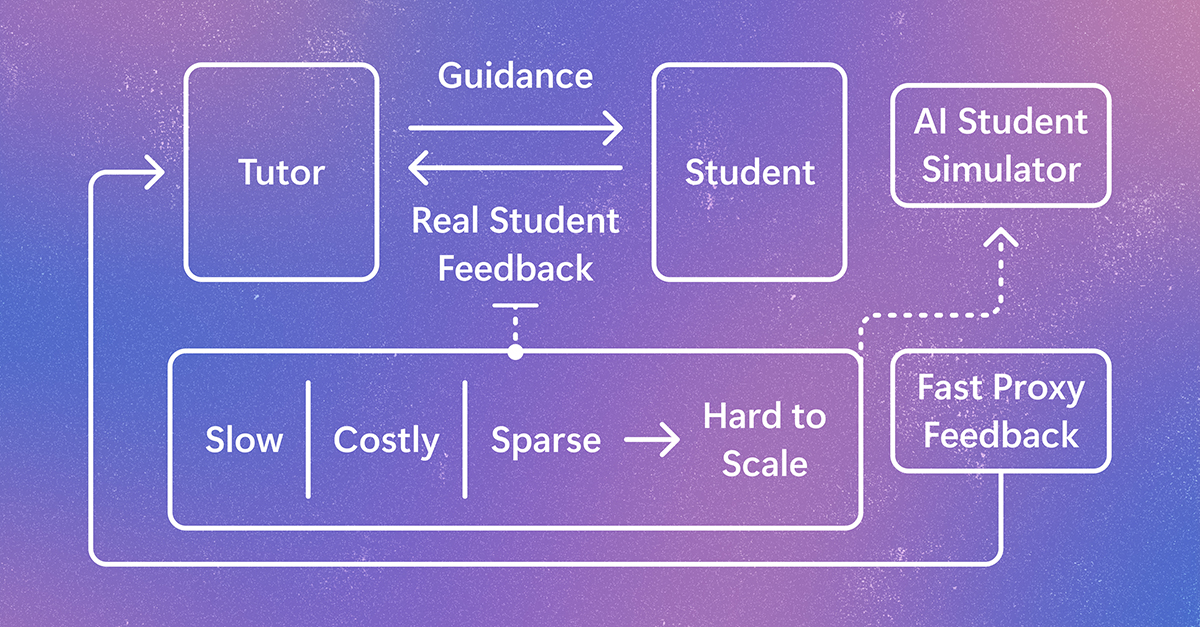
StudentSim is a research system for evaluating and improving AI tutoring tools before they are tested with learners. It models how individuals may engage with tutors, giving feedback to improve tutor performance across subjects like chess, writing, and mathematics. The post Simulating student learning for better AI tutoring appeared first on Microsoft Research.
We use cookies to run the site and, with your consent, for analytics and to show ads.
See our Cookie Policy.