Model fusion combines multiple Large Language Models (LLMs) with different strengths into a more powerful, integrated model through lightweight training methods. Existing works on model fusion focus primarily on supervised fine-tuning (SFT), leaving preference alignment (PA) --a critical phase for enhancing LLM perform...
Yanggan Gu, Yuanyi Wang, Zhaoyi Yan et al.· 0 citations
Pre-trained visual models have become fundamental in computer vision, but they face challenges in continual learning scenarios where data and tasks evolve over time. Low-Rank Adaptation (LoRA) offers efficient fine-tuning capabilities but remains limited for such dynamic environments. Standard LoRA cannot distinguish i...
A concept-guided poisoning unlearning framework that explicitly identifies the concepts that contribute most strongly to the target class or knowledge and uses them to guide the model update, achieving effective unlearning across different tasks while largely preserving retained model utility.
Contextual safety filtering (CSF), a training-free filter that grounds natural-language safety rules in safe and unsafe reference trajectories produced by the generator, is introduced.
Li-Zhi Yang, Yi-Ling Hou, Yao Tang et al.· 0 citations
Reach audiences
Advertise in front of researchers, engineers, and readers.
General-purpose robots must perform a wide range of tasks from agile locomotion to dexterous manipulation. While sim-to-real reinforcement learning (RL) has proven to be a useful tool for this goal, current RL pipelines depend on engineering-heavy, per-task structural priors such as shaped rewards and demonstrations. R...
Octi Zhang, Mateo Guaman Castro, Patrick Yin et al.· 0 citations
In this work, we show that a single Transformer block, applied recurrently, can match the accuracy of a full-depth vision encoder at comparable inference FLOPs without intermediate feature distillation. reViT restores depth-specific transformations by representing the FFN at each recurrent depth as a convex combination...
Adrian Bulat, Yassine Ouali, G. Tzimiropoulos· 0 citations
Density ratios quantify distribution shift from a probability-mass point of view, whereas displacement fields describe, from a dynamical point of view, how one distribution is transported onto another. Although both offer complementary insights, they are usually estimated separately, and converting one into the other r...
Teaching a humanoid to follow instructions with its whole body runs into two obstacles. Its action space is large and tightly coupled: legs, arms, and fingers must move together while the robot keeps its balance, which makes joint-level actions hard to learn. And humanoid demonstrations are scarce, so current humanoid...
Mert Albaba, Jens Bei{\ss}wenger, Anna Manasyan et al.· 0 citations
Safe reinforcement learning commonly places safety and task performance in the same policy objective, where they can introduce competing updates. Safety filters separate them at action execution, but classical designs require an analytic safety function and dynamics model, and standard minimal-intervention filters are...
Song-Yuan Zhang, Baljeet Singh, Sarthak R. Kaingade et al.· 0 citations
Building a quantum model involves a tradeoff: how complex the circuit should be, and how much training data it needs. Caro et al. show that models with fewer trainable gates need less training data to generalize well. Q-FLAIR shows that a quantum feature-map circuit can be grown gate-by-gate, stopping once further grow...
Dense correspondence matching has historically been bounded by simplifying spatio-temporal priors, such as smooth motion and rigid geometry. While effective for classical tasks, these assumptions break down in image editing and reference-guided generation (IEG), where transformations can preserve visual identity while...
Luping Liu, Bingyi Kang, Yifan Wang et al.· 0 citations
Multimodal large language models (MLLMs) struggle with spatial, embodied, physical, and temporal reasoning. We hypothesize that these failures reflect a shared deficit in visual transition reasoning, and test whether this capability can serve as a shared training primitive, one that different models can learn from diff...
Zhe-Yu Fan, Yue Zhang, Ming-Kai Deng et al.· 0 citations
Learn how Google DeepMind and GovTech Singapore uses lightweight on-device Gemma models to intercept conversational scams in private chats with zero cloud data egress.
MIT News · Artificial Intelligence· news.mit.eduOct 13, 2026
Machine-learning networks can learn without detailed instructions from a designer. Those that do may offer insight into how the brain reorganizes itself during learning.
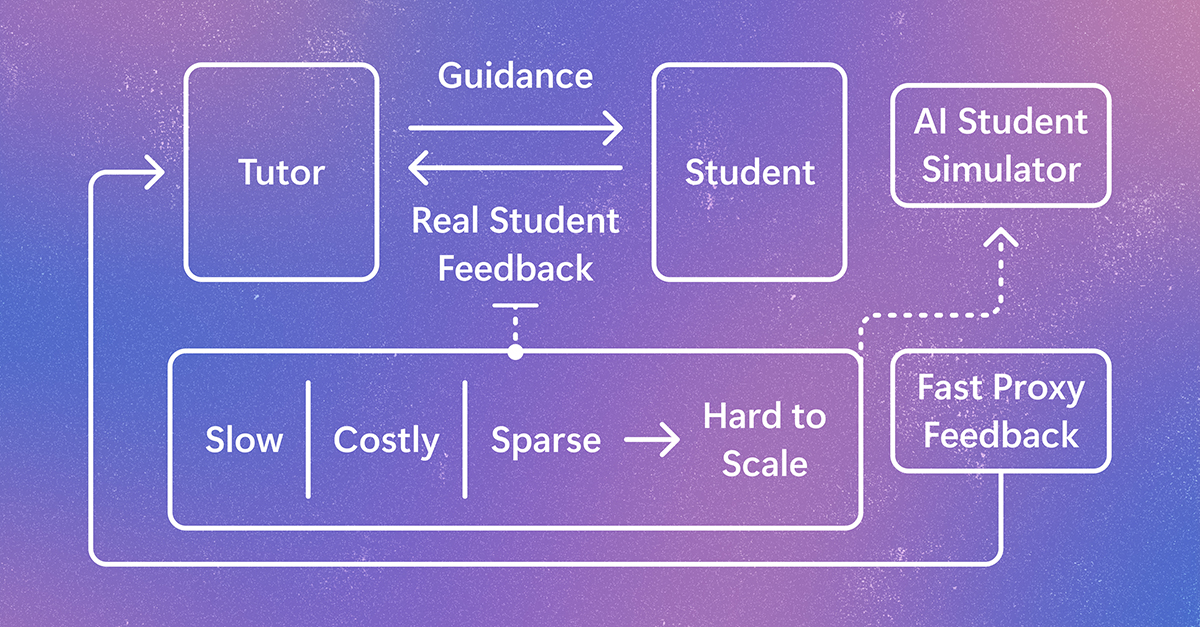
StudentSim is a research system for evaluating and improving AI tutoring tools before they are tested with learners. It models how individuals may engage with tutors, giving feedback to improve tutor performance across subjects like chess, writing, and mathematics. The post Simulating student learning for better AI tutoring appeared first on Microsoft Research.
Exploring how generative AI could make machine vision more accessible to businesses. The post GenEye in a Box: Making Machine Vision Something You Can Just Ask For appeared first on GPT-Lab.
We use cookies to run the site and, with your consent, for analytics and to show ads.
See our Cookie Policy.