In diffusion transformers, a class label or a text prompt is embedded once, and the same condition is reused at every denoising step. We ask whether predicted embeddings can serve as this condition instead. Next-Embedding Predictive Autoregression (NEPA) trains a Transformer to predict the next continuous embedding in...
Adverse conditions such as rain, snow, fog, and dust remain challenging for camera-based perception in autonomous driving. We study multi-class weather recognition from street-view images under domain shift, where most available training data come from non-street-view sources that differ markedly from real driving scen...
Hossein Maghsoumi, George Atia, Yaser P. Fallah· 0 citations
Wildfires pose severe risks to human life, ecosystems, and property. This study presents a machine learning approach for wildfire detection from GOES ABI imagery. A CatBoost model was trained on a large dataset with thousands of ABI images and over 300,000 matching VIIRS fire detections. An evaluation on a separate dat...
Reliable clinical deployment of deep medical image models is hindered by distribution shifts across scanners, sites, and acquisition protocols. Existing domain generalization (DG) methods often focus on style or intensity diversification, but they can still leave networks dependent on domain-specific texture correlatio...
Ahmed Sharshar, Asif Hanif, Naveen Kumar Kummari et al.· 0 citations
Autonomous driving systems have become a central focus of intelligent transportation research, with End-to-End Learning and Modular Architectures offering two prominent design paradigms for their implementation. E2E Learning uses deep learning algorithms to map raw sensory inputs directly to driving actuators, providin...
Multimodal large language models (MLLMs) are increasingly used as automated judges for instruction-based image editing and as reward signals for model training. However, systematically auditing whether these judges are influenced by cues irrelevant to editing quality is challenging because visual interventions may them...
Trajectory crossing remains a critical bottleneck in Flow Matching (FM), and previous works typically view these crossings from a theoretical optimization perspective causing velocity averaging. They attempt to address it indirectly by post-hoc distillation or endpoint coupling, without explicitly regulating the interm...
An optical character recognition (OCR) can scan a paper and extract text using technology, making people's jobs easier. While various OCR systems are available in the software industry, finding a reliable equivalent solution for Bangla takes much work. When it comes to handwritten texts, the situation is much more unus...
A Data-Strategy-Platform taxonomy is introduced that conceptualizes training as an interdependent system and surveys recent advances across data-centric pipelines, learning paradigms, and training infrastructures, and analyze their interplay in shaping model performance, robustness, and deployability.
Cheng-Kai Xu, Yi-Ming Cui, Jia-Qi Liu et al.· IEEE transactions on intelli...· 5 citations
Gaze estimation under natural head-eye motion underpins applications from driver monitoring to human-computer interaction. Single-frame methods predict each frame independently, so consecutive outputs fluctuate as jitter. Multi-frame methods reduce this, but they learn motion implicitly inside appearance features, so t...
A plug-in, SmoothOperator (SmoothOP), which sets the smoothing coefficient of each sample from its prominence, an embedding-space signal measuring how clearly the sample's own class stands out against its strongest competing class, integrates into four existing spherical representation learning methods at minimal train...
Exploring how generative AI could make machine vision more accessible to businesses. The post GenEye in a Box: Making Machine Vision Something You Can Just Ask For appeared first on GPT-Lab.
Jennifer Neville did not want to go into computer science—but that’s exactly where she landed. Neville discusses the starts and stops that led to her professional sweet spot and her work identifying “surprising failures” making it hard for AI to handle complexity. The post What AI gets wrong and what failure teaches us appeared first on Microsoft Research.
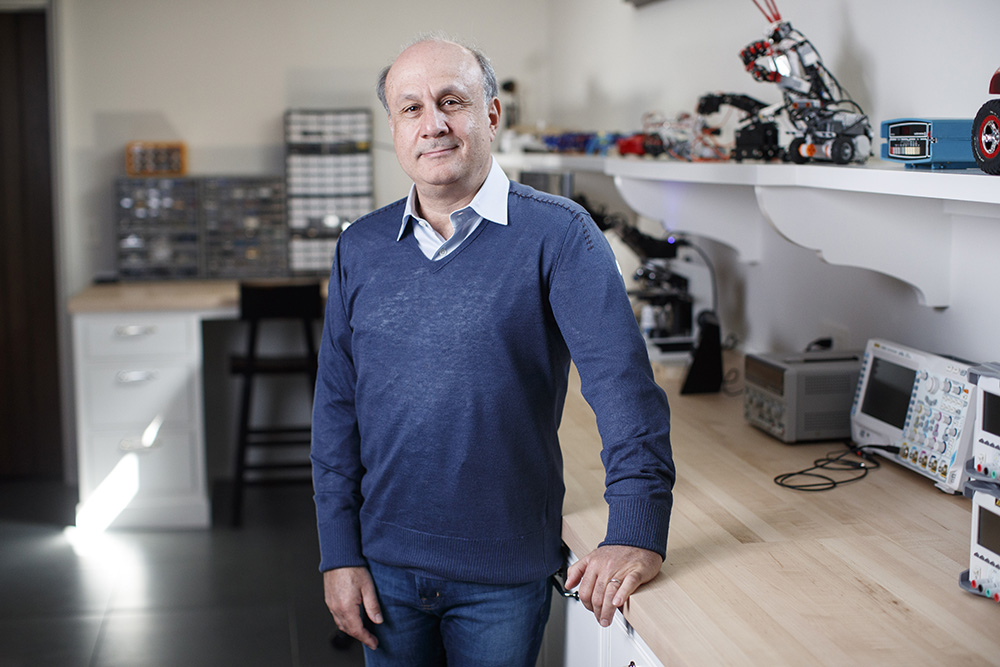
Computer scientist, entrepreneur, and philanthropist will collaborate with the MIT Schwarzman College of Computing to advance AI and scientific discovery.