AEGIS: Anchor-Enforced Gradient Isolation for Knowledge-Preserving Vision-Language-Action Fine-Tuning
Guransh Singh
Oct 2026
Machine LearningComputer Vision
Abstract
Fine-tuning pre-trained Vision-Language Models (VLMs) for robotic manipulation introduces a fundamental stability-plasticity dilemma: continuous flow-matching action experts backpropagate concentrated, low-rank regression gradients into transformer backbones trained on high-dimensional cross-entropy objectives. This cross-modal gradient asymmetry rapidly degrades pre-trained visual reasoning. Existing solutions either disconnect continuous gradient flow via stop-gradients or constrain updates via LoRA, which restricts update rank but remains directionally blind to semantic corruption; both typically rely on mixed-batch VQA co-training, doubling training compute. We introduce AEGIS (Anchor-Enforced Gradient Isolation System), a buffer-free, layer-wise orthogonal gradient projection framework enabling continuous flow-matching fine-tuning while isolating pre-trained representations from destructive parameter updates. Prior to training, AEGIS estimates per-layer Gaussian activation statistics from pre-training data as a static reference anchor. During fine-tuning, a closed-form Wasserstein-2 transport penalty generates an anchor-restoration gradient through the active computation graph. A sequential dual-backward pass applies layer-wise Gram-Schmidt orthogonalization, projecting task gradients onto the orthogonal complement of the restoration vector during directional conflict. We establish an exact energy preservation bound for layer-wise orthogonal projection, showing that AEGIS sheds only 0.62% of gradient energy empirically while halting cumulative feature drift. On PaliGemma2-3B fine-tuned on the LIBERO manipulation benchmark, AEGIS fully preserves pre-trained Visual Question Answering performance and baseline holdout loss while matching continuous action convergence, without replay buffers, teacher models, or co-training data.
This publication proposes a definition and a classification of agile software development approaches and analyses ten software development methods that can be characterized as being "agile" against the defined criterion.
P. Abrahamsson, O. Salo, Jussi Ronkainen et al.· arXiv.org· 727 citations· ⚡54
The study shows that agile practices improve both informal and formal communication, but indicates that, in larger development situations involving multiple external stakeholders, a mismatch of adequate communication mechanisms can sometimes even hinder the communication.
M. Pikkarainen, Jukka Haikara, O. Salo et al.· Empirical Software Engineeri...· 401 citations· ⚡48
The results indicate that software engineering work practices are chosen opportunistically, adapted and configured to provide value under the constrains imposed by the startup context.
Nicolò Paternoster, Carmine Giardino, M. Unterkalmsteiner et al.· Information and Software Tec...· 394 citations· ⚡54
The possibility of inferring high-dimensional data inference in a model that consists of a prior and an auxiliary differentiable constraint given some additional information is considered, thereby allowing a range of potential applications in adapting models to new domains and tasks.
Alexandros Graikos, Esmeralda S. Whitammer, N. Jojic et al.· Neural Information Processin...· 316 citations· ⚡15
Exploring how generative AI could make machine vision more accessible to businesses. The post GenEye in a Box: Making Machine Vision Something You Can Just Ask For appeared first on GPT-Lab.
Microsoft Research Blog· microsoft.comAug 11, 2026
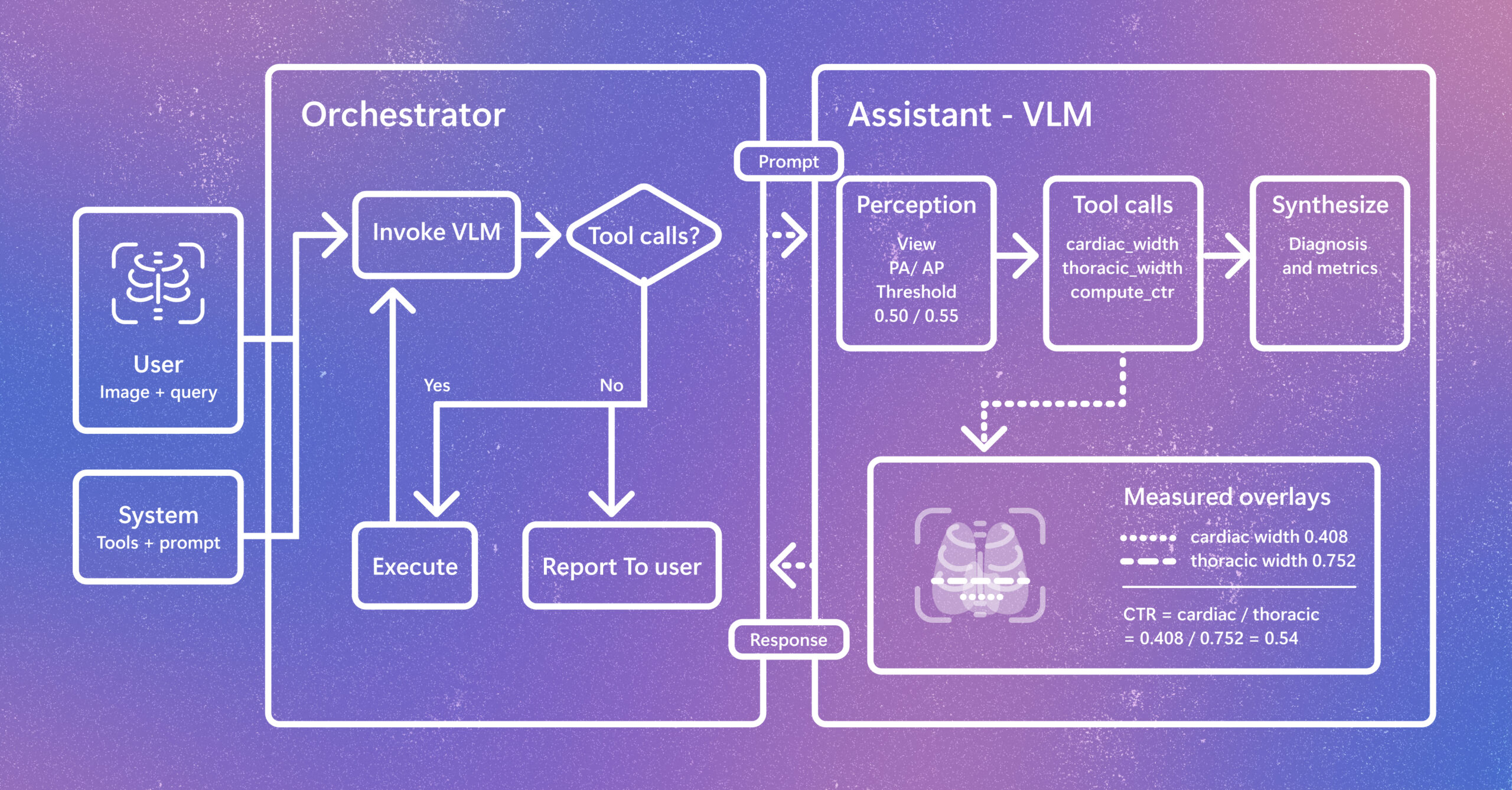
Radiology AI is evolving beyond report generation. CARE-X explores a unified approach that combines flexible reasoning, calibrated predictions, and measurement-based tools for chest X-ray interpretation. The post Introducing CARE-X: Towards Clinically Useful Radiology VLMs with Auxiliary Supervision, Reward-Aligned Learning, and Tool-Augmented Measurement appeared first on Microsoft Research.
Students in MIT’s Concourse program delve deeply into the human condition, debate challenging questions, and learn to develop judgment about issues that can’t be quantified.
We use cookies to run the site and, with your consent, for analytics and to show ads.
See our Cookie Policy.