An advanced system capable of automatically detecting complicated appendicitis from ultrasound images was developed and was explained with gradient-weighted class activation mapping (Grad-CAM), which creates a heatmap of the regions responsible for the model's prediction of the infected areas.
Fahad Ahammed, Omar Faruq Shikdar, Navid Zaman et al.· 0 citations
A novel mechanism to automatically identify which of these point-labels are suitable, and which are actively harmful, when used for propagation is introduced, paving the way for scalable ecological analysis.
César Borja, Breck A. McCollum, J. Byrnes et al.· 0 citations
Results indicate the visual component is dominant but not solely responsible for skill prediction; further work is needed to conclusively disentangle transferable skill features from those bound to a specific visual domain.
Hanna Hoffmann, F. Bechtolsheim, Stefanie Speidel et al.· 0 citations
Vision-language-action (VLA) and world-action models typically absorb unfamiliar manipulation tasks through additional robot data collection and policy optimization. This recurring retraining burden slows the acquisition of new behavior. We present Teach-and-Grow Learning (TGL), a training-free architecture that turns...
Chang Nie, Zhe Liu, He-Sheng Wang· The international journal of...· 2 citations
Reach audiences
Advertise in front of researchers, engineers, and readers.
Cell mimicry arises when different cell types appear morphologically similar. Human pathologists resolve this ambiguity using surrounding tissue context, whereas current vision models either lack contextual reasoning (cell foundation models) or cannot operate at the cell level (pathology MLLMs). We present Loki-OT, whi...
Xiang Li, Yuqi Wang, Casey C. Heirman et al.· 0 citations
MagViT, an interpretable multi-magnification transformer framework with scale-gated fusion and patient-level model selection, is presented, an interpretable multi-magnification transformer framework with scale-gated fusion and patient-level model selection relative to prior ViT-centered BreakHis work.
Nabil Ashab, Soumitra Kundu, Saif Mahmud Parvez et al.· 0 citations
Optizing Your Sampling (OYS), which instead treats timestep selection as a black-box optimization problem, optimizing the target metric directly with Bayesian optimization, improves both simple and sophisticated samplers such as Euler and DPM-Solver++.
Travis Zhang, Christian K. Belardi, Justin Lovelace et al.· 0 citations
It is found that sharpening improves preservation of the very nearest neighbors, while smoothing improves preservation of broader local neighborhoods, outperforming alternative affinity constructions including multiscale methods in the mid-local range.
MASS learns low-dimensional principal manifold coordinates with a dense autoencoder for coarse semantic grouping, and then performs quality-aware sparse feature coverage within each group using a TopK sparse autoencoder and proposes MASS.
Peng Sun, Yi Yang, Antong Zhang et al.· 0 citations
This work introduces Co-RL, a framework in which multiple decoupled models, sharing no parameters, are simultaneously optimized through RL using rewards derived from their peers, and shows that unsupervised reasoning can emerge through cooperative multi-agent training.
Yunhao Yang, Yuexin Bian, Yun-Jie Tian et al.· 1 citation
This work proposes BrainWAM, a structured action-space coordination framework that converts semantic reasoning and predictive world modeling into two specialized action-oriented pathways, and aligns them at the level of compact action representations, and introduces an asynchronous rectified-flow inference strategy wit...
Bing Zhan, Shu-Yao Shang, Shuo Lu et al.· 1 citation
This work introduces EgoCITE (Egocentric Context-augmented Indexing and Time-aware Evidence retrieval), a long-horizon agentic memory framework for egocentric QA that improves accuracy over agentic memory baselines by at least 4.4--14.2% while achieving 36$\times$ lower cost than long-context LLM agents.
Professor Paris Smaragdis develops computers with superhuman hearing for applications like speech recognition, music understanding, and environmental monitoring.
Exploring how generative AI could make machine vision more accessible to businesses. The post GenEye in a Box: Making Machine Vision Something You Can Just Ask For appeared first on GPT-Lab.
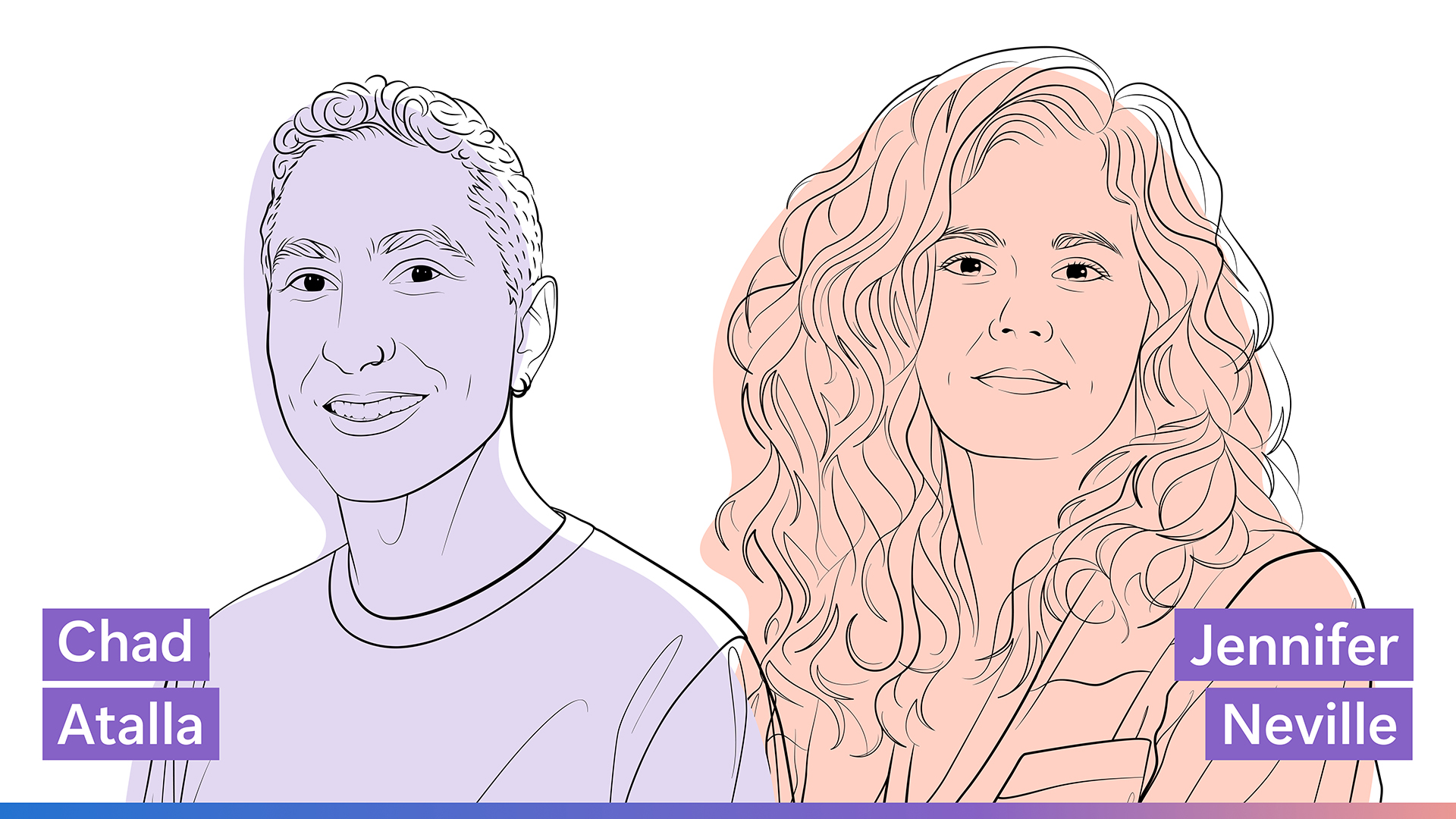
Jennifer Neville did not want to go into computer science—but that’s exactly where she landed. Neville discusses the starts and stops that led to her professional sweet spot and her work identifying “surprising failures” making it hard for AI to handle complexity. The post What AI gets wrong and what failure teaches us appeared first on Microsoft Research.
Computer scientist, entrepreneur, and philanthropist will collaborate with the MIT Schwarzman College of Computing to advance AI and scientific discovery.
We use cookies to run the site and, with your consent, for analytics and to show ads.
See our Cookie Policy.