Sep 2026· Italian National Conference on Sensors· Vol 26· 0 citations· 42 references
Medicine
TL;DR
The FMAD framework integrates multiple collaborative agents for secure communication, federated learning, and coordinated cyber defense in edge–cloud IoT environments and provides a promising foundation for intelligent agent communication and scalable autonomous cyber defense in real-world edge–cloud IoT environments.
Abstract
With increasing system complexity and attack sophistication, autonomous cyber defense has become essential in edge–cloud Internet of Things (IoT) ecosystems, requiring intelligent, secure, and scalable agent communication frameworks. This paper proposes FMAD (Federated Multi-Agent Defense), a conceptual federated multi-agent framework that enables intelligent agent communication for autonomous cyber defense through collaborative sensing and federated learning, with a design emphasis on security and privacy preservation. The proposed framework defines a set of specialized intelligent agents responsible for distributed traffic sensing, threat intelligence analysis, federated model optimization, secure agent-to-agent communication, and adaptive mitigation. As an initial proof of concept, the Threat Intelligence Agent (TIA) was implemented using an xLSTM-based temporal intrusion detection model developed in this study and trained on the CIC-IoT-2023 dataset, achieving a detection accuracy of 99.89% while efficiently identifying temporal traffic anomalies at edge nodes. The FMAD framework integrates multiple collaborative agents for secure communication, federated learning, and coordinated cyber defense in edge–cloud IoT environments. The experimental evaluation focuses on the xLSTM-based Threat Intelligence Agent (TIA) for DDoS detection, while the remaining components are assessed at the design level. However, empirical validation in the current study is limited solely to the TIA. To support trustworthy collaboration among distributed agents, the framework further proposes a secure communication architecture based on Elliptic Curve Cryptography (ECC) key agreement, ChaCha20-Poly1305 authenticated encryption, and a permissioned blockchain ledger, which are designed to provide secure interaction management and traceability within the stated security assumptions. This federated multi-agent approach provides a promising foundation for intelligent agent communication and scalable autonomous cyber defense in real-world edge–cloud IoT environments.

A role-based multi-agent cybersecurity framework for 6G-enabled IoT networks that enables proactive intrusion prediction, real-time detection, and knowledge-driven threat mitigation and a promising step toward scalable and intelligent cybersecurity management in 6G-enabled IoT networks is proposed.
Alaeddine Diaf, A. A. Korba, W. Jaafar et al.· IEEE Open Journal of the Com...· 0 citations
This survey provides an overview of Edge-Fog-Cloud-IoT architectural models and the technologies that have driven them during 2020–2026 and presents a holistic framework and a five-layer reference model that encompass the functional, performance, and trust aspects of distributed systems.
Patrick Effraim, Micheal Mensah, Bismark Budu· Journal of King Saud Univers...· 0 citations
Edge computing has emerged as a critical computing paradigm in modern distributed systems by migrating data processing closer to end users and Internet of Things (IoT) devices. While this paradigm decentralizes processes, minimizes latency, and reduces backhaul bandwidth congestion, it exponentially enlarges the cybera...
Zawad Yalmie Sazid, Robert Abbas· arXiv.org· 0 citations
The proliferation of cloud computing, Internet of Things (IoT), edge computing, and distributed enterprise networks has made the security landscape much more complex than ever before and has created a need for traditional rule-based security measures to be incapable of detecting advanced and ever-changing cyber threats...
Senthilselvan N, P. Anupriya, S. Mathumohan et al.· 2026 International Conferenc...· 0 citations
The rapid growth of the IoT has brought up a massive network of inter-connected devices, operating across domestic, industrial, and urban environments. While these systems provide greatly improved levels of automation, efficiency, and real-time access to data, their mass deployment presents significant cybersecurity ch...
Anant N. Kaulage, Rahul P. Bembade, Amol A. Bhosle et al.· International Conference on...· 0 citations
Related blog posts
Microsoft Research Blog· microsoft.comNov 16, 2026
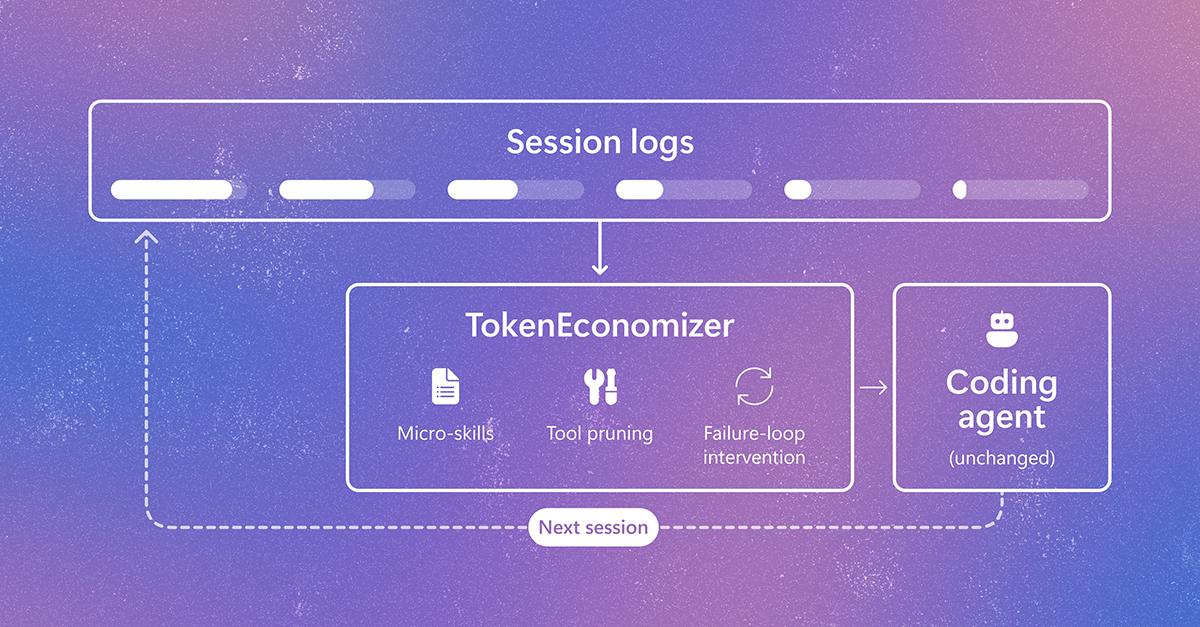
AI coding agents are increasingly help developers fix bugs and build features largely on their own, but every interaction with their models consumes tokens. In each session, an agent sends instructions, tool descriptions, and session history to its model. Most efforts to reduce this cost focus on individual tasks. Yet developers return to the same […] The post TokenEconomizer: Learning from Experience to Make AI Coding Agents More Efficient appeared first on Microsoft Research.
MIT News · Artificial Intelligence· news.mit.eduNov 9, 2026
A machine-learning approach called CheMeleon provides a practical way to develop new drugs or other molecules with much less detailed, expensive experimentation.
We use cookies to run the site and, with your consent, for analytics and to show ads.
See our Cookie Policy.