Noah is a time-aware, task-agnostic, generative transformer model representing and forecasting the full multimodal patient journey, and is the first truly holistic generative model in its field, enabling autoregressive forecasting with optional time control, zero-shot classification, and counterfactual intervention simulation.
Abstract
The digitization of healthcare has generated vast, longitudinal, and multimodal patient records over a lifetime, yet fully exploiting these data to represent and predict patient state trajectories remains a critical challenge. Current AI models often struggle to capture the complex, irregular temporal dynamics and inherent stochasticity of real-world multimodal patient data. Existing AI approaches for modeling longitudinal patient records are predominantly discriminative, limited to a few modalities, constrained by closed categorical vocabularies, treating time as a monotonic inductive bias, or they are limited in forecasting future patient states. We introduce NOAH, a time-aware, task-agnostic, generative transformer model representing and forecasting the full multimodal patient journey. NOAH features a novel bidirectional time integration and a variational latent space to capture the continuous evolution of patient states and the stochasticity of clinical trajectories. Built from over 559 million clinical events from 431,000 hospital visits of 299,000 patients across the MIMIC dataset family, NOAH natively processes medical images, time-series and numeric signals, categorical events, as well as structured and unstructured clinical records. NOAH is the first truly holistic generative model in its field, enabling autoregressive forecasting with optional time control, zero-shot classification, and counterfactual intervention simulation. It generates highly informative and predictive patient state representations that demonstrate strong performance in probing for clinical outcomes, 15 ICD chapters, and 29 comorbidities, as well as in time-to-event prediction. Seamlessly handling diverse modalities and complex temporal dynamics, NOAH provides a versatile, task-agnostic, scalable foundation for intelligent predictive systems in personalized clinical care and digital medicine.

Electronic health records provide irregular observations of latent patient states that evolve continuously over time. Recent autoregressive models condition on clinical histories to forecast future events as sequences of discrete observations. Conversely, multi-marginal flow matching provides a continuous-time formulat...
Silas Ruhrberg Estévez, Kara Liu, Christopher Chiu et al.· 0 citations
TIDE, a Treatment-Informed Dynamics Encoder, a diagonal continuous-time state space uses the true inter-observation interval as its integration step and lets the exogenous intervention channel modulate the decay eigenvalues, so an intervention alters the rate law rather than the level.
Juslin Franklin, Gopalakrishna Kanathur· Journal of Intelligent Decis...· 0 citations
This work proposes MultiSigBERT, a unified framework for multimodal sequential survival modeling in oncology based on path signature representations that achieves a concordance index of 0.743 on an independent test set, demonstrating the benefit of jointly modeling multimodal temporal dynamics together with patient-lev...
Paul Minchella, Stéphane Chrétien, Guillaume Metzler et al.· 0 citations
MMAP is presented, a novel Multimodal Missing-aware Alignment Pretraining method for learning image-tabular representations from incomplete data that outperforms strong multimodal and unimodal baselines on two challenging longitudinal clinical tasks for Alzheimer's disease.
Fiona Kekwick, Matthew Baugh, B. Kainz et al.· 0 citations
Human health is a single underlying state that no measurement observes directly: diagnoses, blood tests, molecular profiles and images each capture one facet at separate times. Inferring health from such evidence requires a representation that integrates every modality and is carried forward and revised as observations...
Z. Wang, O. Zhang, J. Wang et al.· medRxiv· 1 citation
Continuous physiological time series underpin modern clinical monitoring, yet many of the most informative signals are invasive, expensive, or simply unavailable for a given patient. Conditional generation offers a remedy: an absent signal can be synthesized from co-recorded signals and routine clinical variables. Exis...
H. Zhang, Jia-Heng Guo, Yu-Chao Huang et al.· 0 citations
Related blog posts
MIT News · Artificial Intelligence· news.mit.eduOct 13, 2026
Machine-learning networks can learn without detailed instructions from a designer. Those that do may offer insight into how the brain reorganizes itself during learning.
MIT News · Artificial Intelligence· news.mit.eduSep 29, 2026
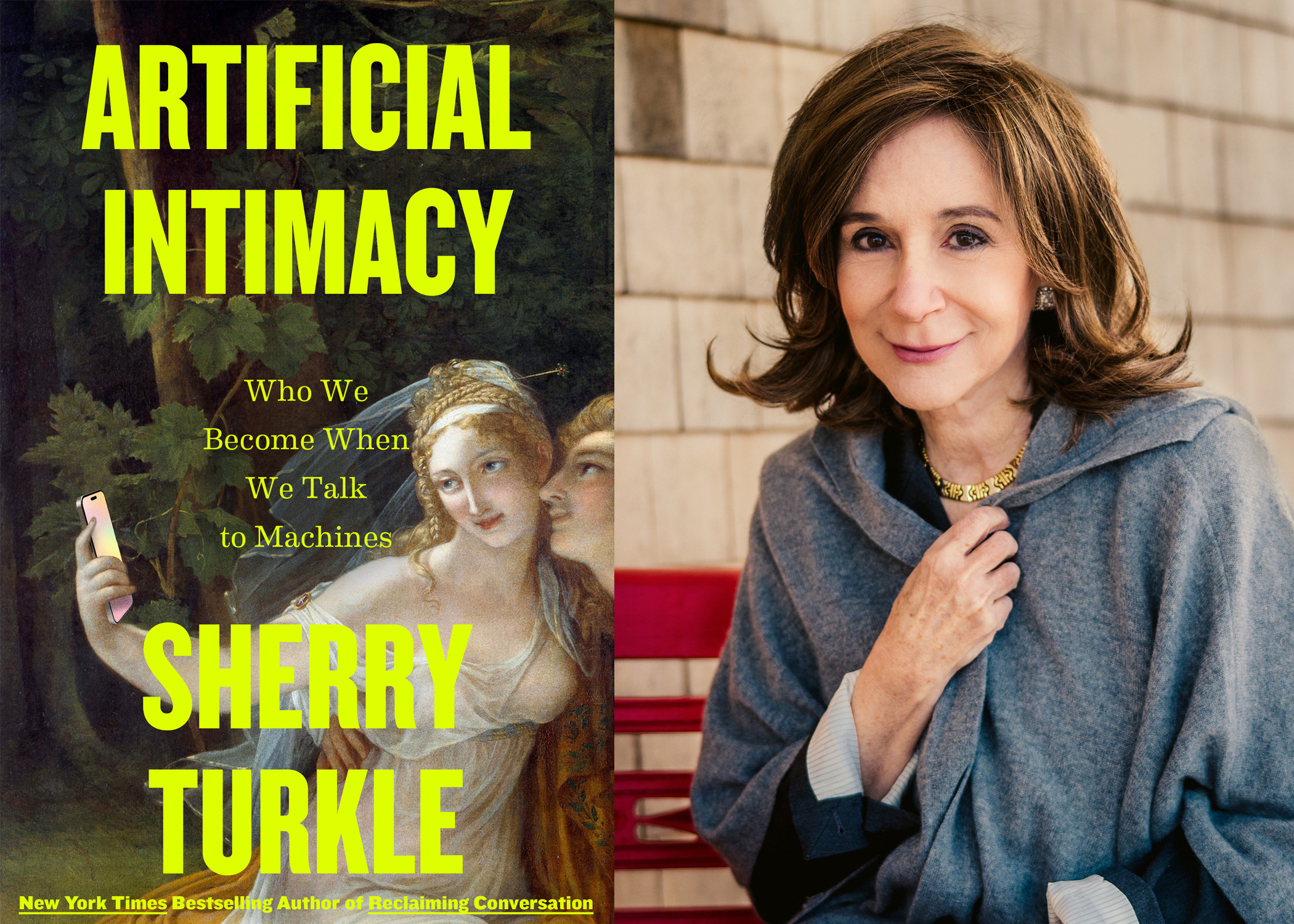
Professor Sherry Turkle’s new book, “Artificial Intimacy,” offers a withering critique of chatbots and the antisocial dynamics she believes they encourage.