Training variational quantum models requires choosing between parameter-shift gradients, which are exact but cost $O(P)$ forward evaluations, and simultaneous perturbation stochastic approximation (SPSA), which uses only two samples but produces high-variance estimates that can degrade optimisation on small supervised tasks. Whether the cheap gradient is usable depends on the variance that results from different choices of the SPSA perturbation scale, learning rate, and gain-decay schedule. We varied those quantities across a broad grid on a 6-qubit, 60-parameter QNLI classifier and compared the best configurations to parameter-shift AdamW and BuresQNG. AdamW-style SPSA with $c_0=0.01$, $\eta=0.10$, $\gamma=0.10$ reached $55\% \pm 11\%$ test accuracy, improving over the default configuration ($49\% \pm 6\%$) but remaining 16-19 percentage points below the parameter-shift baselines because the two-sample SPSA gradient estimate has too much variance for reliable optimisation of 60 parameters in 40 epochs. Classical-gain SPSA and Bures-preconditioned SPSA performed worse, at $51\%$ and $46\%$ respectively. Bures-preconditioning a noisy two-sample SPSA gradient amplifies perturbation noise.

Training the variational angles of the Quantum Approximate Optimization Algorithm once on a small instance and reusing them on larger ones, known as parameter transfer, is the standard route past the exact-simulation wall. Existing literature explains its success almost entirely through structural similarity. We identi...
The results indicate that symmetry compilation concentrates the expressive power of NQS on states relevant to the target problem, thereby reducing model size and training cost without sacrificing accuracy.
Turbasu Chatterjee, Manas Sajjan, Songbo Xie et al.· 0 citations
In this study, we developed and evaluated four conditional energy-based forecasting architectures: a classical Gaussian-Bernoulli CRBM, a hybrid quantum-classical QCRBM, a full-register QQRBM, and a lag-feature QFeatureQRBM with complete derivations of their conditional distributions, Contrastive-Divergence gradients,...
Gerhard Hellstern, Danyal Maheshwari, Martin Zaefferer et al.· arXiv.org· 0 citations
This work examines when structured long-range connectivity provides a useful resource, focusing on sparse power-of-two (PWR2) coupling graphs, and identifies circuit geometry and qubit reconfigurability as task-dependent resources for variational algorithms.
Helene M. Losl, Aydin Deger, Andrew J. Daley· 0 citations
This work presents spectral Born machines, a class of quantum generative models that results from viewing and generalizing the class of IQP Born machines through the lens of group Fourier analysis, and suggests that highly over-parameterized spectral Born machines may be immune to overfitting, even in strongly data-sca...
Austin L. Huang, William Maxwell, Vasilis Belis et al.· 3 citations
A scalable noise-learning framework for Lindblad dissipation rates that combines a stochastic simulation method, the Tensor Jump Method (TJM), with gradient-free optimization of a least-squares cost-function defined on time series of local-observable expectation values is proposed.
A. R. Ramos Ramos, Maximilian Fröhlich, Aaron Sander et al.· 0 citations
Related blog posts
MIT News · Artificial Intelligence· news.mit.eduOct 2, 2026
A weeklong summer workshop brought higher education faculty to campus to explore how AI and machine learning materials can be adapted for their classrooms.
MIT News · Artificial Intelligence· news.mit.eduAug 27, 2026
A new machine-learning framework aims to improve the success rate of computational protein design while moving away from results that reproduce sequences found in nature.
Microsoft Research Blog· microsoft.comAug 20, 2026
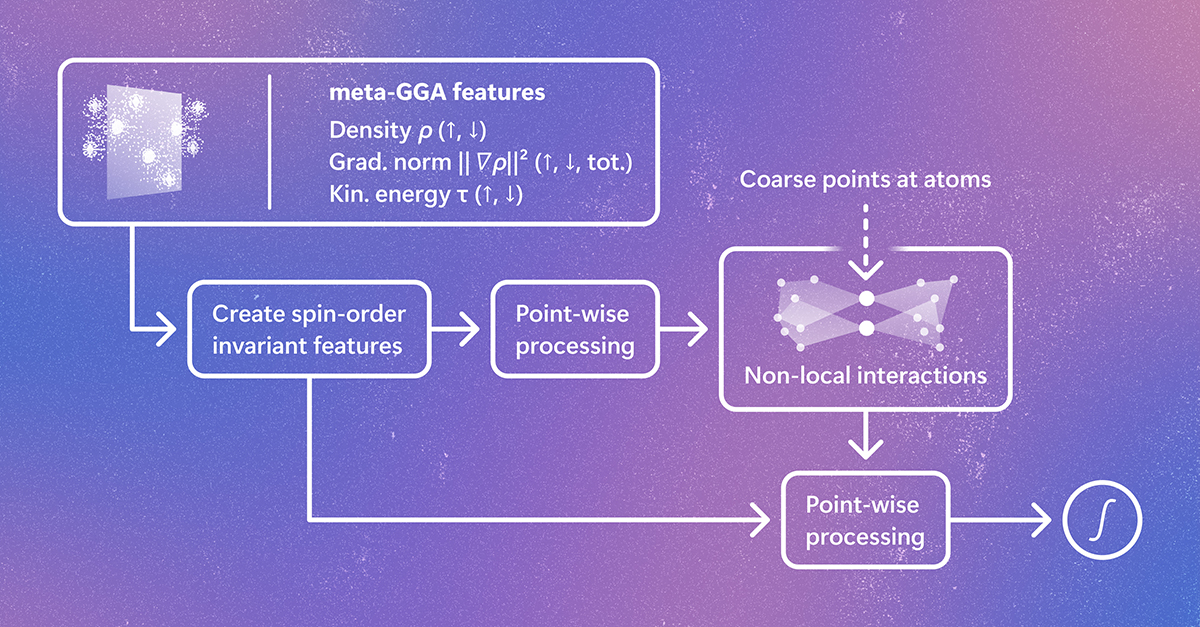
Skala 1.1, the updated deep-learning exchange-correlation functional from Microsoft Research, provides greater accuracy, expanded accessibility across the computational chemistry ecosystem, and a living benchmark to track computational performance. The post Broadening access to Skala creates a faster path to predictive DFT appeared first on Microsoft Research.
We use cookies to run the site and, with your consent, for analytics and to show ads.
See our Cookie Policy.