Hierarchical MIL behavior under the evaluated CPDP settings is characterized and distinguish prediction-oriented attention rankings from defect locations.
The software quality risk prediction helps in resource allocation for software testing and maintenance by predicting the risk of software components. Recently, the research has moved from statistical and machine-learning classifiers to feature selection, class-imbalance handling, ensemble learning, source-code represen...
Monika Parth Limbachiya, S. Degadwala, Dharvi Soni· International Journal of Sci...· 0 citations
DisTillMT is a collaborative learning approach that coordinates file-level and line-level SDP on a unified graph that significantly outperforms ten advanced line-level SDP methods by achieving accuracy gains of 20.35%–91.62%.
Fa Zhong, Rui-Lian Zhao, Ze-Ji Li et al.· Empirical Software Engineeri...· 0 citations
Accurate software defect prediction is essential for identifying fault-prone modules early and reducing software testing and maintenance costs. However, Within-Project Defect Prediction (WPDP) models may perform poorly when the target project has limited labeled defect data. Cross-Project Defect Prediction (CPDP) addre...
Sandhya Kummarikunta, R. P, Anandarao A· International Journal of Eme...· 0 citations
The results indicate that HHO–NN–SDP provides an integrated approach to feature selection, neural-network optimization, and stacking, with a favorable balance between predictive performance and feature compactness across the evaluated benchmark families.
Aqsa, Yu-Lin Wang, Abdul Majid et al.· International Conference on...· 0 citations
The process of classifying bug reports serves an essential function in software maintenance because it helps organizations determine which issues require immediate attention and which resources should be assigned to them. Existing methods for ensemble learning still struggle due to limited feature sets and treat all cl...
M. V. Pavan Kumar, A. Babu, M. Lakshmi et al.· 2026 7th International Confe...· 0 citations
Software defect prediction supports targeted quality assurance by identifying modules that warrant early testing and maintenance attention. This study presents an Explainable Graph Neural Network (X‐GNN) framework for class‐level defect prediction, in which software versions are modeled as directed dependency graph...
Muhammad Saqib, Ijazul Haq, Ibrar Ali Shah et al.· Journal of Software: Evoluti...· 0 citations
Related blog posts
Microsoft Research Blog· microsoft.comNov 12, 2026
What's new in research at Microsoft? Host Anson Ho explores the latest, including AI-powered universal translation, a breakthrough in a 31-year-old mathematics challenge, and advances making AI coding agents faster and more efficient. The post Microsoft Research Focus – Edition #98 appeared first on Microsoft Research.
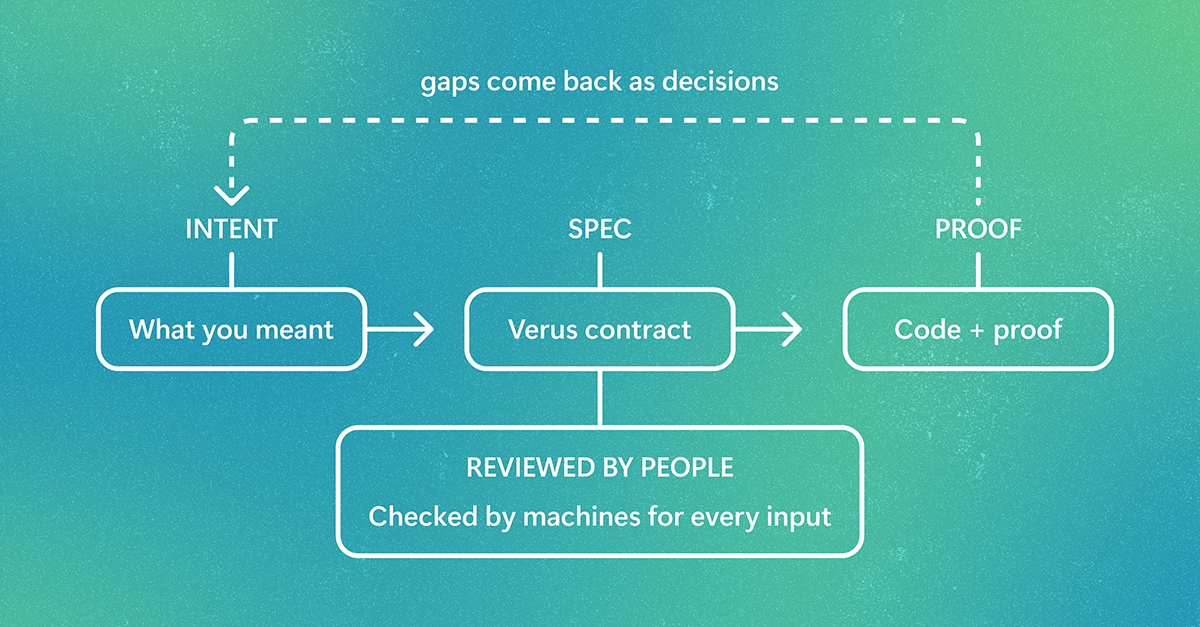
AI agents can generate code at a scale that’s hard for humans to review line-by-line. PDD Kit helps ensure the code is doing what the developer intended by creating formal specifications and testing against them. It converts developer intent into a Verus specification, proves AI-generated code meets it for every input, and uses tests where proofs aren't practical. Developers review intent, not every line. The post Formally verifying agent-written full-stack web apps with PDD Kit appeared first o…