Skip to content
#reinforcement learning Book Open access

Group-Relative RL Post-Training for Sequential Recommendation

Nov 2026 · Proceedings of the 35th ACM International Conference on Information and Knowledge Management · 1 citation · 29 references
Recommender Systems and Techniques

Abstract

Sequential recommender systems are typically trained with next-item cross-entropy (CE), yet evaluated by top-N ranking metrics that reward relative item ordering in the recommendation slate. This mismatch remains unaddressed for strong collaborative sequential models. Recent group-relative reinforcement learning has shown promise for LLM alignment and LLM-based recommenders, but whether a critic-free post-training paradigm can reliably improve standard collaborative sequential recommenders remains unclear. We introduce GRFT (Group-Relative Fine-Tuning), a GRPO-style post-training framework that aligns a pretrained sequential recommender directly to slate-level ranking rewards. GRFT samples multiple top-K slates per user context via Plackett-Luce sampling without replacement, scores them with ranking rewards, and updates the model with a PPO-clipped group-relative objective anchored to the frozen supervised reference. We instantiate rankwise and listwise variants to support position-level and whole-slate credit assignment. Under leakage-resistant global temporal splits on four datasets, GRFT consistently improves a strong sequential backbone, achieving gains of up to 25.3% NDCG@20 and 19.5% Recall@20. The improvements remain complementary to stronger supervised initialization, showing that reward-aligned post-training adds value beyond better supervised training alone. GRFT thus establishes that GRPO-style, critic-free post-training can improve strong collaborative sequential recommenders.

Read PDF

Similar papers

#machine learning Review Open access Oct 2014

Software development in startup companies: A systematic mapping study

The results indicate that software engineering work practices are chosen opportunistically, adapted and configured to provide value under the constrains imposed by the startup context.

Nicolò Paternoster, Carmine Giardino, M. Unterkalmsteiner et al. · 394 citations · ⚡54
#machine learning Review Open access Jun 2014

Why Early-Stage Software Startups Fail: A Behavioral Framework

This state-of-practice investigation was performed using a literature review followed by a multiple-case study approach and presents how inconsistency between managerial strategies and execution can lead to failure by means of a behavioral framework.

Carmine Giardino, Xiaofeng Wang, P. Abrahamsson · 175 citations · ⚡19
#machine learning Review Open access Oct 2016

“Failures” to be celebrated: an analysis of major pivots of software startups

This study conducts a case survey study based on the secondary data of the major pivots happened in 49 software startups, and demonstrates that customer need pivot is the most common among all pivot types.

Sohaib Shahid Bajwa, Xiaofeng Wang, Anh Nguyen-Duc et al. · 127 citations · ⚡15
#machine learning Review Open access May 2016

Key Challenges in Software Startups Across Life Cycle Stages

It is found that what perceived as biggest challenges by software startups do vary across different life cycle stages, even though its significance decreases when the learning focuses of the startups move from problem to solution and their products mature.

Xiaofeng Wang, Henry Edison, Sohaib Shahid Bajwa et al. · 62 citations · ⚡6

Related blog posts

Microsoft Research Blog Nov 16, 2026

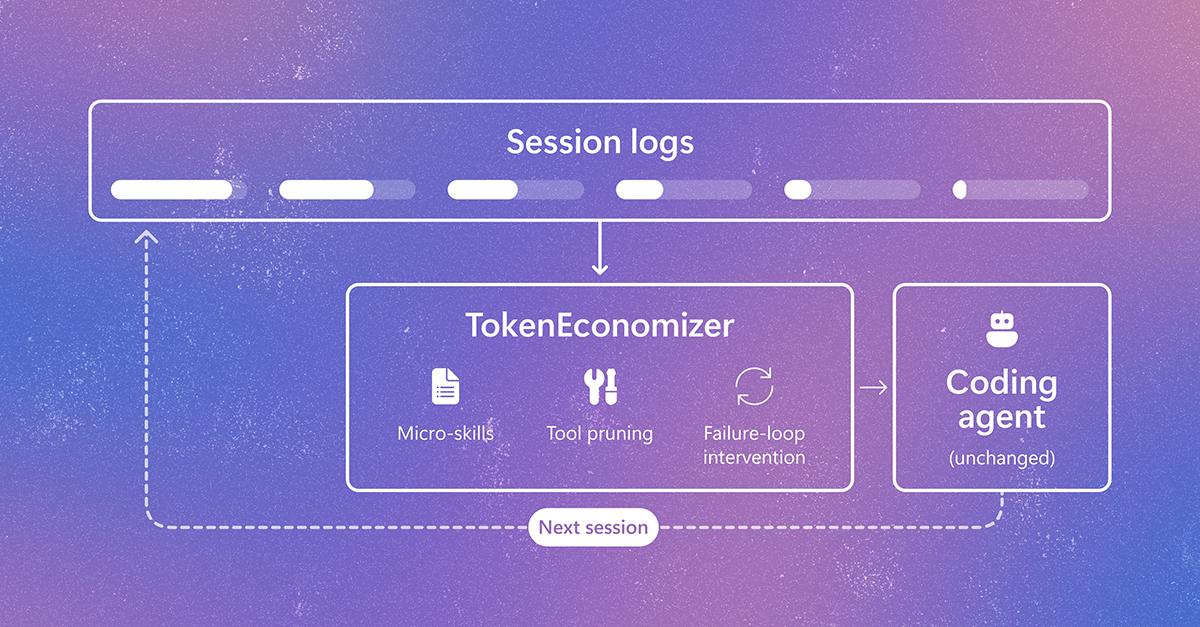
TokenEconomizer: Learning from Experience to Make AI Coding Agents More Efficient

AI coding agents are increasingly help developers fix bugs and build features largely on their own, but every interaction with their models consumes tokens. In each session, an agent sends instructions, tool descriptions, and session history to its model. Most efforts to reduce this cost focus on individual tasks. Yet developers return to the same […] The post TokenEconomizer: Learning from Experience to Make AI Coding Agents More Efficient appeared first on Microsoft Research.

We use cookies to run the site and, with your consent, for analytics and to show ads. See our Cookie Policy.