Skip to content

A Model-Agnostic Correction Framework for Short-Term Building Load Forecasting

Oct 2026 · 0 citations · 50 references
Computer Science

TL;DR

Findings support explicit historical retrieval as an effective and interpretable complement to the building load forecasting and improve the corresponding base forecasters in 90 of 96 dataset-level comparisons.

Abstract

Short-term building load forecasting remains challenging because load patterns can change rapidly with weather and operating conditions. Data-driven forecasting models may become less reliable when the current operating regime is rare or poorly represented during training, even when similar situations exist elsewhere in the historical record. Recent advances in retrieval-augmented time series forecasting offer a promising way to adapt predictions to changing conditions by directly reusing relevant historical cases at inference time. Motivated by this idea, we propose WeL-RAC, a model-agnostic Weather-Load Retrieval-Augmented Correction framework that explicitly retrieves such evidence at prediction time. WeL-RAC retrieves historical cases that are similar to the current condition based on both recent load states and horizon-aligned weather forecasts. Their observed future load trajectories are then aggregated and used to correct the initial prediction, without retraining or modifying the base forecaster. We evaluate WeL-RAC on 31 building cases across three datasets, eight forecasting backbones, and four horizons from 1 to 18 hours. The framework improves the corresponding base forecasters in 90 of 96 dataset-level comparisons. Beyond accuracy, success and failure case studies further illustrate the framework's interpretability by tracing how retrieved historical evidence improves or degrades forecasts. These findings support explicit historical retrieval as an effective and interpretable complement to the building load forecasting.

View source

Similar papers

#machine learning Preprint Oct 2026

Benchmarking Time Series Foundation Models for Load Forecasting Under Covariate Uncertainty

Accurate short-term load forecasting (STLF) is essential for the reliable and efficient operation of modern power systems. While time series foundation models (TSFMs) have recently demonstrated remarkable performance across a wide range of forecasting tasks, their effectiveness for STLF under realistic operational cond...

Tomas Kaljevic, I. Arzola, Yu Zhang · 0 citations
Preprint Nov 2026

Adaptive Residual Modeling for Scenario Learning in Probabilistic Load Forecasting

Uncertainties in weather, user behavior, and distributed energy production introduce significant variability into feeder power. Effective power system operations require both multi-horizon load forecasts and well-calibrated extreme quantiles for the forecast. Nevertheless, standard objectives that fit the full forecast...

Jin-Bao Wang, Jun Liu, Shi-Liang Zhang et al. · 0 citations

Pseudo-Label-Triggered Retraining from Forecast Errors for Online Time Series Forecasting

PILOT (Pseudo-label-Informed Learned Online Trigger), an online retraining framework that learns when to retrain from forecast-error dynamics, achieves state-of-the-art average-rank performance among retraining policies while maintaining a favorable performance--efficiency trade-off.

Yeryeong Kwak, Yoo-Min Jung, Jonghun Park · 0 citations
Conference Open access Sep 2026

NWPAnchor: Exogenous Gating and Weather Regime Reliability for Wind Power Forecasting

Accurate wind power forecasting relies on recent observations and issued numerical weather prediction (NWP), which obey different availability rules. Common multivariate models treat them as ordinary channels and often ignore that extreme weather changes weather–power relations. Sparse, overlapping physical labels also...

Chun-Wang Li, Sheng-Yi Du, Chao Lei et al. · 0 citations
#machine learning Preprint Oct 2026

Retrieval Is Not Enough: Refreshing Memory for Frozen Time-Series Forecasters

Retrieval-augmented time-series forecasting uses the continuations of historical segments similar to the current context as references for a forecaster. Most existing methods build the retrieval memory once from the training segment, leaving observations revealed after deployment unavailable as references, and generall...

Chao-Zhong He, Jian-Yu Xu, Xin-Yi Guo et al. · 0 citations
#artificial intelligence Preprint Nov 2026

FARR: Forecast-Aware Residual Refinement with Matched Endpoint Evidence for Long-Horizon Time-Series Forecasting

Large language models use auxiliary conditioning to incorporate additional information into time-series forecasts. However, auxiliary conditioning does not consistently improve accuracy and can increase forecasting error when its influence is poorly matched to the observed temporal context. We propose Forecast-Aware Re...

Yi-Yang Zhang, Yu-Liang Zheng, Bing-Ran Li et al. · 0 citations

Related blog posts

Microsoft Research Blog Nov 16, 2026

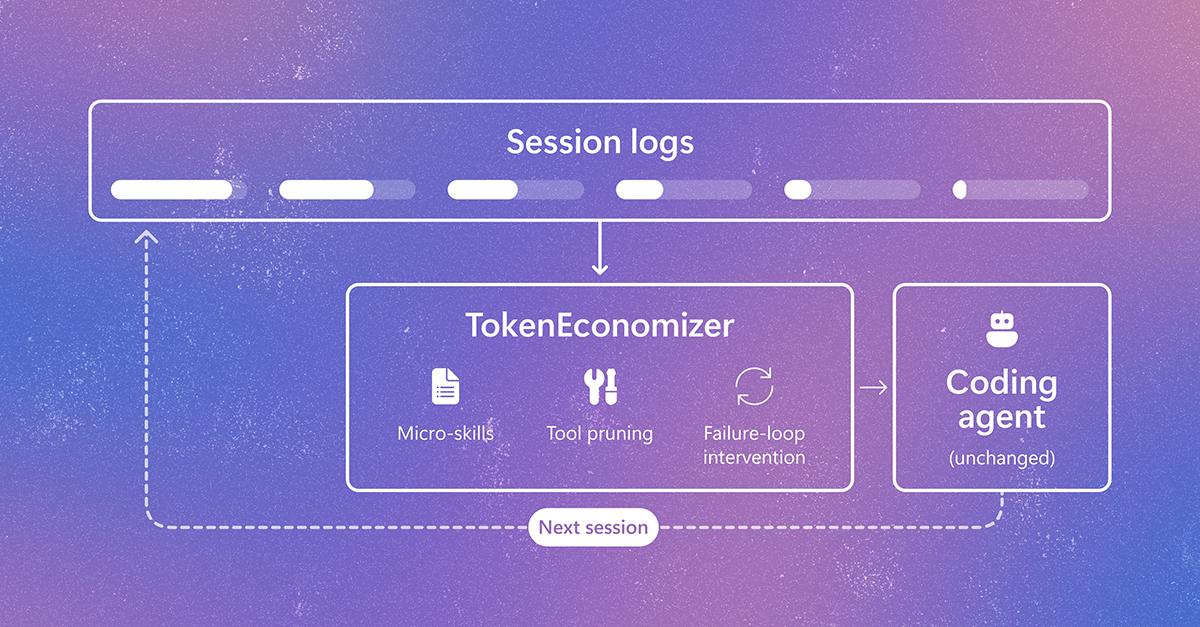
TokenEconomizer: Learning from Experience to Make AI Coding Agents More Efficient

AI coding agents are increasingly help developers fix bugs and build features largely on their own, but every interaction with their models consumes tokens. In each session, an agent sends instructions, tool descriptions, and session history to its model. Most efforts to reduce this cost focus on individual tasks. Yet developers return to the same […] The post TokenEconomizer: Learning from Experience to Make AI Coding Agents More Efficient appeared first on Microsoft Research.

We use cookies to run the site and, with your consent, for analytics and to show ads. See our Cookie Policy.